

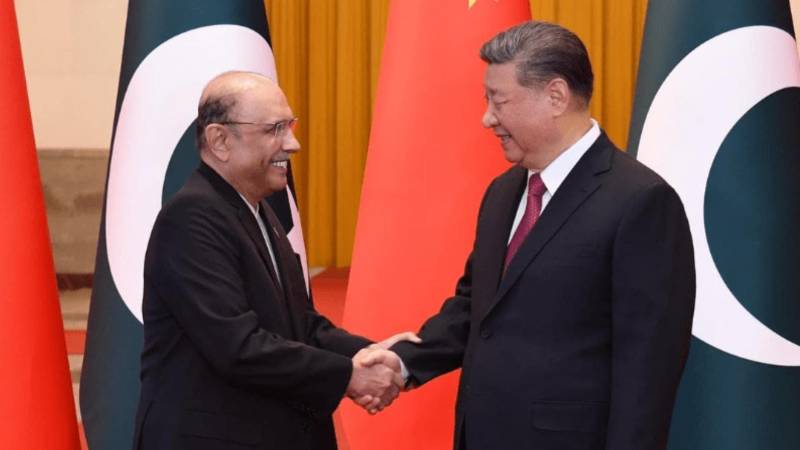
China–Pakistan maintain a strategic cooperative partnership lasting six decades. Historically, the two sides have built strong military–strategic relations as well as people-to-people contacts. With the launch of China’s Belt and Road Initiative (BRI), the relationship gained an economic dimension through the China–Pakistan Economic Corridor (CPEC), which positioned Pakistan as a central partner in Beijing’s connectivity vision. Various Pakistani leaders have visited China over the years, from former president Zulfiqar Ali Bhutto to Prime Minister Nawaz Sharif, each deepening the bilateral bond. In his second visit to China in 2025, President Asif Ali Zardari vowed to further strengthen this strategic cooperative partnership, reflecting the continuity of bilateral ties.
President Zardari’s recent visit to China encapsulates two interconnected but distinct dimensions of Pakistan’s foreign policy: deepening defence cooperation and expanding geo-economic engagement. His meetings with the Aviation Industry Corporation of China (AVIC) on defence and aviation technology, and his tour of the Kashgar Free Trade Zone in Xinjiang, together highlight the hybrid character of Pakistan’s strategic posture. On the one hand, Pakistan continues to invest in strengthening its military capability through joint production and technological transfers. On the other hand, it seeks to build sustainable economic linkages and regional connectivity through trade and industrial partnerships with China. These moves capture the delicate balance between geopolitics and geo-economics that increasingly defines Pakistan’s regional diplomacy.
At AVIC, President Zardari was briefed on advanced aerospace technologies, including the development of unmanned aerial vehicles, integrated command and control systems for multi-domain operations and fifth-generation stealth aircraft such as the J-20. He praised the role of J-10 and JF-17 fighter jets in strengthening the Pakistan Air Force, especially during the recent short war against India. This visit was historically significant, as no foreign head of state had previously been received at the complex, underscoring both the depth of trust and the symbolic value of Sino-Pakistani cooperation. The emphasis on co-production of the JF-17 exemplifies Pakistan’s dual role as both partner and beneficiary, gaining not only access to advanced platforms but also a measure of technological self-reliance. Zardari’s endorsement of China’s Global Development, Security, and Governance initiatives further situates this defence cooperation within a broader framework of political alignment and shared strategic vision.
Pakistan must internalise the geo-economic lessons offered by China while never losing sight of its security imperatives
Indubitably, China has become the second-largest economy in the world due to its visionary leadership and sustained socio-economic policies initiated under its reform and opening-up strategy. Since then, China has maintained a trajectory of reform, development, and security with the aim of safeguarding its national interests while at the same time encouraging peace and stability in its broader neighbourhood. As Xinjiang marks the 70th anniversary of its development, it stands as a testament to the region’s commitment to balancing sustained economic growth with social responsibility and the preservation of cultural heritage. Pakistan has many lessons to learn from the “China Dream,” particularly in reforming its economy along egalitarian lines. Prioritising inclusive growth, strengthening institutions, and fostering innovation could help Pakistan overcome structural weaknesses and realise a more resilient and equitable society.
In Kashgar, the President visited the Free Trade Zone, which has evolved since its establishment in 2015 into a thriving hub of logistics, bonded warehousing, customs clearance, and industrial processing. Covering 3.56 square kilometres, the zone links trade with 118 countries and deals in products ranging from solar panels and electric vehicles to batteries and auto parts. Kashgar is strategically located just 400 kilometres from Pakistan’s Sost port in Gilgit-Baltistan and about 2,000 kilometres from Gwadar, situating it as a critical node in regional connectivity and an essential complement to CPEC. The FTZ also includes a digital trade centre, established in 2024, hosting over 5,400 companies and supporting cross-border e-commerce.
Equally important is the broader developmental transformation of the Xinjiang Autonomous Region, which has made considerable socio-economic gains due to the central government’s reform policies. Xinjiang serves as a crucial gateway linking China with many neighbouring countries, including Pakistan. Its economic growth and modernisation promise positive dividends for the region, particularly Pakistan, as CPEC begins in Kashgar. President Zardari’s presence in the region, along with his prayer at a mosque, carried symbolic weight. It reflected Pakistan’s principled stance against all forms of terrorism and non-state actors, including the East Turkestan Islamic Movement (ETIM). Terrorism is a menace that must be countered, and Pakistan unequivocally sides with China on counter-terrorism in Xinjiang, reaffirming its support for regional stability and its alignment with Beijing’s security concerns.
Finally, Pakistan must internalise the geo-economic lessons offered by China while never losing sight of its security imperatives. Development and economic reform are indispensable for long-term stability and prosperity, yet Pakistan also faces enduring threats from India and a volatile regional environment. In this context, strengthening its weapons systems with advanced Chinese military technology is essential to ensure deterrence and safeguard national security while pursuing economic growth and integration.