

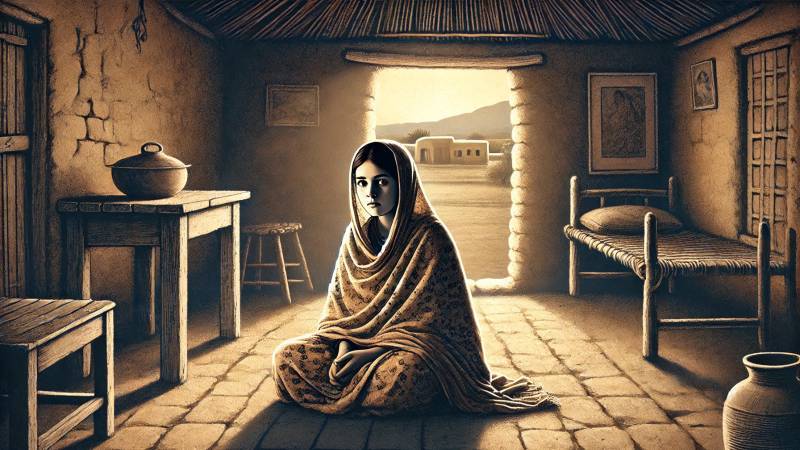
There was a little girl named Aayat. Every month, for around five days, she would feel a sting in her feet, as if bitten by a strange insect. When she told her mother, she brushed it off, saying, “Don’t worry, it’s nothing serious.” She gave her a home remedy, assuring her it would go away with time.
But months passed, and the wound kept returning, each time worse than before. One day, Aayat’s foot became severely infected. At the hospital, the doctors delivered a devastating verdict: the infection had spread, and to save her life, they had to amputate her feet.
A young girl with big dreams lost everything, not because of bad luck, but because of her mother’s illiteracy and the pervasive silence surrounding women’s health.
Aayat’s story is not just about one girl; it reflects the reality faced by thousands in our society. In Pakistan, many young women suffer in silence during their monthly periods. They use unsafe materials, rely on home remedies, or stay quiet out of shame. What begins as a minor infection or irritation often turns into a serious health crisis, all because open conversations about menstrual hygiene remain taboo.
Consider this: if you had a heart attack, would you treat it with a home remedy? Of course not. You would rush to the hospital because it is a serious, potentially fatal condition. So why do we not afford menstruation and women’s health the same urgency? Why do so many women in Pakistan resort to unsafe cloth and avoid seeking professional help for something that is just as critical?
According to a global survey, a woman spends approximately seven years of her life menstruating. Half of the world’s population undergoes this natural process. During each cycle, a woman loses about 30 to 80 millilitres of blood, roughly 16 teaspoons, yet it is still treated as a source of shame.
If just two per cent of these health budgets were dedicated to women’s health and menstrual hygiene, we could resolve most of these issues
In Pakistan, where women make up nearly half of the population, this is not a minor issue; it is a massive national concern. According to a 2022 study, nearly half (49%) of adolescent girls lack access to proper menstrual products. Many miss school, work, or other opportunities every month because they do not have sanitary pads or a private, safe space.
In our society, modesty is often prioritised above all else. This natural biological process has been wrongly linked with shame, causing women to avoid discussing it, even within their own families. This silence has turned a normal, healthy function into a forbidden subject.
Another key reason for this silence is a lack of education. Our mothers never learnt, so they never taught us. In Pakistan, menstruation is still viewed as solely a woman’s issue. A telling example is that fathers will readily buy medicine for a sick daughter but stay silent when she bleeds. It is a natural process, not a shameful one.
While we champion women’s rights and proudly proclaim “ladies first”, we continue to ignore the most fundamental issue affecting every woman: her health. How can a nation progress when half of its population silently suffers from preventable conditions?
This failure is even more disheartening when we see countries with smaller economies doing more. Kenya, for instance, removed VAT on menstrual products in 2004, launched a national menstrual health policy in 2020, and provides free sanitary pads in public schools. If a less developed nation can take such strides, what is our excuse?
At the same time, we have educated, influential women in our ministries, Maryam Nawaz, Uzma Bukhari, Marriyum Aurangzeb, Azra Pechuho, and Shaheena Sher Al, yet none have used their platform to truly champion this cause. At the very least, they should speak up, highlight the issue in the media, and support awareness programmes so that no girl has to suffer in silence like Aayat.
We are spending billions on health. With massive budgets of Rs 46 billion at the federal level, Rs 630.5 billion in Punjab, Rs 326.5 billion in Sindh, Rs 276 billion in Khyber Pakhtunkhwa, and Rs 87 billion in Balochistan, menstrual hygiene is still not a priority. Billions go towards infrastructure, while almost nothing is allocated for awareness or access to safe menstrual products.
If just two per cent of these health budgets were dedicated to women’s health and menstrual hygiene, we could resolve most of these issues. Change does not always require billions; it only requires the will to care.
There is a famous saying: “If you educate a woman, you educate an entire family.” This could not be more fitting. If we educate our mothers about menstrual hygiene, no daughter in the future will have to suffer in silence.
We must speak up on this serious issue. If one voice speaks today, a hundred girls may smile tomorrow. Change begins with education, awareness, and courage, and it starts when we finally decide to talk.