

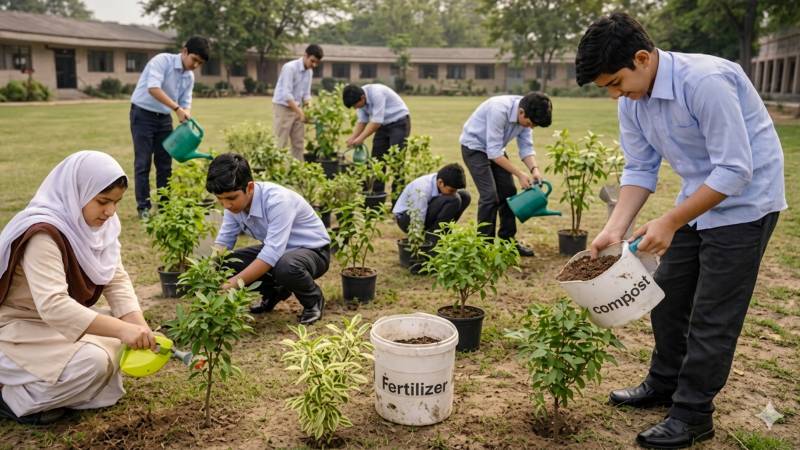
Pakistan’s schools face a challenge that goes beyond classrooms, textbooks and examinations. As temperatures rise, water becomes scarcer, air pollution worsens and extreme weather events become more frequent, the country needs to rethink how schools are designed and operated. Greening schools is not simply an environmental exercise; it is an investment in healthier children, better learning and a more resilient future.
Green school design combines energy efficiency, water conservation, waste reduction, renewable energy, healthy buildings and environmental education. A well-designed school can reduce operating costs while providing students and teachers with a safer and more comfortable learning environment.
One of the simplest principles is to make better use of natural light. Schools should be designed and oriented to maximise daylight while avoiding excessive heat. Good daylighting can reduce dependence on artificial lighting and create classrooms that are more pleasant for learning. Proper ventilation, shading and roof insulation can also help maintain comfortable indoor temperatures, particularly during Pakistan’s increasingly hot summers.
Solar energy offers another major opportunity. Schools can install rooftop solar panels to generate electricity for lighting, fans, computers, water pumps and other equipment. In areas with unreliable electricity, solar power can provide a dependable source of energy. It can also reduce electricity bills and demonstrate renewable-energy technology to students.
Energy-efficient schools can therefore become practical laboratories for climate education. Students can learn about solar energy, energy conservation and carbon emissions not merely from textbooks but from the building in which they study. Where technically and economically feasible, small wind systems may also be considered in areas with suitable wind resources, although solar power is generally more practical for most schools.
Indoor air quality is equally important. Children spend a significant part of their day inside classrooms, and poorly ventilated rooms can contribute to discomfort, respiratory problems and reduced concentration. Schools should ensure adequate ventilation, minimises indoor pollutants and avoid toxic construction materials. Low-emission paints, safe flooring and non-toxic furnishings can contribute to healthier classrooms.
Noise, lighting and temperature also influence learning. Excessive noise can distract students, while inadequate lighting can cause eye strain and discomfort. A green school therefore seeks a balance between natural lighting, ventilation, thermal comfort and noise control. Such measures can create classrooms in which students can concentrate more easily and teachers can communicate effectively.
Water management must be another central element of green school planning. Safe drinking water, functional toilets, handwashing facilities and proper drainage are essential for both health and education. Separate, safe and hygienic toilets for girls are particularly important for encouraging attendance and retaining adolescent girls in school.
Schools should introduce rainwater harvesting wherever local conditions permit. Rainwater can potentially be used for gardening, cleaning and other non-potable purposes after appropriate treatment and management. Water-efficient taps and toilets can further reduce consumption. In water-stressed areas such as parts of Sindh and Balochistan, these measures can make schools more resilient to recurring water shortages.
Waste management should also begin at school. Students can be encouraged to reduce, reuse and recycle materials. Separate bins for different types of waste, composting of organic material and restrictions on unnecessary single-use plastics can turn schools into centres of environmental responsibility.
The choice of construction materials matters as well. Materials should, wherever possible, be durable, locally available, low-toxicity, recyclable or biodegradable and appropriate for the local climate. Hazardous materials should be avoided. The history of asbestos demonstrates why health and environmental considerations must be integrated into construction decisions.
Pakistan needs to move beyond isolated green-school initiatives and establish national standards that make energy efficiency, water conservation, sanitation, waste management and climate education integral to every school.
The location of schools is another important consideration. New schools should, where feasible, be accessible by walking, cycling and public transport. Locating schools close to communities can reduce travel distances, transport-related emissions and the pressure for unnecessary land development.
But a green school should not be limited to its physical infrastructure. Climate literacy must become part of education itself. Pakistan’s children are growing up in a country increasingly exposed to floods, droughts, heatwaves, water shortages and changing agricultural conditions. They need to understand not only what climate change is but also how communities can adapt to it.
A 2021 survey by the Ministry of Climate Change, Viamo and UNDP found significant differences in climate awareness among young people depending on their access to digital technology. According to the survey, 43 per cent of digitally connected young people aged 19–34 demonstrated a high level of understanding of climate change, compared with only 10pc among those without smartphones. The findings highlight the digital divide as an important barrier to climate literacy.
Pakistan has already made several efforts in this area. The National Climate Change Policy 2012 called for greater awareness and the incorporation of climate change into education. Initiatives such as WWF-Pakistan’s Green Schools programme and WaterAid’s clean-school initiatives have also demonstrated how schools can promote environmental awareness. Yet these efforts need to move beyond isolated projects and reach government, private, rural and low-income schools alike.
Climate education should also extend beyond classrooms. Mosques, madressahs, community organisations and local governments can help build public understanding of climate risks. The Islamic Declaration on Climate Change of 2015 called for a transition away from fossil fuels and greater use of renewable energy. Religious and community leaders can therefore play a constructive role in promoting water conservation, tree planting, cleanliness and responsible consumption.
For Pakistan, greening schools should not be viewed as an expensive luxury. Energy-efficient buildings, solar power, water-saving systems, better ventilation and improved waste management can reduce long-term operating costs. More importantly, they can protect children's health and create an environment conducive to learning.
The concept should ultimately be expanded into a national Green Schools Programme, with minimum standards for energy, water, sanitation, waste, construction, greenery and climate education. Existing schools should be gradually upgraded according to local needs and available resources, while new schools should incorporate green principles from the planning stage.
A green school teaches two lessons simultaneously: one through its curriculum and another through its walls, windows, water systems and energy sources. If Pakistan wants a generation capable of responding to the climate crisis, it should begin where the future is being shaped the school.