

When I was young, a famous artist, noticing my creative anger through literature, theatre, and social development work, once asked me, “How come you never thought of painting or doing artwork?”
I admitted how much I had once desired it, how I yearned to create, but how my high school teachers never forgot to remind me in red ink that I “could not even draw a straight line.”
The artist laughed. “Art mein seedhi line kahaan hoti hai?” Where is the straight line in art?
I could never draw a straight line. Instead, I carried all my unruly lines elsewhere: into medicine, into public health, into social development. Always questioning, always resisting deceitfulness and lack of accountability. And even there, more than once, I was “accused” of being an artist rather than a realist.
Now, as I enter the grey years of my life, I still grapple with the question: are “artistic” and “realistic” truly mutually exclusive? Where does the academic end and the activist begin? When does the author stop chasing bestsellers and instead embrace the dreamer’s voice?
In such moments, I find consolation in the lives and words of the greatest. Picasso once said, “It took me four years to paint like Raphael, but a lifetime to paint like a child.” Paul Klee, Jean Dubuffet, and Cy Twombly were celebrated for strokes critics called “childlike” though anyone who has ever tried knows it is anything but easy. Children’s lines are uneven, raw, even chaotic, but they are also honest.
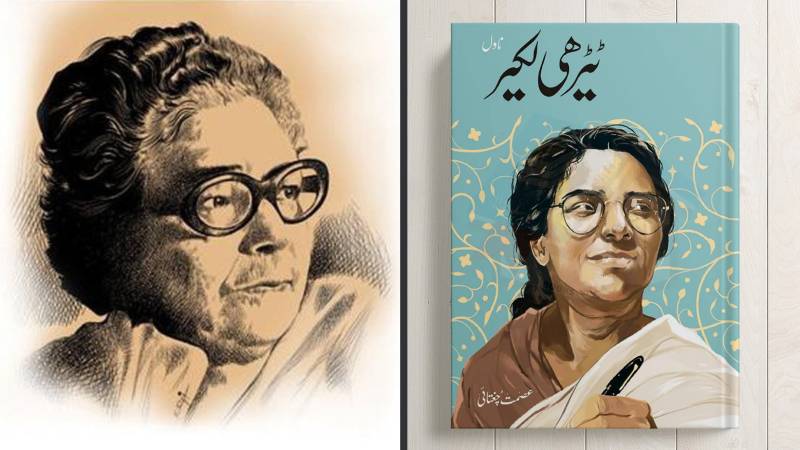
Consolation also comes from Ismat Chughtai, whose 1943 novel Tairhi Lakeer (The Crooked Line) explored female identity, rebellion, and the price of nonconformity. Writing while pregnant, she gave the world an “untamed” heroine/protagonist who lived by her own unruly lines, refusing the rigid expectations of her time. Chughtai’s courage whispers across decades: crookedness can be creativity; defiance can be survival.
And there is solace, too, in writers who mapped the collapses of majestic dreams. Orwell, in Animal Farm, showed us how the oppressed can swiftly become oppressors. Augusto Boal taught that theatre could be resistance, though even his Theatre of the Oppressed was sometimes reduced to expensive performance for elites in well-ventilated and secured halls. Marx gave us a language of class struggle, but watched from exile in London as his words were turned into rigid machinery.
Unruly lines may not please teachers or politicians, but they are what keep art alive and, maybe, what keep hope alive too
The tragedy is rarely the dream itself. It is the loss of dreaming with honesty along the way.
Many readers may remember the essay and speech contests of school days: “If I were the Prime Minister” or “What will I do when I grow up?” We wrote with innocence, sometimes even merging both topics into one essay. We believed in equality, dignity, and fairness.
That child’s heart had courage, not caution. It could be imagined without compromise.
Adulthood, however, disciplines the imagination out of us. Education, careers, and social expectations reward calculation, not creativity. Women in particular are told to be practical, efficient, and serious. To measure straight lines.
Somewhere along the way, I stopped dreaming and drawing altogether. I lived in survival mode, trying to appear sane, brave, and dignified. Maybe many of us do the same. Even when we defied norms, it can be filed away as feminism, or activism, or dismissed as eccentricity. Even when we wrote, many times our words carried the weight of bureaucratic caution or self-censorship. Yet we gather ourselves. I did it many times. I dared again, writing with my adult mind and a child’s heart, with the same unruly lines my teachers despised.
Here is what I see:
- Forests still green, lakes alive, birds uncaged.
- No modern slavery, no bonded haris, no invisible maids moving silently behind doors.
- Politicians’ children sitting beside the children of janitors; voters and leaders waiting in the same hospital queues, riding the same buses.
- Sanitary workers and street cleaners respected, their jobs rotated and dignified, never condemned to lifelong “dirty work.”
- True equality before the law, not just as a slogan.
- Healthcare and pensions as rights, not privileges.
- Actual roofs and shelters prioritised over endless rhetoric about digital harassment.
- A society with no ethnicity or class hierarchies, no gated schools or hospitals, only equal opportunities.
It may sound childish. It may sound naïve. But perhaps childishness is just another word for uprightness or truthfulness.
Truth is the first casualty of power. I recall books, literature and history. Orwell’s pigs promised equality but claimed the milk and apples for themselves. Boal’s theatre was at times reduced to a ritual for donors rather than liberation for the poor. Marx’s egalitarian dream turned authoritarian when honesty was sacrificed to ideology.
We see this even today, on the grandest stages. Platforms meant to embody peace and justice often turn into political theatres of hypocrisy where lofty speeches are delivered while innocent people continue to suffer from forced starvation, relentless bombs, and widening inequalities. The theatre of the oppressed becomes a theatre for the powerful.
The oppressed, once in power, can become oppressors when they lose their child’s clarity.
I return to Picasso’s confession. It is not easy to draw like a child. To embrace unruly lines requires courage, humility, and unlearning. That is why we admire artists who do it. They remind us of something we have lost.
What if politics could learn the same? What if manifestos were written not in jargon but in unruly lines? What if societies stopped pretending that “artistic” and “realistic” are opposites, that activism and academia cannot share a page?
Because this much I know: honesty matters more than labels. And honesty is what every manifesto, every dream, and every unruly line must reclaim.
If artists can spend lifetimes learning to paint like children, then perhaps societies, too, must relearn how to see through the child’s eye. Not because children know everything, but because they begin without the dishonesty that corrupts adulthood.
Unruly lines may not please teachers or politicians, but they are what keep art alive and, maybe, what keep hope alive too.