

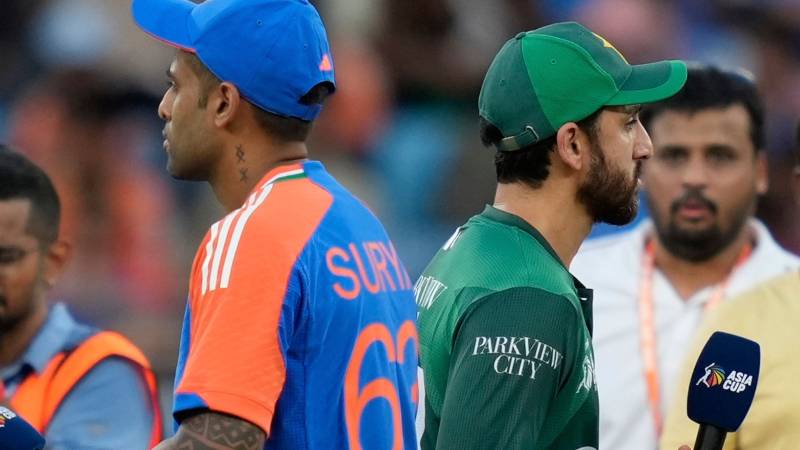
When it comes to a cricket match between Pakistan and India, cricket war, or cricketing war without weapons, are common phrases that have been used time and again to show the intensity of this sporting rivalry. Yet, in the 73-year history of this rivalry, never once was this term taken literally. Everyone knew that it was a mere exaggeration of this much sought-after contest. Asia Cup 2025 has changed that notion and made it look like a literal hyperbole.
Pakistan and India have maintained an acceptable contrasting relationship in cricket. Fierce rivals on the field, but good friends off the field. Stories of Shoaib Akhtar playfully wrestling with Harbhajan and Yuvraj Singh in the hotel room, Wasim Akram and co. Throwing Ravi Shastri in the swimming pool at Holi, or Ganguly sending home-cooked food for Inzamam, are all heartfelt occasions of camaraderie between those whom the media showed as enemy warlords.
These and many other similar stories have brought smiles to cricket fans in both countries. Most recently, at the Asia Cup 2023, we saw another heart-warming incident of Shaheen Afridi presenting a gift to Bumrah for his newborn son. Fast forward to The Asia Cup 2025, and we saw Bumrah gesturing a plane falling after getting the timbers of Rauf, a cheeky reply to Rauf’s political gestures on the previous Sunday.
Asia Cup ended as it was expected to end, with India coming out as champions thanks to their far superior group of players. There is no doubt that the current Indian side, with its over-concentration of star players, is truly a marvel. Yet, cricket has never been just about the players’ skill; it has been more about their conduct and sportsmanship, a feature most necessary to differentiate between good and great players. India carries a legacy of great players; Gavaskar, Kohli, MS Dhoni, and Rohit Sharma are just a few of them.
These players were loved not only for their superior skills but also for being brilliant ambassadors of the game who always maintained their humility. The instances of Kohli hugging Rizwan after Pakistan’s win at the 2021 T20I World Cup, Sharma celebrating Babar’s birthday at the 2023 ODI World Cup, and Dhoni carrying Sarfaraz Ahmad’s son at the 2017 Champions Trophy were a continuation of the beautiful legacy carried by Indian cricketers. Suryakumar Yadav, however, chose to carry a different legacy.
As long as the line between political rivalry and a cricket game remains blurred, these two cricket teams shouldn't play each other
Happening in the aftermath of the four-day war between Pakistan and India in May 2025, and the ongoing post-war diplomatic skirmishes, it was expected that these Asia Cup matches would be intense. But they were not expected to be ugly. After all, wars between the two neighbours are not an uncommon phenomenon. In the past, both have played cricket at times when the soldiers were up in arms at the border. The 8 June 1999 ODI World Cup game between the two took place right at a time when the Kargil war was ongoing on the northern borders. Yet, cricket always remained cricket, war always remained war, and neither was intermingled. This time, it was different, as it became increasingly difficult to differentiate between the two.
It all started with the handshake fiasco when the Suryakumar-led Indian team decided not to shake hands with their Pakistani counterparts. A decision that reeked of political theatrics from the get-go, since hands were consensually shaken at pre-tournament events. While a section of the Indian populace, inspired by jingoism, hailed this act, many sane voices criticised it too. Among those were the great Indian legend Kapil Dev, who said that ‘shaking hands was not a big deal’ while speaking to India Today, and the famed Shashi Tharoo, who termed it ‘against the spirit of the game’ while speaking to ANI. Many termed it a decision that came from the top of the Indian government, and players were just used as pawns of a larger political game. Yet, it is sad that the orders were followed through by the team leadership, and it makes one wonder how Kohli or MS Dhoni would have reacted if given such an option.
Despite being the victims of this unsportsmanlike incident, it did not take Pakistan long to surrender the moral high ground. From Rauf’s openly political gestures to the crowd to the PCB Chairman’s, who also happens to be the chairman of the Asian Cricket Council, posts on X, it has just turned more and more ugly and unnecessary. The figurative use of 6-0 by Pakistanis, hinting at the recent aerial battle, had no place in any conversation about cricket and was extremely unfitting to be used as a cover for a poor display of their cricketing skills. As fate brought them back to play each other again and again in the same tournament, each match between the two became a dreaded event.
Asia Cup is finally over, and for true cricket fans, it is a sigh of relief. Like previous times, the usual post-event analyses on team performance and loopholes in strategy have taken a back seat, and the ugly politics that spanned out even up to the trophy presentation are the highlight. This is not how cricket fans want to remember a cricketing event between India and Pakistan. As long as the line between political rivalry and a cricket game remains blurred, these two cricket teams shouldn't play each other. As for this Asia Cup, it is only wise to put it in the lowest compartments of our memory and never speak of it again.