

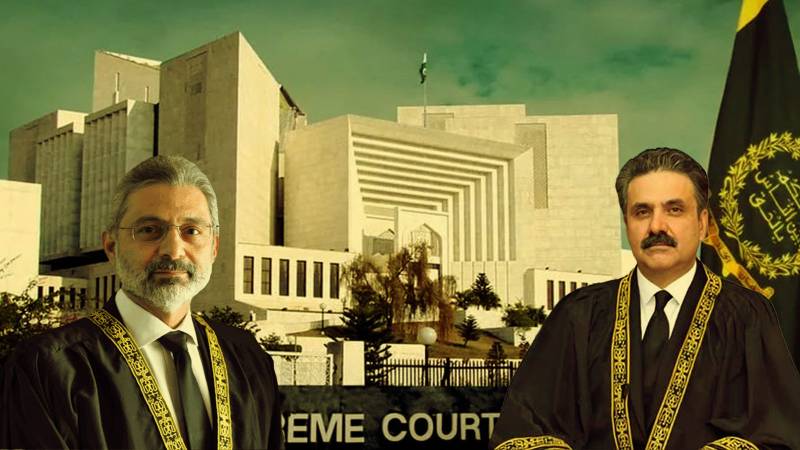
The outgoing year, 2024, witnessed the Supreme Court affirming its constitutional role of dispensing justice without activism, reaffirming the supremacy of Parliament, and emphasizing the upholding of democratic principles. The top court, through its judgments and decisions on the administrative side, sought to reinforce the role of elected representatives in governance.
It has also been noted that the Supreme Court maintained an exemplary relationship with the executive and military establishments throughout the year, despite divisions among judges, political polarization mainly caused by Pakistan Tehreek-e-Insaf (PTI), allegations of intelligence agencies' intervention in judicial matters, and certain challenges in the passage of the 26th Constitutional Amendment (judicial package). In fact, the top court remained vital in the continuity of the incumbent system and in maintaining stability.
Resignation Of Pro-PTI Judges
However, at the outset of 2024, the top court saw a shocking upheaval when a senior judge from the pro-PTI camp, Justice Ijazul Ahsan, resigned. This came a day after another judge from the same camp, Justice Mazahir Ali Akbar Naqvi, accused of corruption, also resigned. The resignations of these two pro-PTI judges created an environment of smooth functioning within the Supreme Court, favoring the current political system, as the judges who took the ‘popular view’ found themselves in the minority.
Following this development, Justice Mansoor Ali Shah, the senior puisne judge, and Justice Athar Minallah emerged as vibrant, bold, and outspoken figures against the executive. Their ire was visible on multiple occasions, both in addresses to gatherings, remarks in cases, and additional notes in different judgments. However, the executive's move to avoid the seniority principle in the appointment of the Chief Justice through a constitutional amendment helped settle the dust considerably.
Despite challenges, the Supreme Court in the outgoing year adhered strictly to the rule of law, delivering judgments that were well-grounded in legal, constitutional, and procedural principles, leaving little room for criticism.
PTI's Election Symbol Revoked
The year 2024 began with a significant judicial and political development when a three-judge bench of the Supreme Court, led by then-Chief Justice Qazi Faez Isa, upheld the December 22, 2023, decision of the Election Commission of Pakistan (ECP) to revoke the PTI's iconic election symbol, the ‘bat.’ The ruling was issued just moments before the expiration of the fifth extended deadline set by the ECP for candidates to submit their party tickets.
Death Sentence on Pervez Musharraf Upheld by Court
In January, a four-judge bench, also headed by then-CJP Isa, upheld the death sentence imposed on the late former military ruler, General (retired) Pervez Musharraf, by a special court in a high treason case. Although the judgment was largely symbolic, it delivered a strong and unequivocal message against undemocratic forces.
SC Takes Steps to Rectify Historic Missteps
With Qazi Faez Isa at the helm, 2024 was viewed as an opportunity to address and rectify the historic missteps of the Supreme Court. In March, a nine-member bench, headed by then-CJP Isa, unanimously held that the trial under the 1979 judgment that sent former Prime Minister Zulfikar Ali Bhutto to the gallows did not meet the requirements of a “fair trial and due process.”
In the same month, the top court's five-judge larger bench, headed by then-CJP Isa, set aside the dismissal of former Islamabad High Court (IHC) senior puisne judge Shaukat Aziz Siddiqui. The proceedings of the case were broadcast live on the apex court’s website.
Reserved Seats Granted to PTI
In July, however, political turmoil ensued when the top court, in the name of complete justice, granted PTI the reserved seats. PTI was not before any court during the litigation for these seats. A full-court bench, headed by then-CJP Isa, gave a judgment on the appeal of the Sunni Ittehad Council (SIC), a PTI political ally. Out of the full court, eight judges, headed by Justice Mansoor Ali Shah, gave a majority ruling in favor of PTI. The bench also went beyond the ruling and issued a schedule by assuming the powers of the ECP.
Not only this, Justice Shah’s bench also gave two written clarifications detailing the procedure for granting the reserved seats to PTI. Observers and political pundits believe that the case and the clarifications proved to be career suicide for Justice Shah. The judgment irked the executive and other state institutions, leading to mistrust and the judge being ruled out for the post of Chief Justice. The review petitions in the case are still pending, while the Parliament is yet to complete revisions to the appeals, which have been pending for seven months. However, two judges in a dissenting note termed the majority decision an overreach of constitutional mandate.
Constitution of Election Tribunals in Punjab
In September, the top court set aside the Lahore High Court (LHC)’s judgment and the notification issued by it for the constitution of Election Tribunals in Punjab to handle petitions regarding the general elections of 2024. The ruling was seen as a significant step in the electoral process in Punjab, ensuring that the election tribunals were adequately staffed to handle electoral disputes effectively.
Amendments to NAB Laws Nullified
In the same month, the top court furthered the supremacy of Parliament by overturning a previous ruling that had nullified amendments to the National Accountability Bureau (NAB) laws. Additionally, the top court bestowed the President of Pakistan with constitutional powers to promulgate ordinances. Following the promulgation of an ordinance, the former CJP Isa nominated Justice Aminuddin Khan as the third member of the committee tasked with forming benches and fixing cases under Article 184(3) of the Constitution.
Likewise, in October, a larger bench headed by then-CJP Isa criticized Justice Munib Akhtar's ruling on the interpretation of Article 63-A of the Constitution. The larger bench noted that the previous majority judgment paved the way for the leader of a political party to become a dictator, as he or she could never be challenged. The larger bench unanimously accepted a review petition against the 2022 verdict related to the defection clause under Article 63-A and reinstated the Constitution in its actual form.
The principle of seniority in the appointment of the Chief Justice of the High Court was also bypassed in 2024. The Judicial Commission of Pakistan (JCP), chaired by then-Chief Justice Qazi Faez Isa, recommended Justice Aliyan Neelum for the post of Chief Justice of the Lahore High Court (LHC), despite her being third in seniority in the high court.
Passage of the 26th Amendment
The outgoing year, 2024, also witnessed significant structural changes in the judiciary, particularly the Supreme Court, following the passage of the 26th Amendment. The amendment limited the top court to its core function of dispensation of justice, without judicial overreach or activism. The amendment had a positive effect on the disposal ratio in the top court. However, in light of the amendment, Justice Shah could not retain the robes, and Justice Yahya Afridi, who was third in seniority, became the Chief Justice of Pakistan.
Justice Aminuddin Khan became head of the Constitutional Bench with majority votes in the JCP. The role of the executive in appointments of judges increased after the 26th Amendment. Justice Shah remained vocal against the amendment and the increased executive role, terming it detrimental to the independence of the judiciary.
However, longstanding issues are being resolved through the 26th Constitutional Amendment and the recent approval of JCP rules and procedures for the appointment of judges to superior courts. The top court's decisions in 2024 had far-reaching implications for the country’s governance, legal framework, and political equilibrium, highlighting its central role in upholding the rule of law and shaping Pakistan’s democratic processes.
During the past year, six judges of the Islamabad High Court (IHC) addressed a letter to the Supreme Judicial Council (SJC), seeking guidance on handling potential interference in judicial affairs by intelligence agencies. This letter garnered significant public attention and was leveraged by PTI as a pressure tactic against the Supreme Court. The then-Chief Justice of Pakistan (CJP), Qazi Faez Isa, took suo motu notice of the matter, which remains pending before the court. However, the SJC, in its first meeting under the leadership of the new CJP, Yahya Afridi, decided to revisit the issue of institutional interference in judicial matters and the alleged intimidation of judges. The council also expanded consultations on this critical issue.
Judicial Reforms
Upon assuming office, CJP Afridi immediately embarked on reforms, overturning one of the more contentious decisions of his predecessors by reconstituting the three-judge bench-fixing committee under the Practice and Procedure Committee. This reconstitution included the re-induction of Justice Munib Akhtar, signaling an effort to foster unity among the judiciary. Despite these efforts, resistance from Justice Shah over amendments persisted, creating hurdles. The petitions challenging the 26th Amendment remain pending before a constitutional bench.
CJP Afridi also launched several initiatives aimed at improving judicial operations and public trust. A Jail Reforms Committee was formed to review and report on the condition of the country's prisons. The CJP expressed satisfaction with Punjab Government projects addressing jail reforms and personally visited lower courts in remote areas to assess their functioning.
In December, the Supreme Court introduced an E-Affidavit System and an instant certified copies service at its Lahore Branch Registry. These initiatives aim to enhance judicial efficiency, transparency, and accessibility for litigants. Additionally, with the backlog of cases reduced to 50,000, the court reinstated in-chamber hearings for interim applications, stay matters, and expedited hearings for all bail matters. Under CJP Afridi’s leadership, the top court disposed of 4,372 cases in his first month.
As part of broader judicial reforms, CJP Afridi initiated a comprehensive program to enhance service delivery and expand access to justice. This initiative, beginning at the Supreme Court level, aims to extend to lower courts and involves collaboration with academia and professional lawyers, reflecting a commitment to fostering a more efficient and inclusive judicial system.