

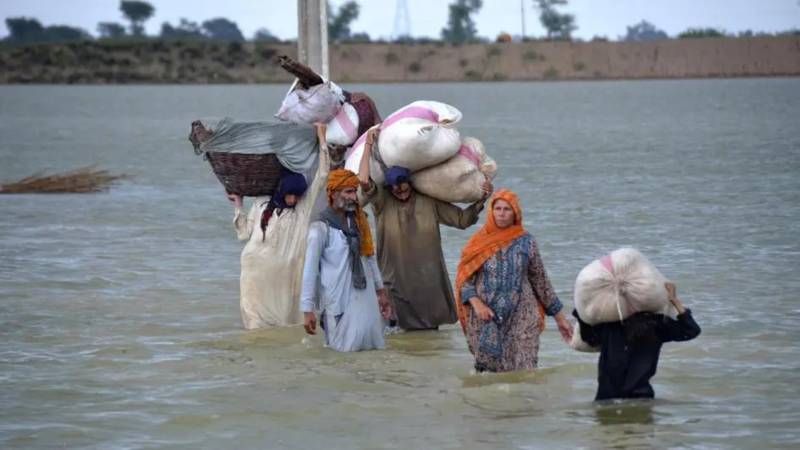
Every year, Pakistan grapples with torrential rains that, due to inadequate infrastructure, displace thousands and claim hundreds of lives. Punjab is facing its worst riverine flooding in decades, with urgent needs in shelter, food, water, sanitation, health, and livestock support. According to UNOCHA, since late June, 6.9 million people have been affected, including 4.7 million people in Punjab, 1.6 million people in Khyber Pakhtunkhwa, 356,000 people in Gilgit-Baltistan, and 185,000 people in Sindh. The families returning to their homes find their homes damaged and livelihoods destroyed.
Entire communities were submerged, crops destroyed, and livelihoods obliterated, highlighting the urgent need for sustainable climate-resilience strategies and proactive preparedness. Environmental conditions can exacerbate disaster impacts, just as disasters can, in turn, degrade the environment. The adverse effects of environmental degradation on human vulnerability manifest in ways such as deforestation, flawed forest management, and unsustainable agricultural practices, which amplify storm or typhoon devastation through landslides, flooding, silting, and contamination of groundwater and surface water. Rapid deforestation disrupts rainfall patterns by reducing evapotranspiration rates, moisture flow, and the soil’s water-retention capacity.
These alterations, often triggered by large-scale deforestation, can lead to drought and desertification, or to soil erosion, debris flows, and floods. In particular, deforestation aggravates river and lake flooding by accelerating erosion and clogging waterways. Downstream water quality and availability suffer as well, due to damage in upstream catchment areas, ultimately diminishing agricultural productivity in affected regions. Altering landscapes through deforestation and the draining of wetlands fundamentally disrupts the hydrological systems of river catchments. This disruption, when amplified by climate change, results in erratic rainfall and increasingly unpredictable flooding. The consequences, though first appearing upstream, inevitably travel downstream. Siltation clogs rivers, which degrades agricultural lands and intensifies flooding in cities.
Disaster risk reduction is a long-term, low-visibility investment. It offers no guaranteed short-term rewards, giving politicians and donors little reason to prioritise it over more tangible and politically pressing concerns
At a broader level, the unsustainable use of resources drives pollution and environmental decay. According to the Intergovernmental Panel on Climate Change (IPCC), human-induced climate change will magnify this crisis, leading to more frequent and severe water-related disasters. Variations in temperature and precipitation accelerate desertification, reduce agricultural yields, and strain water supplies. When combined with rising sea levels and extreme weather events, these elements create a dangerous compounding effect, intensifying both the frequency and impact of modern disasters.
Rapid urban growth is one of the key factors in the increase in disaster risk. Land-use changes and haphazard development are undermining our ability to cope with natural disasters. With a steady growth in the economy and higher population densities in urban areas, unplanned development of complex infrastructure and poor governance are leading to an increase in vulnerability to natural disasters.
In particular, lower-income communities with a lack of resources are compelled to gravitate to marginal lands such as floodplains and stream banks, which are highly vulnerable to natural disasters. Thus, these urban centres often form hotspots where the probability of the occurrence of large-scale disasters involving significant mortality, economic loss, or both is very high. The potential of urbanisation is being jeopardised by a lack of vision of the kind of economic, social, and physical environment desired by the urban population, an absence of appropriate policies, and poor urban management and service delivery.
The question of why development so often ignores obvious disaster risks can be answered by looking at political incentives. Disaster risk reduction is a long-term, low-visibility investment. It offers no guaranteed short-term rewards, giving politicians and donors little reason to prioritise it over more tangible and politically pressing concerns. This mismatch between the chronic nature of the risk and the acute focus of policymaking leaves communities vulnerable.
The solution requires a fundamental shift in mindset: moving from reaction to proaction. Both the disaster and environmental communities must evolve from managing crises after they occur to preventing them from happening. This means shifting from disaster response to risk management, from contaminant clean-up to pollution prevention, and from flood control to integrated floodplain management.
This proactive approach is put into practice through powerful adaptation strategies. Nature-based solutions, such as reforestation and wetland restoration, absorb excess floodwater. Rigorous land-use planning can prevent construction in high-risk zones. Crucially, enhanced early warning and early action systems empower people to move out of harm’s way, directly reducing exposure to future deadly floods.