

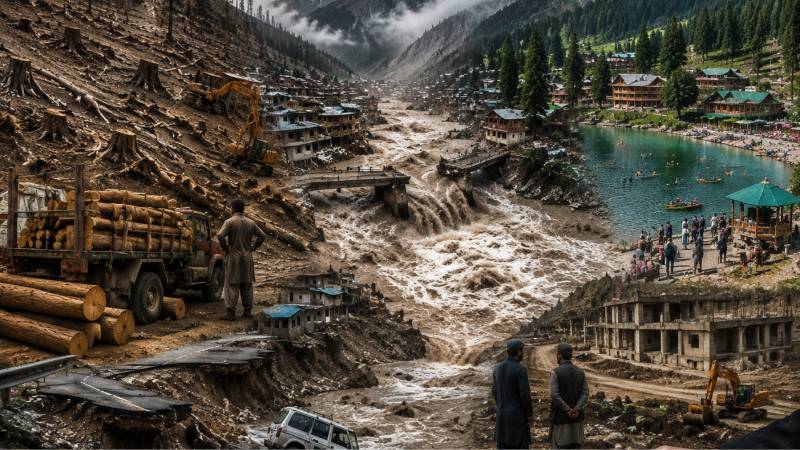
This July, as families made their usual monsoon trips to Swat, Naran, and the Galiyat for cool air and river views, Khyber Pakhtunkhwa was once again counting bodies instead of tourists. Since July 19, heavy monsoon rains and flash floods have killed at least twenty two people across the province, nine of them were children, as roofs collapsed and homes were swept away in Peshawar, Buner, Bajaur, Mansehra, and other districts. Authorities have gone so far as to warn residents and tourists to avoid vulnerable destinations altogether until the spell passes. This is not an isolated bad week. It is the latest entry in a pattern that has repeated itself almost every year since 2022.
It has become easy, and convenient, to call these disasters the price of climate change. They are not, at least not entirely. Climate change is loading the dice with heavier and more erratic monsoons. But whether those rains turn into an inconvenience or a catastrophe depends on decisions made in Peshawar and in district offices long before the clouds gather. Unless governance catches up with the climate, Khyber Pakhtunkhwa risks losing one of the few economic sectors it has actually gotten right.
Tourism was, until recently, a genuine success story for the province. Swat, Kalam, Kumrat, Chitral, Malam Jabba, Naran, Kaghan, and the Galiyat drew millions of domestic visitors in the years after the pandemic, with over a million tourists recorded in KP in 2021 and 2022 alone. Hotels, transport operators, guides, and handicraft sellers built livelihoods around this boom, and the provincial government leaned into it, launching eco tourism partnerships and training hundreds of hoteliers and restaurateurs in basic environmental management. For a province better known internationally for conflict, tourism offered a rare and welcome counter narrative.
Whether those rains turn into an inconvenience or a catastrophe depends on decisions made in Peshawar and in district offices long before the clouds gather.
That narrative has since been interrupted, again and again. The historic 2022 floods devastated roads, bridges, and hotels across the north. A fragile recovery followed in 2023, built on infrastructure that was patched rather than rebuilt. Then came 2024's landslides, and finally the catastrophic monsoon of 2025, which by one detailed assessment destroyed 45 bridges, damaged over ten thousand homes, and cut two hundred kilometres of road network in KP alone. Each cycle chips away further at the trust tourists place in these destinations. People do not stop visiting beautiful places because they have become less beautiful. They stop because they no longer feel safe getting there.
Climate change explains the heavier rain. It does not explain why that rain turns so quickly into disaster. Part of the answer lies in the mountains themselves, or rather in what is disappearing from them. KP once held close to 40 percent of Pakistan's forest cover, but decades of illegal logging have pushed its own forest cover down sharply, even as the province continues to account for a large share of the country's remaining coniferous forests. Healthy forest cover slows runoff, holds soil in place, and buys villages downstream precious time. Strip that cover away and rainfall that once soaked into the mountainside instead rushes straight into the rivers, carrying silt, boulders, and eventually hotels and roads with it. Experts have been warning about exactly this connection between illegal deforestation and flood severity for years, and the warnings have largely gone unheeded.
This is where the story stops being about weather and starts being about governance. Hotels and guesthouses continue to be built inside river channels, the very construction pattern that a government inquiry blamed for diverting the Swat River's flow last June and putting tourists directly in its path. Timber mafias keep operating despite repeated provincial bans, protected in places by weak enforcement and, investigators allege, political cover. Early warning systems remain patchy in exactly the valleys where flash floods develop fastest. And the institutions meant to manage all this, the Tourism Department, the Forest Department, PDMA, and local district administrations, too often work in isolation rather than as a single system. Climate change may trigger a flood. Governance decides whether that flood becomes a catastrophe.
Other mountain economies show this does not have to be the trade off it currently is in KP. Switzerland pairs strict zoning in its alpine regions with rigorous forest conservation. Nepal has built community forestry programmes that give villages a direct stake in protecting the tree cover their tourism depends on. Bhutan has gone further still, capping visitor numbers to keep both its forests and its tourism revenue intact for the long run. In each case, conservation and tourism income reinforce each other rather than competing.
None of this requires reinventing the wheel in KP. It requires enforcing rules that already exist and closing the gaps between departments that currently operate as silos. That means a genuine, unforgiving crackdown on illegal logging rather than periodic seminars about it, strict enforcement of river setback laws so hotels stop being built in flood channels, digital early warning systems tied to real evacuation plans, and one empowered authority that can force the Tourism, Forest, and Disaster Management departments to actually coordinate before the next monsoon, not after it.
Khyber Pakhtunkhwa's valleys remain as breathtaking as they have ever been. Swat still earns comparisons to Switzerland for a reason. But scenery alone cannot carry an industry through repeated tragedy. If the forests keep disappearing and the rivers keep being encroached upon, the province will keep losing tourists, along with the jobs and revenue they bring. The mountains are not failing Khyber Pakhtunkhwa. Its governance is.