


Amin Gulgee presented his performance art piece The Game on 31 October 2025 in front of the main auditorium of the Karachi Arts Council. It was billed as the pre-opening act of the World Culture Festival, organised by the Arts Council of Pakistan, Karachi and the Government of Sindh. This is an impressive cultural festival that features theatre, music, dance, visual arts and film by over a thousand artists from more than 140 countries. It runs from 31 October to 7 December.
Amin stated, “When Mohammad Ahmed Shah and Shahid Rassam asked me to do a performance work at the Arts Council it was hard for me to refuse. My father, Gulgee, had apparently helped raise money back in the day for its construction, a fact I learned when I was going through archival material while curating the Gulgee Museum. More personally, I remember going there many times as a child accompanying my parents to exhibitions of local artists at what would later be called the Ahmed Pervez Art Gallery. It is in this space that I recall my father and a French-speaking artist painting a monumental canvas in front of a live audience to Sufi music. This, according to the academic Gemma Sharpe, who accessed the Art Council’s archives, was around 1980. I remember that I was still in in high school, and I sat mesmerised, as did the rest of the audience, for hours as we watched both painters move and dance with oils.”
As day turned to dusk, a large crowd of spectators gathered. It was a crowd as diverse as Karachi, including kids from Lyari, matrons from Defense, artists and art students. Spectators jostled with photographers in the small courtyard upon the red carpet, angling for a view of the performance. Amin ceremoniously took his place on a metal chair before his installation Fracture, which comprises an iron-and-steel chessboard table with 12 fragments of his face cast in bronze, each mounted upon a steel base. He explained, “I had used the installation twice before for the performances Play Me and Play Me II. In both I sat across from a woman. In Play Me, I collaborated with Sara Vaqar Pagganwala. This was a confrontational work in which we both periodically banged my cast features on the table shouting ‘No!’ In Play Me II, I sat opposite Zarmeene Shah. We conspiratorially laughed out loud as we played.”
Amin Gulgee’s return to the Karachi Arts Council was deeply personal, recalling childhood memories of his father, the legendary Gulgee, painting monumental canvases to Sufi music in the same space
Amin performed this new 40-minute piece work along with the visual artists Jamal Ashiqain, Umaina Khan and Farrukh Shahab. All were dressed in black and all wore objects Amin had created. Amin wore a cooper helmet with a mesh plume bisecting its top. Umaina and Farrukh’s faces were ominously obscured by copper mesh masks while Jamal wore a strip of copper mesh seemingly sewn with round Sindhi mirrors over his eyes. Umaina and Farrukh’s heads were covered by black chadors; Jamal’s was concealed by a black hoodie. As the performance began, Umaina stood on a foot-by-foot black granite cube and began to sing. Farrukh and Jamal lit two tall copper structures each containing six kerosene torches. Jamal then leaned upon another black granite block in front of Amin, while Farrukh walked round and round the three.
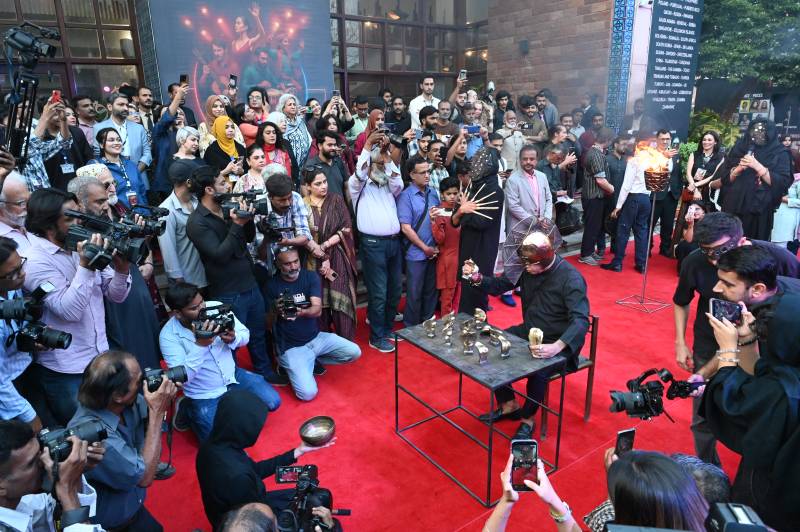
Amin wanted The Game to be played by him alone. He left it open as to how it would unfold.
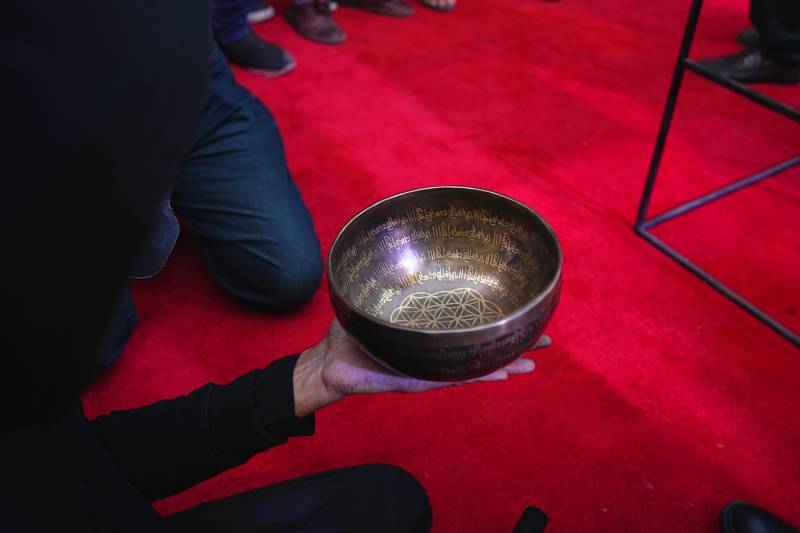
He elaborated, “I waited until the event itself to decide how I would react to this board and the fragments of my face as pieces to be moved. Some elements of the performance were planned beforehand, however. I had already decided to wear my Pak-Futuristic helmet The Legionnaire and I had long, gothic nails glued on by Atiya Malik, who recently completed her BFA in Canada. She spent a couple of hours painting them in black and red; this was a meditative process, which helped me focus. I also wanted to be surrounded by guardians in a protective ritual. Jamal Ashiaqin was to periodically make sounds by using a wooden mallet on a brass Tibetan prayer bowl. Umaina Khan was to stand behind me and sing. I told her specifically not to use language, just scales. Farrukh Shahab, also in black with his face similarly hidden, was to orbit us. I had given him foot-long copper nails leafed in gold which I had made and used for earlier performances. He was told to gently touch the audience with his talons. I had instructed all the people documenting this work on my behalf to wear mesh eye coverings as well.”
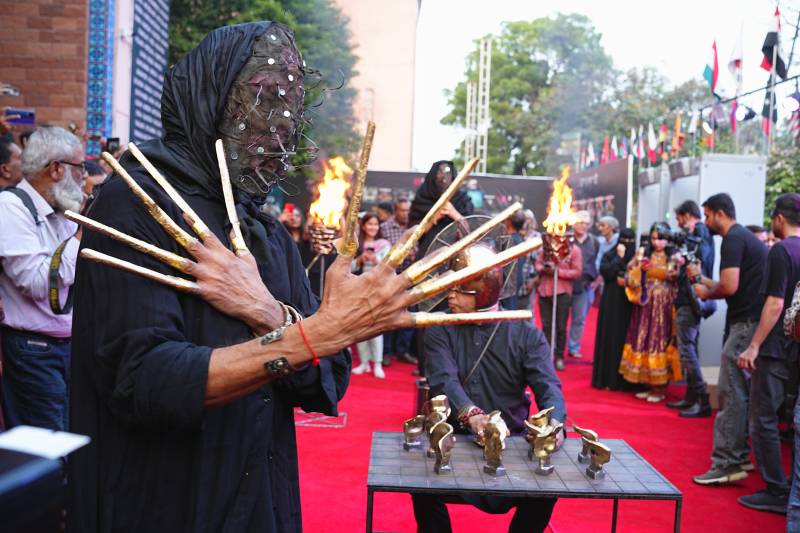
The overall effect was almost medieval, and punctuated by sound, from Amin’s slamming of his bronze pieces against the iron tabletop, to the metallic din of Jamal striking the bowl with his mallet, to Umaina’s hypnotic, wordless voice. Black smoke from the lit torches curled skywards. The Vienna-based Iranian artist Maryam Kouhestani poetically observed, “Listen. There is a beautiful woman singing. Fire rests upon her left and right shoulder, smoke curls within her heart, and her throat is hollow to the deepest depths—a call and a refusal intertwined.” Umaina explained, “Positioned opposite Amin, as he moved his chess pieces, I performed alaab, translating his gestures into vocal expression. My voice became an immediate interpretive response to his actions, creating a surreal interplay between movement and sound.”
In his process, Amin said, one must always leave oneself open to the unforeseen. This was particularly true for The Game, much of which he left up to chance. He elucidated, “When we arrived at the venue and I seated myself in front of my table, I asked the game to speak to me. Shielded by my helmet, I slowly looked at the audience. Suddenly I picked up one of my pieces and aggressively banged it on the table. The iron base of my object broke off. This was not something that I had anticipated. I picked up a shard of my face, which could no longer stand on its own, and showed it, cupped in my hands, to the people around me. I then started breaking all my pieces one by one by slamming them on the chessboard.”
Amin said that when a performance starts it takes over your body and mind. A metamorphosis happens, a transformation. “The emotions I experienced during the act were anger, loss, grief and love,” he stated. He went on to say, “I am a control freak and also vulnerable. Unlike my father, I do not invite people to witness my process of making. No one is welcome in my workshop other than the artisans who help me. Only after a sculpture is resolved do I reveal it. I take all the time I need to make sure it is what I want it to be. Performance art is out of my comfort zone. That’s what makes it energising for me. There is a loss of control. The unexpected eventually defines the act itself.”
Aqib Faiz, a Karachi-based artist whose father worked as an artisan with Amin’s father for his mosaics in lapis lazuli, said, “I loved the intensity and dynamics and drama involved in the way the whole performance was spread and laid out for the audience.”
Amin stated that this has been a challenging and interesting year for him. In January, Skira, the Milan-based publisher of books on art, released his monograph, Amin Gulgee: No Man’s Land. He introduced the book at the Karachi Literature Festival, les Récollets in Paris, the Global Encounters Festival in Dubai, and Canvas Gallery in Karachi. He opened the museum of his father’s work in February. He launched the accompanying Gulgee Museum: The Handbook, published by Lightstone, at the tenth Adab Festival, which took place in Karachi on 22-23 November. Presenting his latest performance at the Arts Council, to which his father was intrinsically connected, had particular meaning for him.
“Perhaps The Game was my therapy,” he concluded.
Mohammad Ahmed Shah, President Arts Council of Pakistan Karachi, stated, “Amin’s powerful and thought-provoking performance set a compelling tone for the festival, celebrating creativity, courage, and the transformative power of art. We are proud to have featured such a significant performance on this global cultural platform.”