

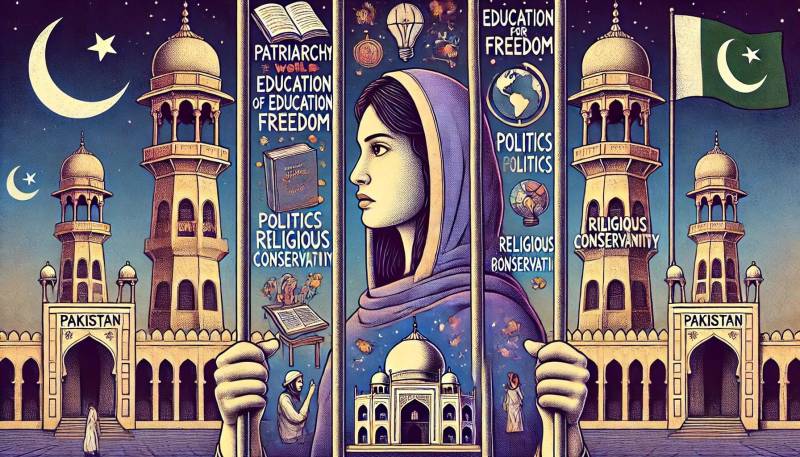
The ongoing pursuit of gender equality in Pakistan is intricately linked to a deep-seated nexus of religion, patriarchy, and politics, which collectively contribute to gender oppression. This troubling alliance has served as a fundamental driver behind the social, economic, and political challenges confronting women. Consequently, Pakistan consistently ranks near the bottom on various established global gender indices, underscoring the persistent challenges associated with achieving gender equality.
Religious nationalism, frequently misinterpreted or exploited for political advantage, has been weaponised to restrict women's rights. Concurrently, entrenched patriarchal norms continue to dominate women's lives, limiting their autonomy as well as their participation in political discourse and economic opportunities.
For instance, the Hudood Ordinance of 1979, which was enacted under General Zia-ul-Haq’s military regime, has had a profoundly detrimental impact on women’s lives in Pakistan. The laws contained within this ordinance are characterised by significant flaws and ambiguities, resulting in their misapplication by both public and private prosecutors.
The Hudood Ordinance ultimately further marginalised women by placing their bodies under the jurisdiction of patriarchal and religiously sanctioned structures. Although some aspects of these laws have since been repealed, the enduring influence of religious nationalism continues to shape societal attitudes toward women in Pakistan.
In addition, religious conservatism has provoked a backlash against feminist progress, with various social and political factions collaborating to undermine feminist movements. This backlash is frequently framed as a defense of "traditional family values" and national identity, depicting feminists as threats to the social fabric of Pakistan. Such narratives serve to reinforce the prevailing concept of women’s subordination, effectively diminishing the hard-won gains achieved by the feminist movement.
While political parties are constitutionally mandated to allocate seats for women in the National Assembly, they continue to underrepresent women in pivotal decision-making roles
Furthermore, patriarchal norms in Pakistan perpetuate widespread gender-based violence (GBV), encompassing domestic abuse and honor killings. Women’s bodies are often subjected to violence justified by prevailing societal conventions. According to the Human Rights Commission of Pakistan, cases of honor killings—wherein women are murdered by male relatives for perceived breaches of family honor—remain alarmingly prevalent.
The backlash against feminism has played a significant role in perpetuating violence against women, as feminist discourse is frequently dismissed as radical or un-Islamic by those seeking to uphold patriarchal norms. This rhetoric not only undermines the feminist movement but also renders it increasingly perilous for women to articulate their experiences of violence. Feminist activists encounter persistent harassment, threats, and violence, which inhibit their ability to organise effectively and advocate for legal reforms and social change.
Women’s political representation in Pakistan remains critically low. Current data illustrates a stark gender imbalance in voter turnout across the nation. Despite an overall increase in the number of registered voters, male voters consistently outnumber their female counterparts. While political parties are constitutionally mandated to allocate seats for women in the National Assembly, they continue to underrepresent women in pivotal decision-making roles. As a result, women are often relegated to ceremonial or subordinate positions within political structures, which significantly diminishes their influence over policies that directly impact their lives.
Economic disempowerment constitutes a major factor that perpetuates gender inequality in Pakistan. Only 25% of women actively participate in the formal labor force, and many are employed in the informal sector, where labor laws and protections are frequently nonexistent. This economic marginalisation compels women to rely on male relatives, particularly in a society where inheritance laws and property rights are often skewed in favor of men. The gender pay gap in Pakistan is particularly concerning, standing at an alarming 34%, which is more than double the global average.
The economic disempowerment of women is closely linked to their limited control over reproductive rights. Access to family planning and reproductive healthcare is often restricted, especially in rural and conservative areas. Pakistan’s maternal mortality rate remains one of the highest in South Asia, with 178 maternal deaths per 100,000 live births, many of which are preventable. Women in rural areas frequently lack access to healthcare services and are subject to cultural norms that limit their capacity to make autonomous decisions regarding their reproductive health.
Furthermore, child and forced marriage continue to be grave issues in Pakistan, despite national laws and international commitments aimed at addressing these concerns. According to the 2017-18 Pakistan Demographic and Household Survey, 8% of women aged 15-19 were either pregnant with their first child or already mothers. Obtaining accurate data on child marriage is challenging, as many unions are verbally solemnised, go unregistered, and often involve misrepresentation of the bride’s age.
Despite the significant resistance from entrenched systems of oppression, the resilience of the feminist movement, ongoing legal reforms, and increasing awareness of women’s rights present meaningful opportunities for progress. The pursuit of gender justice extends beyond the realm of women’s rights; it represents a critical step in dismantling the regressive systems that hinder the nation’s advancement. Empowering women through education, political participation, and economic opportunities is essential for national progress. Thus, it is not merely a matter of gender equality but a fundamental necessity for the country to thrive.