

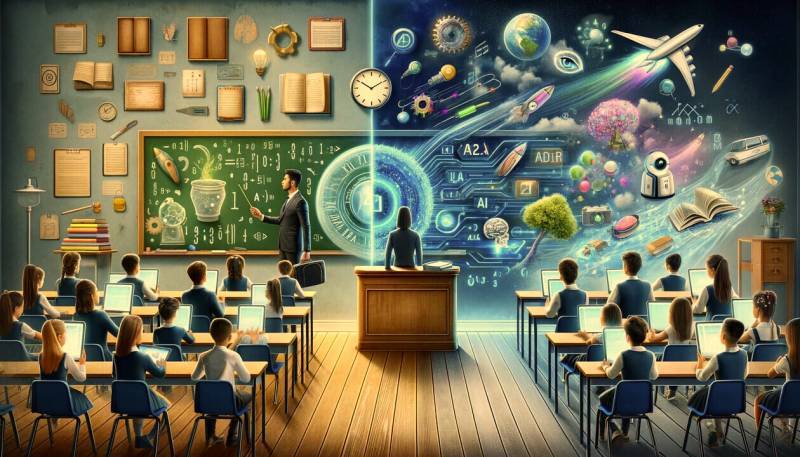
Universities worldwide are undergoing a profound transformation—driven by the rapid rise of artificial intelligence (AI). Classrooms, syllabi, grading, access, pedagogy, and even the very meaning of teaching and learning: all of it is being rewritten. And in Pakistan, the question is not about the opportunity—it is about our readiness. The opportunity is massive, but are we truly prepared to take the leap?
In other parts of the world, AI is no longer an experiment; it is infrastructure. From personalised learning pathways to predictive analytics, grading automation to curriculum design—AI has already become a core component of higher education in countries that decided not to wait. For us, the promise of AI is not just about playing catch-up. It could be a wrecking ball to break through decades of institutional decay: limited access, poor equity, and declining standards. But the critical question remains: where is our plan?
Yes, AI can personalise education. The phrase is familiar. But it must not become a cliché. In a nation where the education system treats students as interchangeable units—blind to their backgrounds, languages, abilities, and life circumstances—AI offers something our traditional structures never could: the capacity to meet students where they are. It can adapt to different learning needs, remove the tyranny of English-centric content, and localise education in ways no textbook ever has. Imagine adaptive platforms that accommodate learning curves, delivering content tailored to region, culture, and individual pace. In a country fractured by inequality, these are not technological indulgences. They are necessities.
In Pakistan, teachers are trapped in clerical tedium. Those entrusted with the task of mentoring, guiding, and inspiring young minds are burdened with administrative chores. Attendance logs, exam scripts, and paperwork consume their time and energy. AI systems that could handle these tasks are ignored, mismanaged, or dismissed. The result? Exhausted educators and a system squandering both talent and potential. It is not that we lack the tools—we simply refuse to use them. From Vision 2025 to Digital Pakistan, the slogans are ambitious, even inspiring. But behind them lie pilot projects with no scalability, underfunded schemes, and systematic neglect of teacher training.
With adaptive exams, intelligent tutoring, and tools finely attuned to local pedagogical needs, there lies an opportunity to reconstruct our higher education entirely—from the ground up
We want AI in our classrooms, but we won’t invest in the people expected to run it. We speak of digital futures, but our institutions still operate on pre-digital logic. We expect 21st-century outcomes from a system that, in practice, hasn’t moved beyond the 1990s. Take language, for example. Pakistan’s multilingualism is usually framed as a problem, but it could be an opportunity—if we bothered to use AI-powered translation and natural language processing tools to bridge the language divide. These technologies exist. They can render academic content into Urdu, Punjabi, Sindhi, Balochi, and Pashto. But again, that would require foresight. The problem is political will—and planning.
Instead, we teeter on the brink of another missed opportunity. AI can help identify struggling students before they drop out. It can map learning patterns and suggest timely interventions. But what do we do with this data? Who is responsible for protecting it? Who ensures it is not sold, disclosed, or reused without consent? In a society where political tensions, religious sensitivities, and social divisions shape much of the national discourse, failing to consider the ethical implications of AI—privacy, consent, and bias—is not mere negligence. It risks eroding public trust. And then there’s the panic. ChatGPT, generative AI, “students are cheating!” Yes, misuse will happen. But where are the countermeasures? Where are the ethical guidelines, the revised curricula, the teacher training sessions? Our response has been predictable: suspicion and overreaction. Rather than teach students how to use these tools critically and ethically, we’ve chosen to fear them. This is not forward-thinking. It is institutional paralysis.
The deeper resistance to AI is not technical. It is cultural, structural, and emotional. University budgets are threadbare. Rural campuses battle for stable connectivity. Many educators are untrained in even basic digital skills. These are real obstacles. But our response has not been to address them—it has been to delay, to deflect, and to hope that somehow, the future won’t arrive before we’re ready. But it has.
AI will reshape assessment, curriculum design, and even the spatial logic of the university. With adaptive exams, intelligent tutoring, and tools finely attuned to local pedagogical needs, there lies an opportunity to reconstruct our higher education entirely—from the ground up. But this will require more than dashboards and declarations. It requires a re-imagining of education itself—a profound rethinking of what education should be in the age of intelligence—human and machine alike. This isn’t about replacing teachers. It’s about freeing them to teach. It isn’t about automating learning. It’s about deepening it. And it isn’t about outsourcing intelligence. It’s about recentering it—on ethics, empathy, creativity, and wisdom.
But none of this happens by accident. If we are to be serious, the next steps must be bold: real collaboration between government, universities, industry, and civil society. We need AI research centres—not just talk of them. We need policies—not just pilots. We need training that is continuous, inclusive, and practical. We need to invest in internet infrastructure the same way we once built roads and power lines. And above all, we need to treat this not as an upgrade—but as a transformation.
AI is a force multiplier. In the right hands, it can elevate Pakistani universities to a new global standard. This is a moment of truth for higher education in Pakistan. The tools are arriving. The world is moving. The only question now is: will Pakistan’s universities rise to meet the future—or be left behind by it?