

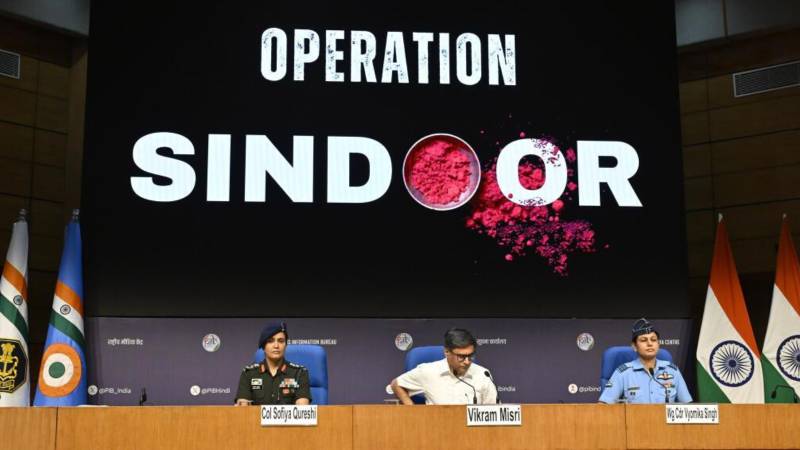
Whenever tensions flare between India and Pakistan, multiple narratives emerge—some grounded in truth, others heavily distorted. In a recent policy report, Indian Lt Gen Paramjit Singh (retd) claimed that a single phone call between military officers of both nations on 10 May 2025 prevented a potentially dangerous confrontation from escalating into full-scale war. While this may sound impressive at first, such stories often reveal only one side of the story. In reality, what happened behind the scenes was far more complex. To grasp the full truth, we must look beyond the headlines and question the misleading versions being presented as fact.
That so-called “single phone call” between the DGMOs, now being praised as a game-changing moment, raises a serious question: which call actually stopped the war? Was it truly just a military-to-military exchange that brought peace, or is this a cover-up for a much larger political embarrassment? The truth is, when India’s military encountered unexpected resistance and suffered setbacks during Operation Sindoor, Prime Minister Modi found himself cornered and desperate. It wasn’t the DGMO reaching out for peace; it was Modi who contacted Trump, seeking urgent assistance to help de-escalate a rapidly deteriorating situation slipping out of India’s control.
India had encountered unexpected and determined resistance from Pakistan, during which its advanced Rafale jets faced significant setbacks. Finding himself in a difficult strategic position, Modi appealed to Trump to intervene and persuade Pakistan to agree to a ceasefire—fully aware that, at that moment, only US influence could help India retreat from the brink. Now, instead of admitting this, the story is being flipped to suggest that Pakistan initiated contact through the DGMO hotline to request a ceasefire. This is not merely misleading—it is an attempt to conceal the fact that India’s aggressive strategy had backfired and required foreign intervention to pull back from the edge.
Ever since India suffered embarrassment during Operation Sindoor, its leadership and media have relentlessly spewed venom against Pakistan in a desperate attempt to rewrite history and divert attention from their failures
Singh praises Operation Sindoor as a strategic success, proudly claiming it struck terrorist sites deep inside Pakistani territory. But let’s be clear: this was not a clean, precise military operation; it was a brutal display of power intoxication that struck civilian areas and sacred sites. Among the targets were mosques, homes, and community infrastructure in Punjab—far from the Line of Control (LoC) and with no confirmed link to any militant activity. These attacks killed civilians, violated religious sanctities, and ripped through the moral fabric of international conflict laws. By celebrating such operations, Singh is not offering a military analysis—he is justifying indiscriminate violence and dangerously rewriting the rules of engagement. If this is the new doctrine India seeks to adopt, it’s not deterrence—it’s provocation dressed as pride, placing millions of innocent lives at risk.
Singh’s accusation that Pakistan uses terrorism as a legitimate policy tool is an old and tired narrative that New Delhi keeps recycling to cover its own tracks. It’s the same predictable script deployed whenever India finds itself backed into a corner. Pakistan—a country that has sacrificed nearly a million lives in its decades-long fight against terrorism—has itself been a major victim. Time and again, the roots of such terrorism have been traced back to India, with Kulbhushan Jadhav standing as a living, undeniable proof of this reality.
Singh’s declared intention to “respond more forcefully” to future terrorist attacks than during Operation Sindoor is equally alarming. Such statements raise legitimate fears that India may resort once again to a false flag operation—just as suspicions continue to cloud the unverified Pahalgam attack. Even the Indian government has been unable to confirm who was responsible. This failure to identify the culprits exposes the incompetence of Indian institutions and reveals a glaring hole in their internal security. One must ask: do the earth or the skies swallow them?
In the same breath, Singh claimed India exercised “initial restraint” during the confrontation with Pakistan—then what were its Rafale jets doing violating Pakistani airspace? Were they on a sightseeing tour? Such actions directly contradict the narrative of restraint and reveal the aggressive posture India prefers to disguise with diplomatic doublespeak.
Throughout his report, Singh conveniently ignored the fact that Pakistan not only strongly condemned the Pahalgam incident but also called for an impartial international commission to investigate—a move that directly challenged India’s credibility and highlighted its unwillingness to submit its claims to independent scrutiny.
The truth is, ever since India suffered embarrassment during Operation Sindoor, its leadership and media have relentlessly spewed venom against Pakistan in a desperate attempt to rewrite history and divert attention from their failures. When the facts don’t favour them, fabrications fill the gap—but reality always prevails.