

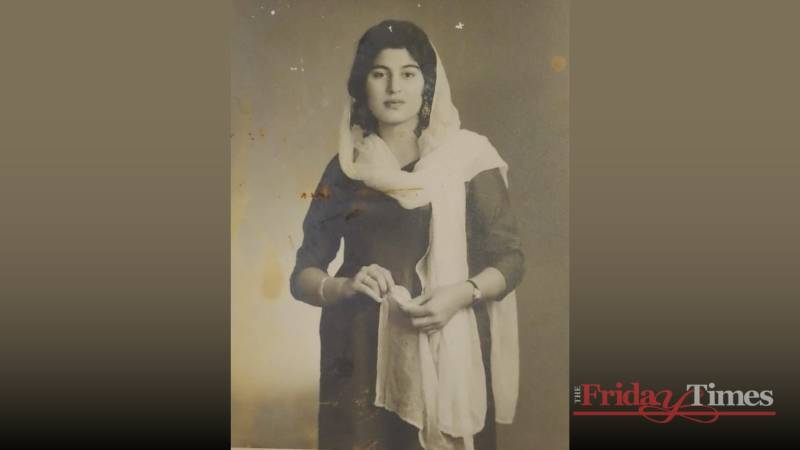
She was among the eldest of us ‘Model Town cousins’, having enjoyed an idyllic childhood there with her parents, Rasheed and Farhat Zaman, and siblings Seemie, Haroon, and (arriving later) Noreen and Shariq. The setting was our grandfather Mir Azizuddin’s home in A Block, overseen by our grandmother Fatima Begum—where Rukhie’s beautiful home with its charming little garden also stood, and where, coming full circle, she passed away.
Tall and statuesque, she could have been mistaken for a 1940s Hollywood heroine—charming by nature and soft-spoken in manner. She married in Karachi (where her father, a most able engineer, spent much of his career) Hafeez Khan, likewise a noted engineer with WAPDA, and created beautiful gardens—having inherited her mother’s passion—wherever they were posted, whether in the deserts of Sindh or the plains of Punjab.
He hailed from a distinguished family of Bangalore and was similarly calm in demeanour, with a quiet but distinct sense of humour.
Rukhie had a number of close friends and classmates from both her Karachi and Wah days (her father having served as Chief Engineer at POF and later KESC), and from the WAPDA days with Hafeez Bhai. She remained in touch with these friends throughout her life. One such dear friend—also now sadly departed—was Ulfat Sherpao, whose son Jehangir is a dear friend of my brothers and me as well.
Very recently, another family elder passed away in our A Block: Begum Saeeda Choudhary, daughter of Mian and Begum Karam Elahi, neighbours and family friends of our grandparents.
Stepping into her premises was also a fairytale-like experience: greeted first by a garden—minute but marvellous—with every kind of seasonal flower in every possible hue
Though she did not belong to the later generations of working women in Pakistan, Lalarukh was an avid reader, enjoyed watching quality television, and could converse on almost any subject—from politics and world affairs to fashion. And this mental acuity, despite physical trials and tribulations, she retained until the end. Entering her parlour, as I often enjoyed doing (being her immediate neighbour, as Gul (Shaheen Amjad Malik) had been mine), was like going ‘through the looking-glass’, as Alice in Wonderland.
She would, with a softly sparkling smile, greet one amidst an ordered array of beautiful ornaments; an assortment of children and teenagers engaged in various scholarly and extra-curricular tasks; a tempting selection of treats; and a collection of classic cats—mostly Persian and sometimes Siamese. As my children discovered to their delight when visiting her some years ago. And surely, so did all her nephews and nieces; she was the iconic aunt.
Who then, having by now gathered that she had no children of her own, were all these—aged approximately five to fifteen—who kept her constant company yet instinctively knew when she required seclusion and space? These were the children of her two devoted staff members, whose education and recreation she supported and sponsored practically as if they were her own. For this too, she would surely be blessed.
Stepping into her premises was also a fairytale-like experience: greeted first by a garden—minute but marvellous—with every kind of seasonal flower in every possible hue. Again, like the ‘Golden Afternoon’ song from Alice in Wonderland in real life. The driveway and outer corridors were shaded by cool green gauze, the overall effect—alongside the perfect green lawn—being, in Jane Austen’s words, of ‘the most perfect refreshment’.
I—and so many others—thus have much to thank this remarkable relation and fine friend for: her selfless assistance to others; her creation of a beautiful ambience for all who were privileged to enter it; her devotion to both detail and the larger picture; and the sheer enjoyment of her company, with her quiet wit and soft charm. Model Town—and for many of us, most of whom turned up in droves to bid her farewell—Lahore, shall not be the same without her.