

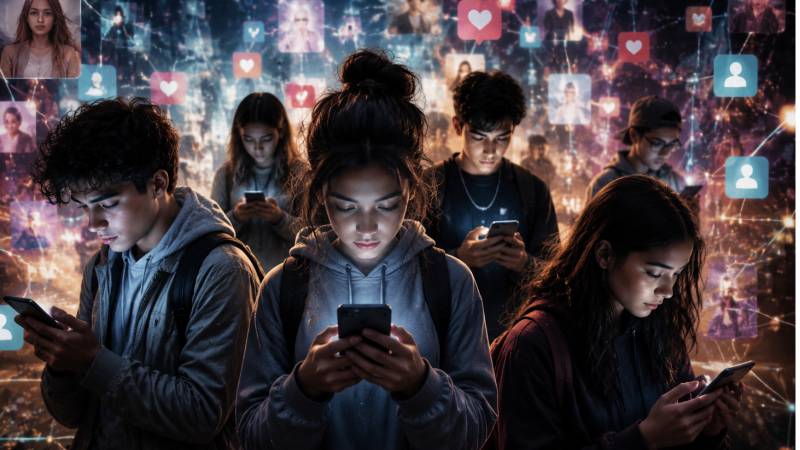
Say the word Generation Z this week and they return within minutes, on a television panel, inside a party manifesto, in a marketing meeting or across a university campus. Newspapers dissect its habits, politicians chase its votes, brands redesign products around its tastes and firms hire consultants to study it. This attention is so relentless that it becomes tempting to assume Gen Z must be uniquely important, perhaps the most consequential generation in living memory. But before accepting that conclusion, it is worth asking a simpler question: has society confused visibility with importance?
I belong to this generation myself, and that is precisely why the hype troubles me. Around me are mostly ordinary students, job seekers and young professionals trying to finish a degree, find work and build a future, not revolutionaries reshaping history by sheer force of will. This is simply what life looks like once the cameras are switched off. The gap between how extraordinary Gen Z appears online and how ordinary it feels in everyday life is the real story worth examining.
The explanation lies less in the uniqueness of Gen Z than in the timing of its arrival. It is the first generation to spend its adolescence inside smartphones, Instagram, TikTok, YouTube and algorithm-driven feeds, meaning almost everything it does is recorded, measured and analysed in real time. Earlier generations experienced wars, economic crises and cultural upheavals of their own, yet their lives were never transformed into endless digital content because the technology simply did not exist. A hairstyle or slang word from 1975 remained local. Today, similar trends become global within days. Gen Z appears unusually influential largely because its life is structurally visible, not because it is historically unprecedented.
That visibility also makes ordinary generational behaviour look like cultural revolution. Every generation has experimented with fashion, slang and identity to distinguish itself from its parents. What has changed is not the behaviour but the distribution system. A hairstyle in Seoul can become fashionable in London within days, while a phrase coined in New York can appear in Karachi almost overnight. Social media creates the impression of one coordinated global youth culture when, in reality, digital platforms deserve much of the credit for its speed and reach.
The real revolution was never Gen Z itself. It was the rise of social media and the algorithmic attention economy.
The consequences extend far beyond fashion. They increasingly shape how young people consume information itself. Time spent on short-form video has risen sharply in many countries, while reading books and long-form essays has declined. Psychologist Jonathan Haidt argues that the shift from play-based to phone-based childhood coincides with rising anxiety and shorter attention spans, although researchers continue to debate the extent to which smartphones alone explain these trends. The point is not that Gen Z is less intelligent but that growing up with algorithm-selected content encourages habits that reward speed over reflection.
These habits are not simply matters of personal choice. They reflect the architecture of the platforms themselves. Long before smartphones existed, Marshall McLuhan argued that the medium shapes how people think, not merely what they think. Shoshana Zuboff later showed how digital platforms do not simply record preferences but actively cultivate them because human attention has become a commodity. Neil Postman's warning that entertainment increasingly displaces serious public debate applies with even greater force to today's algorithmic feeds. Social media does not merely reflect behaviour, it helps produce it.
If media theory explains how platforms shape behaviour, psychology explains why those influences become so powerful. Henri Tajfel demonstrated that people derive self-worth from group membership, helping explain why many young people increasingly define themselves through online communities, political tribes and fandoms. Within these groups, the bandwagon effect encourages conformity, while group polarisation pushes opinions towards greater extremes. Confirmation bias ensures people consume information that reinforces existing beliefs and many develop parasocial relationships with influencers they will never meet. None of these tendencies is new. What is new is the scale and intimacy with which digital platforms amplify them.
These dynamics increasingly shape politics as well. Bangladesh's 2024 uprising against Sheikh Hasina began over job quotas, Sri Lanka's 2022 Aragalaya emerged from economic collapse, Nepal's 2025 Gen Z protests followed a social media ban layered onto years of frustration with corruption and India's Cockroach Janata Party movement grew from exam paper leaks and youth unemployment. In every case, unemployment, inflation, corruption or political exclusion created the underlying grievances, while digital platforms accelerated mobilisation, spread information rapidly and reduced the need for formal leadership. As political scientist Erica Chenoweth's research on nonviolent movements suggests, communication technologies can make mobilisation easier, but they are not substitutes for genuine political grievances.
Yet politics is only one arena in which Gen Z's visibility has become valuable. It is also a market and a voting bloc. Brands redesign products around its tastes, political parties compete for its support and media organisations produce endless stories about its habits because doing so attracts attention and generates profit. Importance, in other words, is partly manufactured by those who benefit from manufacturing it.
Seen in this light, the fascination with Gen Z becomes easier to understand. Every generation has believed itself to be living through a unique historical moment. What distinguishes Gen Z is not that belief but the machinery surrounding it. Algorithms now document, amplify, monetise and globalise almost every aspect of a young person's life. Society is not wrong to notice Gen Z constantly. It is wrong to assume that constant attention proves exceptional historical importance. Visibility is not the same as influence.
History may ultimately remember Gen Z not as the generation that transformed the world through its own uniqueness, but as the first generation whose identity was continuously shaped, amplified and commercialised by the platforms it grew up inside. The real revolution was never Gen Z itself. It was the rise of social media and the algorithmic attention economy, reshaping politics, culture and public opinion for everyone. The world did not mistake Gen Z for being important because it changed history. It mistook unprecedented visibility for unprecedented significance.