

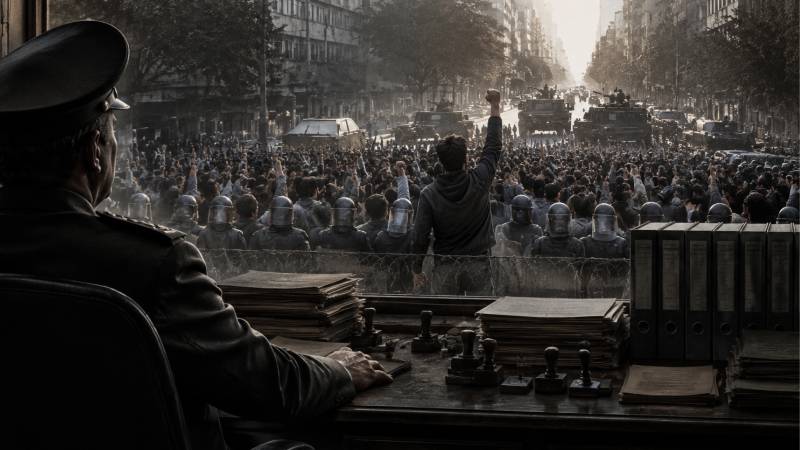
Mohammed Hanif has always understood that Pakistan's deepest conflicts are rarely fought only on battlefields or in parliament. They are fought in classrooms, newspapers, courtrooms, drawing rooms, mosques and police stations, where language determines legitimacy and silence becomes a form of obedience. His latest novel, Rebel English Academy, returns to this familiar terrain but approaches it with greater emotional depth and philosophical ambition than perhaps any of his previous works.
Set in the uneasy aftermath of Zulfikar Ali Bhutto's execution in 1979, the novel unfolds under the long shadow of General Zia-ul-Haq's martial law. Yet to describe it simply as a political novel would be misleading. Politics provides the landscape, but Hanif is ultimately interested in something more enduring: how power shapes language, memory and identity, and how ordinary people continue resisting even when resistance appears impossible.

The fictional setting of OK Town feels unmistakably Punjabi, recalling the social landscape of Okara without ever becoming a documentary reconstruction. Martial law hangs over every conversation. Public grief is suspect. Ideological loyalty is demanded. Even private memory carries political consequences. Bhutto may have been executed, but the anxieties surrounding his legacy remain very much alive. The state's greatest challenge is no longer eliminating an individual; it is controlling the memories that survive him.
At the centre of this world stands Sir Baghi, founder of the modestly named Rebel English Academy. On the surface, he teaches affordable English classes. In reality, his academy becomes something far more subversive: a refuge for damaged lives, an archive of forgotten stories and a quiet challenge to official history. Baghi is among Hanif's most fascinating creations precisely because he refuses to resemble the conventional revolutionary hero. His very name means "rebel," yet his life has been shaped as much by compromise as conviction. He has opposed authority, accommodated it, mocked it and occasionally depended upon it. He carries the vocabulary of revolution while possessing the instincts of survival.
This contradiction lies at the heart of Hanif's understanding of political resistance. Dictatorships rarely produce flawless heroes. They produce frightened people making imperfect choices. Survival itself becomes a political act, and courage often appears not as grand defiance but as quiet persistence.
Survival itself becomes a political act, and courage often appears not as grand defiance but as quiet persistence.
The academy itself functions as the novel's central metaphor. English is not simply another language to be mastered. In Pakistan it has long represented bureaucracy, privilege, colonial inheritance and access to power. Those who command English frequently command institutions. Courts, universities, corporations and the higher civil service continue to privilege linguistic fluency as a marker of authority.
Hanif understands this paradox perfectly. English remains both an instrument of exclusion and a possible language of liberation. It once belonged to colonial administrators; today it belongs to state institutions and urban elites. Yet it also allows marginalized citizens to document their experiences, challenge authority and enter conversations from which they have traditionally been excluded. Teaching English therefore becomes an unexpectedly political activity. Baghi's students are not merely learning grammar. They are learning how official language works—and perhaps how to resist it. The arrival of Sabiha Bano transforms this modest academy into something even more consequential.
She enters carrying the burdens of imprisonment, bereavement and suspicion. Her parents have suffered under the political system; her husband has died under circumstances clouded by uncertainty. Baghi encourages her to write as part of her English lessons. What begins as classroom homework gradually becomes testimony. Through writing, Sabiha reconstructs a life that the state would prefer forgotten.
Hanif wisely resists presenting her as a conventional political activist. She delivers no grand speeches and leads no dramatic uprising. Instead, she observes, remembers and records. In societies where official history routinely erases inconvenient lives, such acts become profoundly political. If Baghi teaches rebellion, Sabiha embodies it.
Her imperfect English becomes one of the novel's most effective symbols. The flaws in her language never diminish the truth of her experience. Indeed, they make her voice more authentic. She writes outside the polished vocabulary of official reports, judicial commissions and bureaucratic memoranda. Her testimony cannot easily be absorbed into the language that has often concealed injustice. This concern with language has always animated Hanif's fiction, but Rebel English Academy develops it with unusual sophistication.
Words do not merely describe reality; they organize it. States label people as patriots, traitors, extremists or terrorists. Religious institutions distinguish believers from heretics. Bureaucracies convert human suffering into files and procedures. Military governments rename repression as stability. Control the vocabulary and one begins controlling public memory.
Yet Hanif repeatedly demonstrates that language remains unstable. Official narratives may dominate newspapers and textbooks, but whispered stories, rumors and personal recollections continue circulating beyond the state's reach.
Rumor occupies a particularly interesting position within the novel. Under authoritarian rule, official information becomes inherently suspect. In response, ordinary citizens construct parallel networks of knowledge through gossip, hearsay and personal testimony. Rumours are not simply unreliable facts; they become unofficial archives preserving experiences excluded from official history.
Hanif has explored military authoritarianism before, most memorably in A Case of Exploding Mangoes. The targets remain recognisable here: authoritarian institutions that project absolute confidence while functioning through insecurity, paranoia and absurdity.
What distinguishes this novel is not its politics but its texture. Its comedy feels quieter, sadder and more reflective. One of the novel's finest observations comes through a military instruction: "If anything moves, salute it; if anything is still, paint it white."
The sentence is unmistakably funny. Yet beneath its humor lies an entire institutional philosophy: hierarchy without reflection, obedience without purpose and ritual elevated above reason. Hanif's satire succeeds because his jokes explain systems rather than merely decorating them.
Readers familiar with Pakistan's bureaucratic culture will recognize this immediately. Meetings generate minutes rather than decisions. Procedures become more important than outcomes. Files circulate endlessly while responsibility disappears. Hanif's humor exposes not isolated eccentricities but deeply embedded institutional habits. Captain Gul represents another dimension of authoritarian power.
An intelligence officer driven by ambition, surveillance and desire, he embodies the psychology of state repression. Yet Hanif refuses to reduce him to caricature. Gul imagines himself as a historical figure protecting the nation from dangerous ideas. His fantasies are simultaneously comic and disturbing because they reveal how ordinary officials justify extraordinary cruelty.
Violence becomes easier when one believes oneself to be defending civilization. Similarly, Hanif's treatment of religion avoids easy binaries. The character Molly occupies the uneasy intersection of religious authority, personal ambition and institutional power. Hanif is sharply critical of hypocrisy, yet he never suggests that Pakistan's political conflicts can simply be divided into secular virtue and religious vice. His characters inhabit overlapping worlds where ideology, survival and personal weakness continually intersect.
Control the vocabulary and one begins controlling public memory.
If the novel occasionally falters, it does so largely because of its own ambition. Several narrative strands remain unresolved. Certain characters appear destined for larger roles before quietly receding. Captain Gul's fantasies seem to promise conclusions that never fully materialise. Some readers may find these loose ends frustrating. Yet one suspects that Hanif's refusal to provide neat resolutions is itself deliberate. Authoritarian societies rarely offer satisfying endings.
Political prisoners disappear without explanation. Investigations remain incomplete. Marriages survive without happiness. Families inherit unanswered questions. Official commissions announce closure while ordinary citizens continue living with uncertainty. In this sense, the novel's incompleteness reflects the incompleteness of history itself. Not every question receives an answer because history has denied these characters the luxury of resolution.
Throughout the novel, Hanif demonstrates extraordinary confidence in language itself. His English remains unmistakably Pakistani without becoming self-conscious or exoticized for international audiences. Punjabi and Urdu rhythms quietly shape his prose. Cultural references emerge naturally rather than as explanatory footnotes for foreign readers.
Rebel English Academy is far more than a novel about General Zia's dictatorship. Refusing to simplify Pakistan for international readers, Mohammed Hanif writes from within its contradictions, exposing how education, language, memory and institutions shape both power and resistance. His greatest achievement is showing that rebellion often begins not with slogans but with the courage to bear witness. Whether or not literary prizes recognise it, Rebel English Academy stands among the most significant works of contemporary Pakistani fiction, reminding us that while states may control official histories, they can never fully silence the stories people continue to tell.