

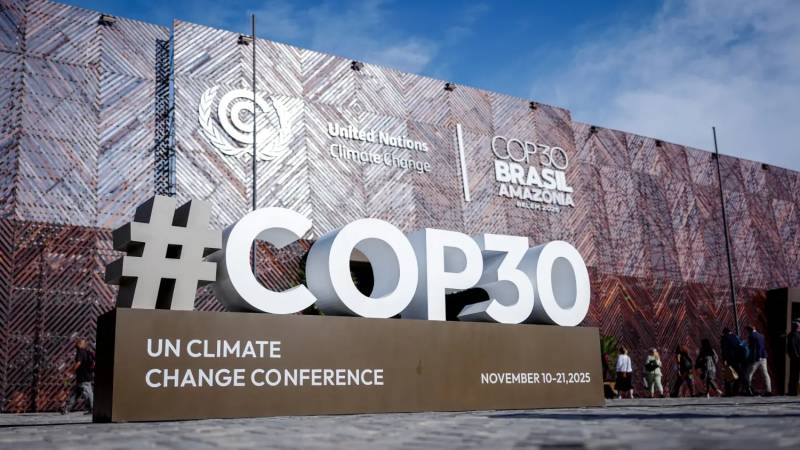
As climate impacts intensify across the Global South, powerful nations are shaping a global climate order that protects their own interests while leaving vulnerable countries to bear the harshest consequences. Pakistan, among the world’s least responsible yet most affected, now finds itself confronting an unequal climate system that mirrors the geopolitical imbalances. The United States’ retreat from global climate leadership, underscored by its absence from COP30, has slowed international momentum.
Despite the boost to adaptation finance, COP30 largely failed to rise to the moment on the most urgent fronts: phasing out fossil fuels and closing the emissions gap. COP summits are fast becoming as ineffective as routine UN sessions, filled with rhetoric yet starved of real outcomes. This failure is no accident; it is sustained by the powerful nations of the Global North, whose calculated delays preserve their interests while vulnerable countries bear the mounting costs. Pakistan stands as one of the clearest examples of this injustice.
At COP30, China tried to benefit from the vacuum created by the absence of the US, projecting itself as a leader of South–South cooperation even as it remains the world’s largest emitter, with over 62% of its electricity produced from fossil fuels. China also holds significant influence over highly polluting mining operations in least-developed countries, where weak governance and limited regulation allow environmentally harmful extraction to flourish. Through the Belt and Road Initiative, countries like Pakistan shoulder the environmental burdens of coal power and mineral extraction while China consolidates long-term influence in the region.
Western powers, despite shaping global emissions standards and climate finance frameworks, continue offering loan-based instruments tied to policy conditions that undermine economic sovereignty, while failing to deliver adequate loss-and-damage support and expanding fossil-fuel production at home. Gulf states echo the same contradictions, hosting high-profile climate summits while intensifying oil and LNG exports.
Financial institutions, such as the World Bank and the IMF, reinforce Global North priorities through structural adjustment and policy conditionalities, while China’s parallel lending architecture often replicates similar extractive patterns. This dynamic leaves oppressed nations, often called the Global South, stuck in unequal systems that maintain dependency and force them to bear the environmental damage created by global development.
In the context of Pakistan, this represents a profound moral imbalance: a nation with minimal historical responsibility for climate change now bears the highest price. The miseries of the poor in Pakistan are further compounded by the country’s inability to benefit from global climate funds at a significant level, because international criteria often demand highly specific, technically complex, and bankable project proposals. Such a high level of institutional capacity takes years for Pakistan to build.
Pakistan is on the frontline of a crisis it did not create, but vulnerability is not destiny
COP30 reflected these contradictions, delivering no binding fossil-fuel phase-out commitment, while scientific assessments warned that the world is headed toward 2.5°C warming. Pakistan contributes less than 1% of global emissions yet ranks 15th on the Global Climate Risk Index 2026, with the 2022 floods displacing 33 million people and causing losses exceeding USD 30 billion.
Recent scientific studies published in reputable Nature Partner Journals converge on the finding that the 2022 catastrophic events in Pakistan were overwhelmingly driven by extreme precipitation, intensified by climate change, atmospheric river events, monsoon variability, and saturated soils, while snowmelt and glacial factors played secondary roles.
A country with a population of 255.2 million growing at 2.55% annually strains water, land, and energy systems, while an HDI of 0.544 (168th globally) reflects deep structural inequities that magnify vulnerability. Externally, extractive models persist, as seen in CPEC-linked coal projects, US interest in Pakistan’s critical minerals, and the environmental burdens placed on communities in oppressed regions. Regionally, South Asia suffers some of the world’s worst air pollution according to IQAir rankings, yet India–Pakistan tensions obstruct cooperation on shared airsheds and hinder joint water governance under the Indus Waters Treaty.
Despite progress through policies such as the National Climate Change Policy, the National Adaptation Plan, and the GLOF programme, weak local governance and limited implementation capacity continue to undermine resilience efforts. Pakistan now stands at a critical juncture: it can continue cycles of dependency and elite-driven policy or shift toward a people-centred model of climate governance rooted in justice, sovereignty, and community leadership.
Real resilience demands empowered local governments, inclusive planning, stronger early-warning systems, community-led adaptation, and a firm insistence that global climate finance be delivered as grants rather than debt.
The scientific record leaves no ambiguity: Pakistan is on the frontline of a crisis it did not create, but vulnerability is not destiny. Climate justice requires that the countries least responsible for warming no longer carry the greatest burden of its devastation. Pakistan must therefore reclaim its agency, demand accountability from major emitters, whether in Washington, Brussels, Beijing, or Riyadh, and champion a global climate regime anchored in equity, dignity, and self-determination. Only by aligning national policy with this vision can Pakistan reshape its climate future and emerge not as a passive victim of global climate politics but as a leading voice for justice across the Global South.