

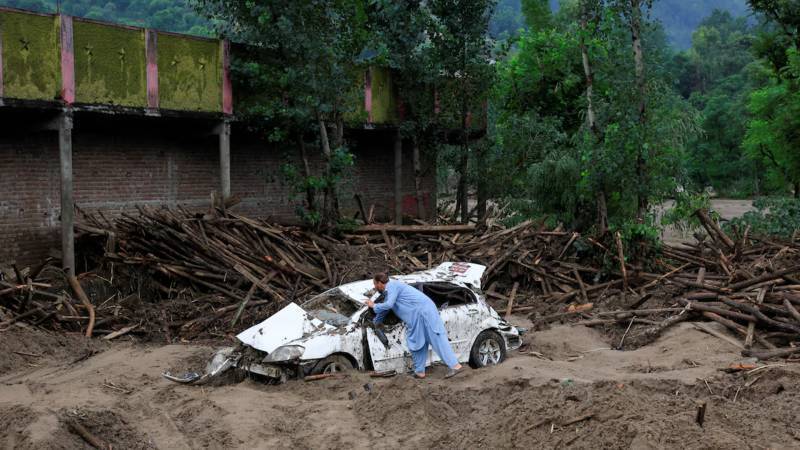
In the last 15 years, Pakistan has faced a destructive flood every single year, each one more disastrous than the last. The past few weeks seem to have witnessed the worst of it with immense monsoon bursts triggering destructive flash floods and landslides across Khyber Pakhtunkhwa and urban flooding plaguing cities like Rawalpindi and Karachi alike. The National Disaster Management Authority’s (NDMA) monsoon SITREP reports 798 deaths, 1074 injuries and the destruction of 7001 houses between 26 June and 24 August. In Khyber Pakhtunkhwa, an emergency has been declared, while over 2356 families have been displaced along the Indus and Chenab in Punjab. The proof of our unpreparedness for the monstrous impacts of climate change is everywhere, recorded and shared online, discussed on national television, and seemingly unsolvable.
Climate change, however, is not an isolated natural disaster, and so it cannot be treated as one. It will exacerbate all our existing vulnerabilities because it exacerbates what is already wrong within a system. While Pakistan has responded to its vulnerability with several climate initiatives: the updated National Climate Change Policy, large-scale tree-planting, glacier-outburst mitigation projects, and reforestation drives across coastal Sindh, on the ground, little changed. Large-scale projects worth hundreds of millions are being implemented, with little to no impact on the real issues. Staying true to the culture of bureaucracy and inefficiency, Pakistan has chosen a reactive approach to deeply systemic problems.
The institutions most in need of coordination are fragmented. Basin management is split among irrigation departments, the Federal Flood Commission, NDMA/PDMA/DDMAs, local governments, and municipal authorities, with overlapping mandates and uneven capacity, failing to respond at the height of risk. Post-2010 and post-2022 reviews of the flooding situation have repeatedly cited unclear roles, limited local government authority, and weak enforcement of zoning with no real reform. Even when risk maps exist, development control often bends to political economy realities, manifested in the urban nightmare that is Karachi’s drain politics. Enduring governance failures like these have trapped Pakistan in a cycle of disasters. Clinging to colonial ideas of development, expansion and the occupation of water sources, Pakistan has offered itself to the devastation of climate change.
Transparent governance, stronger institutions, and fair relocation policies not only save lives during disasters but also create a development model that values equity, accountability, and the rule of law
At the same time, there is ever-increasing discourse on how Pakistan contributes to less than 1% of global GHG emissions, but ranks as the 5th most vulnerable country to climate change. While necessary, this discourse ignores the alarming reality that the world is consistently failing at meeting its climate and emissions goals. Climate finance is not moving to vulnerable countries at the rate it was promised, and even if all of the promised finance were poured in, Pakistan’s fundamental problems of bureaucracy and systemic inefficiency would remain.
What Pakistan and other extremely vulnerable countries need to realise is that the global north is uninterested in shifting resources away from profits. So while we highlight and fight against the inequality of climate impact, we also need to build our own capacity. An effective response to climate change will not come from remote and inaccessible technology, nor will it come from millions pouring in reactive aid. The solution to building resilience to climate catastrophes is the same development solution that we have been ignoring for decades: investment in public goods, pro-citizen policies, and a strong social safety system.
Illegal land use and settlements need to be targeted head-on and immediately, on active floodplains and on wetlands in urban areas. Cities must protect drainage channels with legal easements, build more open green spaces to absorb water, and ensure services like electricity and water are raised above flood levels. Institutions need to be capacitated to design and lead strategies of resilience and response, as opposed to implementing donor-funded projects. In concurrence, social safety nets need to be expanded, building on BISP’s existing structure, to cover displaced families quickly, with fast cash transfers ready when floods strike, and health systems should stock clean water, sanitation, and mobile clinics to prevent disease outbreaks. At the same time, all provinces need to adopt open, publicly available risk maps and reporting systems so encroachments, weak embankments, or blocked drains can be tracked and fixed quickly.
Thus, building disaster resilience looks exactly like what sustainable development in the country should be. When housing codes require safer construction and raised plinths, families are not only protected from future floods but also live in healthier, more durable homes. Expanding social safety nets like BISP to respond quickly to disasters doubles as poverty reduction, ensuring vulnerable families have a stable floor to recover from shocks of any kind. Repairing and maintaining rivers, canals, and drainage systems strengthens agriculture and urban services, which are the backbone of food security and economic growth. Transparent governance, stronger institutions, and fair relocation policies not only save lives during disasters but also create a development model that values equity, accountability, and the rule of law. In other words, the same reforms that reduce vulnerability to climate-related floods also advance national priorities for poverty reduction, food and water security, sustainable cities, and inclusive economic growth.
We cannot wait for the global community to accept blame and decide to come together and help. We cannot afford to. We must stop deflecting blame when we have the adaptive capacity. So much of climate resilience and adaptation in Pakistan is about what not to do; stopping existing harmful practices and enforcing existing laws and policies. The primary goal of policies and plans should be to reduce social vulnerability to climate change or otherwise. And while hydromet and infrastructural responses remain important, the biggest resilience gains will come from where people live, how cities are governed, and how quickly the state can protect and compensate them.