

The Kingdom of Saudi Arabia (KSA) attracts international investments. Prime Minister Shehbaz Sharif is in Saudi Arabia to win Saudi investment. It is sad to see that no serious talk is taking place on this meaningful visit.
Putting politics of confrontation aside, one area that is ignored by and large is maritime affairs and the blue economy. It is very important to understand its potential so that a proper policy can be shaped, dedicated to harnessing this potential. This sector is the backbone of our trade with Arabian Gulf countries and the world.
Vice Admiral (Rtd) Ahmed Saeed, president of the National Institute of Maritime Studies (NIMA), told me in a candid discussion that Saudi Arabia and other Gulf Cooperation Council (GCC) countries are very important to Pakistan and the world.
The Gulf is an energy corridor and the backbone of our economy. More than 40 percent of the world’s energy sources are located there and traded through this region. We get our major energy supplies from the Gulf.
We also have cultural, traditional, and religious affiliations with Saudi Arabia. Saudi navy officials used to be trained in Pakistan. At that time, there were three Arab cadets for each Pakistani cadet in our academies. Later, they built their institutions, where many Pakistani instructors were teaching. Arabs are still trained here as well. Many chiefs of naval staff of Arab countries have been trained in Pakistan. This is a strength for Pakistan.
He stressed that other than the Aman Exercise, with Saudi Arabia, we hold the Naseem-ul-Bahr exercises exclusively.
On attracting foreign investment to Pakistan, he said that shipping is a very lucrative business worldwide. There are no second opinions on it. If you go to any shipyard to place an order, you will get a delivery date of at least three years later. This shows how heavily shipyards have booked orders. But Pakistan is lagging in this race.
"I would say that partly because of political motivations and vested interests, we were not offering incentives to either local or foreign investors. We suffered a lot due to it," he said.
"There were 73 ships before 1971. But when businesses were nationalised, it turned away all investors, national and international. Simply put, the 10 ships that we have can carry only 10 percent of the cargo we trade. We need to hire ships to handle the remaining 90 percent of the cargo, valued at 65-67 billion dollars," he said.
"When you hire ships, you will have to pay higher freight rates. War surcharges will also have to be paid wherever they are applied. Besides, there is a delay in delivery, as when a ship is full to its capacity, only then will it come here," he said.
"When these ships finally arrive in our area, the bigger problem is that their freight payment is made in foreign exchange, and six to eight billion dollars go into this account," he explained.
He said, "If we had our ships, we could cut these losses by at least 50 percent, which is very good."
Asked whether, nowadays, seas are becoming more militarised, with the interests and conflicts of international powers everywhere, he replied, "Yes, there are many changes in the new policy. Many incentives are set for investors now. But political stability comes first. Then comes overall security and a sustainable policy."
"Whosoever comes to invest in this capital-intensive shipping industry will not be interested in a policy that may be stable only for five years. They need a long-term policy. There should be a maritime policy for at least 30 years. When foreign investors see that local investors are gaining profit, only then will they come in. We have discussed all these things at the stage of formulating maritime policy," he said.
He said the good thing is that more than 60 countries participated in the Aman Exercise. At the same time, the Aman Dialogue was also held. NIMA has played an important role in this process. Maritime diplomacy is a very relevant part of our diplomacy, he added.
"We can say that every country that faces the sea is our neighbour because we can go there without any hindrance. Wherever any natural disaster like an earthquake or drought strikes in these countries, Pakistan dispatches aid, including medicines and other items, through ships," he said.
"Our ships make a goodwill gesture in these countries, including Turkey. It has built our good image," he said.
He said the main purpose of the Aman Exercise is that maritime nations should sit down and discuss the issues and come up with a common solution to maritime problems. This time, the issues of seafarers were discussed. He added that over 120 delegates attended the Aman Dialogue, rubbishing the impression that Pakistan is being diplomatically isolated.
"It also shows Pakistan's regional power. Leaders from different countries like Bangladesh, America, Britain, African countries, and Middle Eastern countries were all in the same place. It is a diplomatic success for us all. It strengthened the argument that Pakistan can bring together divergent countries and hold dialogue on global problems," he said.
On the importance of maritime affairs in building relations with landlocked Central Asian countries, he said there are 42 countries affiliated with the UN that are landlocked. The United Nations Law of the Sea allows them to use the coast of any country, he said. "Pakistan is the nearest maritime nation that can offer these Central Asian countries an opportunity to do business through the sea," he said.
On the need for collaboration, he said, "No single country, not even the US, can deal with all the problems surfacing at sea. This is why we have invited Central Asian countries to the Aman Dialogue."
He said Pakistan is the most experienced and trusted maritime force in this region. The Combined Maritime Force was created in our region in 2000 by the US. It was meant to counter piracy and terrorism. Pakistan became a member of the counter-terrorism force in 2004 and joined the anti-piracy force in 2009. Pakistan is a middle-level power in the region.
"In the days to come, we will increase our global relevance," he said.
On the concept of naval diplomacy, he said, "The sea is a common heritage of humankind. As many Arab navy officials are trained here, it gives Pakistan ease of movement in diplomatic corridors. I was an instructor at the Navy Academy and was happy to find that one of my students came to meet me during the Aman Exercise. He was in a diplomatic position now."
On the potential of the blue economy in Pakistan, he said, "Developed maritime nations have a 16 to 20 percent share of sea-related activities in their economies. In developing countries, it is 8 to 12 percent."
"We have more sea resources than many countries. We should also have this share. Allah has given us more than 1,000 kilometres of coastline. Under maritime and UN Law of the Sea, we have been given many provisions to benefit from maritime potential," he said.
"For maritime nations, territorial waters stretch over 12 nautical miles, followed by a contiguous zone of 24 nautical miles and an exclusive economic zone of up to 200 nautical miles," he said. He added, "Then there is the continental shelf, which can extend to 350 nautical miles. Hence, we have up to 290,000 square kilometres related to the economy and maritime affairs. All activities happening in this zone can play a major role in our economy."
He said it plays an important role in Pakistan’s economy, covering fishing, ports, shipping, trade and transit trade, the ship recycling industry, and much more. Then there are precious minerals and other important resources in the sea. About 40 disciplines cover it.
"We have the capacity to generate 100 billion dollars if we tap into this potential by only 6 to 8 percent. It also includes CPEC (China-Pakistan Economic Corridor)," he said.
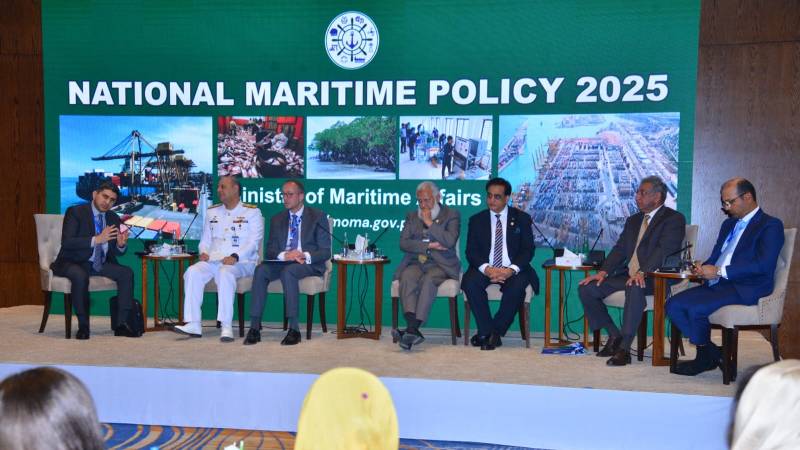
"The first thing that shows political will is maritime policy. Unfortunately, our maritime policy has not been reviewed since 2001. It was urgently needed. The government has now done a lot of work on it and is serious about it."
He said NIMA has been a very active part of this process and is working for the National Maritime Policy to be implemented sooner rather than later.