

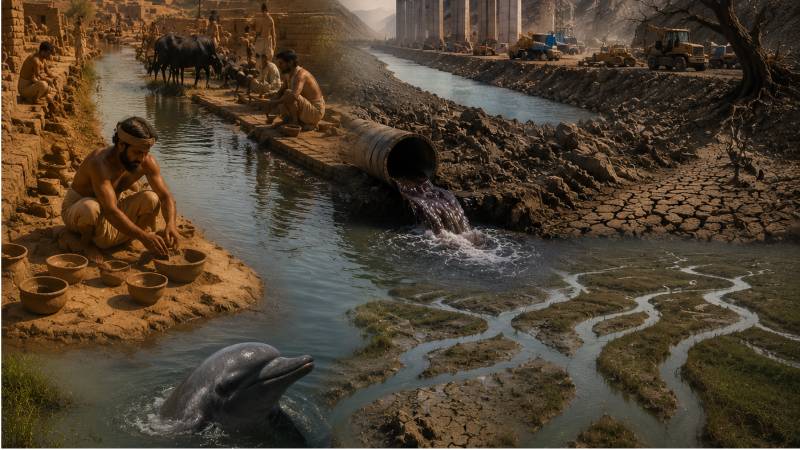
More than three thousand years ago, the poets of the Rig Veda imagined the Indus Basin differently. In the Nadi Sukta, the Hymn of the Rivers, they described the Sapta Sindhu [Land of Seven Rivers] not as separate channels but as a single living body. The Sindhu [Indus], they wrote, was the lord of moving floods. Its tributaries rushed toward it like calves to their mothers, joining "in the same chariot." The roster mapped a unified whole: the Sindhu [Indus], Sarasvatī [Ghaggar-Hakra], Śutudrī [Sutlej], Vipāś [Beas], Paruṣṇī [Ravi], Asiknī [Chenab], and Vitastā [Jhelum]. This was not mere poetry. It was a form of knowledge.
When monsoonal shifts and tectonic drift later choked the Sarasvatī system, the basin's map evolved. The seven became five. The Mahābhārata and Purāṇas called the region Pañcanada [Land of Five Rivers], yet the fundamental perception held: these rivers belonged together. Darius I administered the valley as one satrapy. Alexander's chroniclers knew it as Pentapotamia, not a series of obstacles, but one integrated system. Across the Iranian plateau, the Zoroastrian Vendidad named the same region Hapta Həndu, a phonetic twin proving that basin-wide thinking predated the split of Indo-Iranian civilization itself. The ancients possessed a science of togetherness. When climate turned against them, they adjusted their maps without fragmenting their imagination. We have done the opposite.
In April 2025, three days after the Pahalgam attack, India's Foreign Secretary announced that the Indus Waters Treaty was being held in abeyance. The agreement that had survived three wars, nuclear tests, and sixty-five years of hostility was suspended in a single evening. New Delhi declared it would remain so until Pakistan "credibly and irrevocably" ended support for cross-border terrorism. Islamabad insisted the treaty remained fully operational. Diplomats have since argued over legal clauses and whether the word "abeyance" has any meaning in international law. Yet in all the thunder about who owns the water, almost nobody is asking the older question: What keeps the river alive?
The 1960 Indus Waters Treaty deserves its reputation. Negotiated with World Bank facilitation and signed by Jawaharlal Nehru and Ayub Khan, it replaced Partition's most dangerous uncertainty with rules that have endured for decades. By allocating the Western Rivers [Indus, Jhelum, Chenab] to Pakistan and the Eastern Rivers [Ravi, Beas, Sutlej] to India, it prevented war. Its achievement deserves recognition.
Its fundamental limitation deserves recognition too. The treaty allocated water with extraordinary precision, but it never attempted to govern rivers as living ecosystems. In 1960, environmental flows and river ecology scarcely featured in international water diplomacy. The negotiators solved the problem they were asked to solve. Sixty-five years later, science and ecological reality have changed the question.
Yet in all the thunder about who owns the water, almost nobody is asking the older question: What keeps the river alive?
Water can be measured, allocated, and diverted. Rivers cannot. Look at what the distinction has cost. The Ravi tells the story most starkly. Before 1960, it entered Pakistan carrying substantial annual flows, a river capable of diluting pollutants, flushing sediment, and sustaining aquatic life. Successive upstream storage and barrages have intercepted virtually all of this natural flow before it crosses the border. What remains is no longer a river in any ecological sense. A healthy river cleanses itself. A diminished one cannot. The damage is compounded by transboundary pollution. The Hudiara Drain, originating in India's Gurdaspur district, enters Pakistan carrying untreated industrial and sewage effluent (heavy metals, organic pollutants, toxic loads) before mixing into the Ravi near Lahore. Pakistani drains and factories add further contamination to what is already a severely compromised channel. The diminished river cannot process what flows into it. In winter, long stretches through Punjab now resemble a drain more than a waterway. Historical surveys recorded diverse native fish populations; that diversity has collapsed. The Indus River dolphin [Platanista minor], once common across the basin, has vanished from these reaches.
The Sutlej reveals a parallel tragedy. During the 1930s, the Sutlej Valley Project transformed arid Bahawalpur into an agricultural heartland. That miracle rested on a living river. Today, the Sutlej enters Pakistan only intermittently during monsoon releases, already laden with pollution from India's industrial zones. Drains like the Buddha Nullah discharge untreated effluent and heavy metals into the river on the Indian side before it crosses the border. The barrages remain and the canals still function, but the river's ecological pulse has been replaced by managed, artificial flows carrying a toxic load. Falling water tables, rising salinity, and dying floodplains are the quiet invoices of a river stripped of both volume and health.
These Eastern Rivers losses reverberate downstream to the Indus Delta. Historically, the Indus system carried vast sediment loads to the Arabian Sea, sediment that built and sustained the delta ecosystem. Upstream trapping and massive abstractions have reduced this to a fraction of its historic volume. Starved of freshwater pulses and sediment, the delta has contracted severely. Mangrove cover has collapsed by more than half from its historical extent. Sea intrusion has devastated fertile agricultural land in Sindh. Coastal fishing communities have watched their livelihoods disappear.
The ecological collapse, then, is transboundary in origin. Upstream water diversions, transboundary drain pollution carrying industrial and municipal waste from Indian sources, Pakistani industrial discharges, municipal sewage, and encroachment have all taken their toll. Domestically, provinces still feud over discharge at barrages as if the river were a ledger rather than a life. The Hudiara brings toxins from the Indian side; Pakistani factories add more. Neither country alone can solve this. Both must acknowledge that legal access to water does not ensure environmental stewardship. Stewardship requires recognizing that the rivers belong together, even if the politics do not.
Yet the treaty's original silence on ecology has become impossible to ignore. The IWT was designed for a stationary hydrology. Today, Himalayan glacier retreat, erratic monsoons, and cycles of extreme drought and flooding mean that water security can no longer be separated from basin resilience.
Here is the crucial distinction: allocation determines who may use water. Governance determines whether the river itself survives. Rethinking river governance does not require reopening the treaty's core allocations, a political impossibility. Instead, it requires supplementing the existing framework with science-based protocols that recognize rivers as living systems. The Permanent Indus Commission must evolve beyond volumetric disputes to jointly define and implement minimum seasonal environmental flows for cross-border channels. The Ravi needs certain flows during specific months not to generate new allocations, but to maintain the baseline hydrologic continuity required for ecological survival: to recharge aquifers, transport sediment, and dilute pollutants. This costs neither country additional water; it restores the mechanism that makes allocated water viable.
This cooperation must be supported by real-time, shared water-quality monitoring stations at critical border entry points: the Ravi at Jassar and the Sutlej at Ganda Singh Wala. These will systematically track salinity, heavy metals, and the specific pollution loads entering through transboundary drains like the Hudiara and Buddha Nullah. Such monitoring is not surveillance; it is mutual accountability. India must treat effluent before it enters Pakistan through drains. Pakistan must treat its own discharges with equal rigor. These measures should be institutionalized through a Regional Transboundary Environmental Annex to the treaty framework, establishing dedicated protocols for transboundary drain management, climate adaptation, and joint sediment recovery.
Crucially, any international step must be matched by rigorous internal stewardship. Domestic policy must fundamentally reframe riverbeds as vital ecological corridors, not commercial real estate. This requires strict municipal and industrial effluent treatment in expanding cities like Lahore, bans on unchecked floodplain encroachment, and investment in nature-based watershed restoration. The responsibility is shared.
Over three thousand years ago, civilizations from the Punjab to Persia recognized the rivers of the Indus as an indivisible whole. Modern river-basin science confirms that ancient intuition. Between those two eras came an age in which humanity learned to engineer and divide rivers with extraordinary precision. That diplomatic achievement brought stability. Stability, however, is not stewardship.
The Indus Waters Treaty divided legal rights over water because twentieth-century political realities demanded it. It could not, however, sever the ecological relationships that bind the basin together. Rivers can be divided on maps. They cannot be divided in nature. The diplomats, engineers and lawyers will continue to argue over procedure. The provinces will continue to feud over cubic feet. But the rivers are still moving toward the sea in the same chariot, as they have for millennia. Only our blindness has changed.