

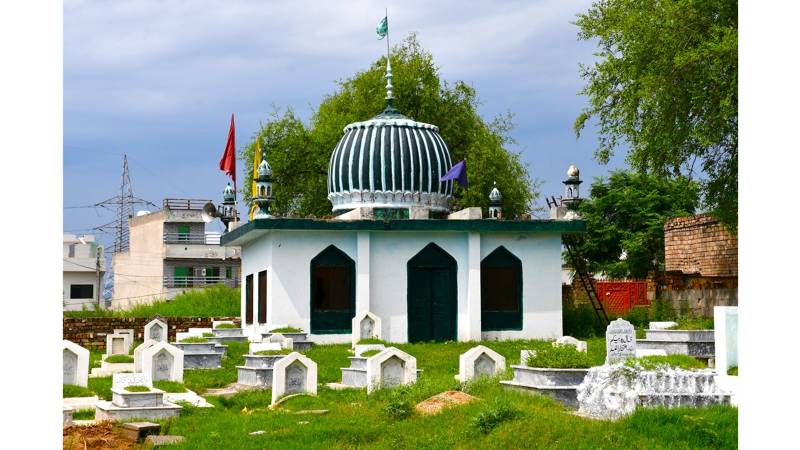
While researching the Qadiri Naushahi saints of Pothohar for my forthcoming book, I came across several lesser-known shrines, particularly in Islamabad, whose spiritual genealogies are difficult to trace. Despite these challenges, my exploration has revealed a rich yet under-documented layer of Naushahi presence in the region. I have already published several articles on the Qadiri Naushahi saints of the Rawalpindi district and the Islamabad Capital Territory, and these new findings further deepen the narrative of Pothohar's spiritual heritage.
In 2023, I learned about a shrine to a Naushahi mystic in Sud Gangal village during an interview with Muhammad Hanif Hanfi, a famous Pothohari Punjabi poet. He was unaware of the saint's name but mentioned that there was a shrine dedicated to a Naushahi mystic. After our discussion, I visited Sud Gangal village and discovered that the shrine belonged to Sain Mian Bahauddin Naushahi. I had previously read books on Naushahi saints but did not find his name there, suggesting that several Naushahi mystics have escaped the attention of scholars.
Through my anthropological lens, I uncovered hidden, often overlooked shrines in Pothohar. Through my research, I strive to bring these neglected cultural spaces into focus, revealing the deeper stories they tell about the region's society, heritage, and identity.
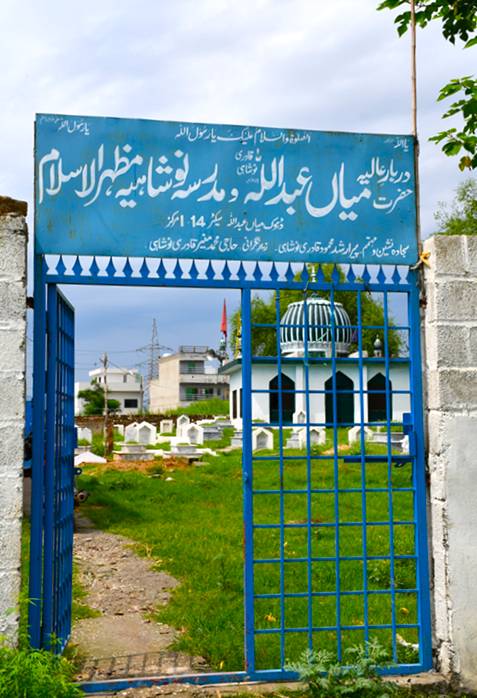
In Sud Gangal village, approximately 3 km from Rawat town and accessible via the Rawat-Kallar Syedan Road, I conducted interviews with several individuals to investigate the historical context surrounding Sain Mian Bahauddin Naushahi. My primary inquiry focused on identifying the spiritual lineage of Sain Bahauddin Naushahi. Through discussions with Sufi Pir Munir of Sud Gangal, I discovered that Sain Mian Bahauddin's descendants reside in Dhoke Mian Abdullah. A week later, I visited Dhoke Mian Abdullah, located in the I-14 sector of Islamabad, where I met Pir Muhammad Arshad Mehmood, the Sajjada Nashin of the shrine of Mian Abdullah Naushahi.
Mian Abdullah Qadiri Naushahi was the son of Sain Mian Bahauddin Qadiri Naushahi. I had a conversation with Pir Muhammad Arsahd Mahmood Qadiri Naushahi regarding the history of Sain Mian Bahauddin and his spiritual genealogy. He could not tell me about spirtual geneaology of Sain Mian Bahaudddin Naushahi. He asked me to contact Mian Zafaryab Ali Qadiri Naushahi, the sajjada Nashin of Mian Muhammad Saeed/Mian Muhammad Sahe, whose shrine is located in Jairo Ratial village, Gujar Khan. I have visited the shrine of Mian Muhammad Sahe twice. I later contacted Mian Zafaryab Ali to inquire about both Sain Mian Bahauddin and Mian Abdullah, whom he claims were not deputies or disciples of Mian Muhammad.
Today, Dhoke Mian Abdullah is a living example of the Qadiriyya Naushahiyya tradition, maintaining the spiritual vitality nurtured by Mian Abdullah and his descendants
Mian Muhammad Sahee/Saeed was a deputy (khalifa) of Syed Mir Kalan Badshah Qadiri Naushahi, whose shrine is located at Rokhia Sharif in Gujar Khan. Syed Mir Kalan Badshah Qadiri Naushahi was the deputy of Hafiz Qaimuddin Barqandaz Qadiri Naushahi (d 1765), who was himself a deputy of Pir Muhammad Sachiar Qadiri Naushahi (d 1707). Pir Muhammad Sachiar Qadiri Naushahi was a deputy of Haji Muhammad Naushah Ganj Bakhsh (d 1654), the founder of Naushahiyya Silsila.
On the instructions of his spiritual master, Hafiz Qaimuddin Barqandaz Qadiri Naushahi, Syed Mir Kalan Badshah Qadiri Naushahi spread the Qadiriyya Naushahiyya Silsila in the Gujar Khan tehsil. Muhammad Hanif Hanfi (1999:294) states in "Ruh Da Rishta" that Syed Mir Kalan Badshah Qadiri Naushahi had five prominent deputies (Khulfa), Mian Muhammad Saeed (Sahe), Syeda Mai Nawab Sahib Qadiri Naushahi, Mian Khair Muhammad Qadiri Naushahi (d 1783-84), Shaikh Muhammad Ji Qadiri Naushahi (d 1759), and Mian Muhammad Azeem Qadiri Naushahi.
Mian Muhammad Sahe was born in the town of Gujar Khan. He belonged to the Chauhan Rajput caste. He received initiation into the Qadiriyya Naushahiyya Silsila from Syed Mir Kalan Badshah Qadiri Naushahi. Following his initiation, he went to Jairo Ratial village, as directed by his spiritual mentor, to disseminate the teachings of the Qadiriyya Naushahiyya Silsila. Jairo Ratial became a thriving centre of the Qadiriyya-Naushahiyya Silsila during the time of Mian Muhammad Sahe Qadiri Naushahi. Syed Sharif Ahmad Sharafat Naushahi (1971:151) states in Sharif ul Tawarikh” Vol . 3, No. 4 that Syed Hyder Shah was a disciple of Mian Muhammad Saeed (he has written his name as Mian Muhammad Saeed) Qadiri Naushahi, who played a significant role in disseminating the teachings of his spiritual mentor. However, Mian Zafaryab Ali Qadiri Naushahi disputes this claim, rejecting it outright. Mian Zafaryab Ali Qadiri Naushahi, whom I interviewed, argues that Mian Muhammad Sahe did not initiate anyone into the Qadiriyya Naushahiyya Silsila, meaning that he did not grant bayat (the formal pledge of allegiance) to anyone.
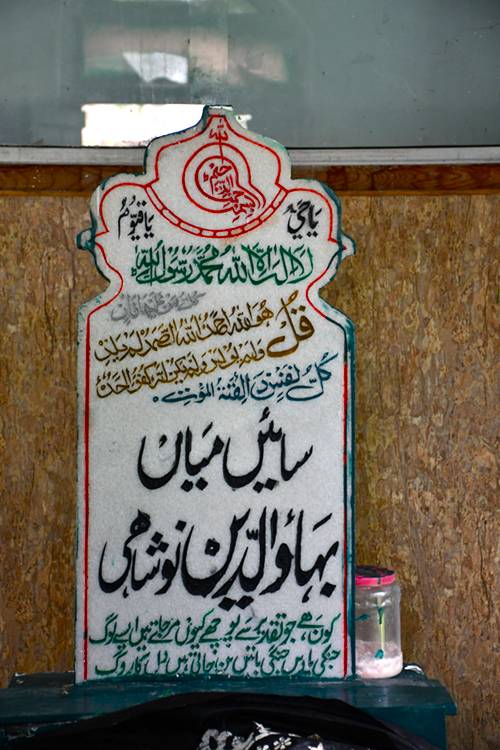
From the discussions with Pir Muhammad Arshad Mahmood Qadiri, Naushahi seems that Sain Bahauddin and Mian Abdullah Qadiri were affiliated with the shrine of Mian Muhammad sahe of Jairo Ratial. It is unclear who the spiritual masters of Sain Mian Bahauddin and Mian Abdullah were. Based on several years of fieldwork in Pothohar, I have developed a thorough understanding of the shrine culture in this region. Some disciples were formally initiated by their spiritual masters, while others primarily served them without initiation. Even those who served but were not initiated identified themselves with a Sufi affiliation. Both father and son were likely connected to the Darbar of Mian Muhammad Sahe Qadiri Naushahi.
According to Pir Muhammad Arshad Mahmood, the Sajjada Nashin of the Dargah of Mian Abdullah, both Sain Mian Bahauddin and his son Mian Abdullah were residents of Misrial in Rawalpindi. Sain Mian Bahauddin had many followers in Misrial and other villages in Rawalpindi. His followers took him to Sud Gangal, where he spent most of his time.
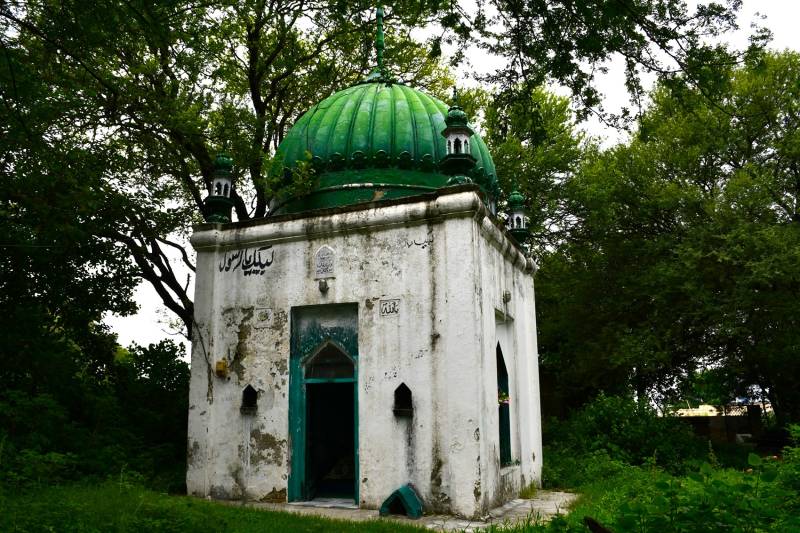
There is a beautiful tomb built over the grave of Sain Mian Bahauddin. In the graveyard of Sain Mian Bahauddin Naushahi lies the grave of Sain Said Muhammad, the son of Sain Fateh Muhammad. Sain Said Muhammad, also known as Sain Saidu, took bayat (an oath of allegiance to a Sufi master) from Mian Muhammad Ghani Qadiri Naushahi. Mian Muhammad Ghani Qadiri Naushahi was the son of Mian Mehboob Alam, the first sajjada nashin of Mian Muhammad Sahe Darbar. After the death of Mian Mehboob Alam, his son, Mian Muhammad Ghani, became the sajjada nashin of the darbar of Mian Muhammad Sahe.
Sain Syed Said Shah was known for his piety. He passed away in 1964 and was buried near the tomb of Sain Mian Bahauddin. Next to his grave lies that of his son, Sain Reham Ali, who died in 1980. The descendants of Sain Syed Said Shah currently reside in Moza Aban.
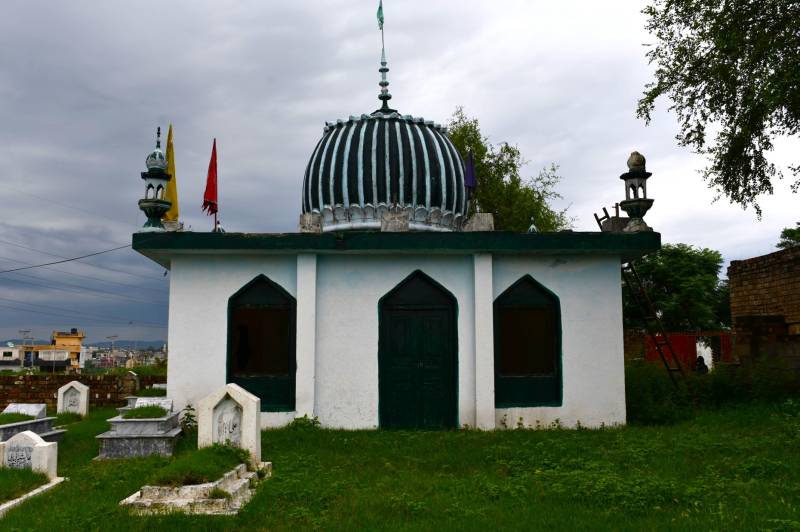
After the death of Sain Mian Bahauddin, his son Mian Abdullah continued his father's legacy. Known for his piety, Mian Abdullah devoted his life to preaching the Qadiriyya-Naushahiyya silsila in the village that eventually came to be named Dhoke Mian Abdullah. He passed away in 1910 and was buried in Dhoke Mian Abdullah, which is now located in I-14 near Haji Camp in Islamabad. A tomb has been constructed over his grave. In addition to his grave, there are three other graves nearby, including those of his son, Haji Mian Sultan, his mother, Zainab Bibi, and his wife, Amina Bibi. Mian Abdullah had four sons: Mian Noor Hasan, Haji Mian Sultan, Mian Bostan, and Mian Muhammad Hasan.
Sain Mian Bahauddin and his son, Mian Abdullah, played a pivotal role in spreading the Qadiriyya Naushahiyya silsila, nurturing a spiritual tradition that continued through Mian Abdullah's descendants. Today, Dhoke Mian Abdullah stands as a vibrant Naushahi center in Islamabad.