

In a prior column, I expressed my views on whether America had entered a stage of decline. I also shared what I learned from talking to a dozen friends who have worked in a variety of American industries. The overwhelming view in this group was that the US was in decline. The only question was how fast it will decline and by when it will cease to be a major power.
In this column, I share the views of several experts on the topic. I first turned to review what Sir John Glubb wrote in 1976, in an essay entitled “The Fate of Empires.” Glubb, who retired as a lieutenant general of the British Army and served as an adviser to the King of Jordan, presents evidence drawn from the past 3,000 years which indicates that, on average, empires last around 250 years. That is an eerie coincidence with the upcoming 250th celebration of American independence on the 4th of July. He identifies several factors that precipitate a decline:
- Cultural Decay: A shift from public service to personal gain, celebrity worship, and a loss of belief in shared ideals.
- Economic Strain: Massive federal debt and an obsession with wealth and luxury.
- Internal Division: Increased political polarisation and the rise of a "captious" (fault-finding) citizenship.
- Foreign Challenges: Emergence of rivals (e.g., China) challenging American global leadership.
Commenting specifically on the US, he noted that the US arose suddenly as a new nation, and its period of pioneering was spent in the conquest of a vast continent, not of an ancient empire. Yet the subsequent life history of the United States has followed the standard pattern: the periods of commerce, of affluence, of intellectualism, and of decadence.
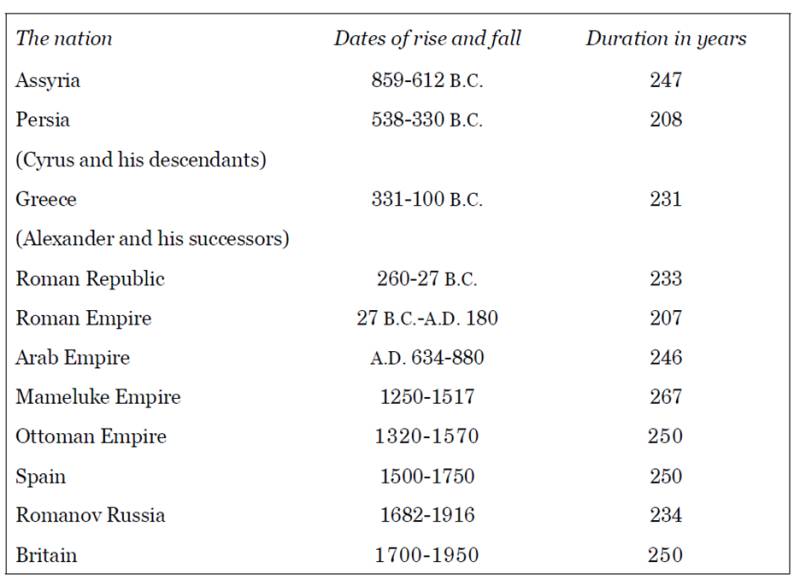
He tabulated the lives of many empires, as shown in the table below, and concluded that the average lifespan was 250 years. It’s worth noting that the Great Mughals ruled India from 1526 to 1707, or 181 years.
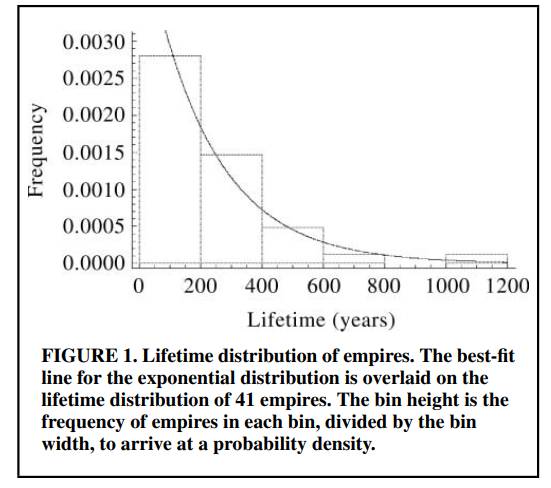
These findings were corroborated by Samuel Arbesman in 2011, when he published a very interesting graph. He assembled a database on the duration of empires across the world going back 3,000 years, which is as far back as written history allows one to go. He found that the average age of empires was centred around 250 years.
Then I turned to what four leading academics in the US have said on the topic. These include Professor Paul Kennedy, a historian at Yale University; Paul Krugman, an economist at New York University; John Mearsheimer, a political scientist at the University of Chicago; and Jeffrey Sachs, an economist at Columbia University.
Glubb’s viewpoint seemed to jibe with Paul Kennedy’s view that America’s global military commitments, such as the wars in Vietnam, Afghanistan, and Iraq, were outpacing it economic capacity. He called this phenomenon “imperial overstretch.” He posited that global power was shifting to other nations such as China, and the US was in the process of transitioning from being the world’s only superpower into becoming one of many major powers.
John Mearsheimer argues similarly that American power is experiencing a significant, relative decline as the world moves from a unipolar moment to a multipolar system, accelerated by dysfunctional foreign policies. While China and Russia rise, Mearsheimer believes the US faces internal decay and has lost its “King of the Hill” status. He blames the US for engaging in constant, unnecessary wars that have not only weakened the US economically, but also undermined its democracy at home.
The United States believes itself to be the 'indispensable nation' - Ibn Khaldūn would note, gently but firmly, that every empire in its period of decline has said something very like this
According to Jeffrey Sachs, American civilisation is experiencing a decline as it pursues a misguided strategy of maintaining global hegemony in a multipolar world. Sachs argues that this pursuit is destabilising, causing internal turmoil, and leading to the breakdown of US institutions. In his view, the current administration is ineffective and “out of control.” He identified three major factors that were leading to decline:
- Destabilising Force: Sachs describes the US as a “destabilising nation” that acts unilaterally, disregarding international law, and hindering diplomacy, particularly through actions like NATO expansion and economic coercion.
- Failed Hegemony: He believes the US relies on an outdated belief in its own pre-eminence, refusing to accept a multipolar world, which is resulting in a “losing battle” and failing to secure lasting peace.
- Domestic and Global Crisis: Sachs warns that “gangsters” within the US government are creating a “complete breakdown” of internal and foreign policy, risking global economic collapse, such as in the energy sector.
Paul Krugman similarly argues that American global influence is in decline, characterised by a loss of soft power, erosion of democratic norms, and decreased economic dominance. He cites rising inequality, political corruption, and ideological hostility to science as key factors, while noting a shift away from traditional alliances. He puts forward several aspects of decline:
- Loss of Global Standing: The US is no longer the dominant economic and military power, partly due to the rise of China and damaged trust in American reliability.
- A Crumbling Political Structure: American democracy is threatened by a right-wing alliance, which he describes as corrupt and, at times, compared to the former USSR.
- Social and Economic Factors: A “second Gilded Age” has descended on the US with high inequality and warned of a “rise in unnecessary deaths” due to attacks on health and scientific institutions.
- Allies: Canada has moved closer to the EU, suggesting a decline in America's international standing.
Finally, I turned to the views of Dr Hatem Bazian, a lecturer in ethnic studies at the University of California, Berkeley. In a recent essay, he draws on the work of Ibn Khaldun. Dr Bazian writes: “There is something almost eerie about reading the Muqaddimah today, which is on my desk that I turn to regularly. Written in the fourteenth century by the North African polymath ʿAbd al-Raḥmān ibn Khaldūn, it reads less like a medieval historical treatise and more like a diagnostic report filed in advance on the empires of our own time.”
Here is a quote:
“The United States believes itself to be, in the words repeated by every American president in living memory, the “indispensable nation,” the necessary guarantor of world order, the final defender of civilization. Ibn Khaldūn would note, gently but firmly, that every empire in its period of decline has said something very like this. That the Romans believed it. That the Abbasids believed it. That the British believed it. Self-belief of this kind is not a symptom of strength. In the Khaldūnian model, it is a symptom of the particular blindness that accompanies the third and fourth stage of civilizational decline, when the ruling class has become so accustomed to dominance that it cannot perceive, let alone prepare for, its own approaching limits.”
The short answer, based on expert opinion, is that no great power is immune from decline.
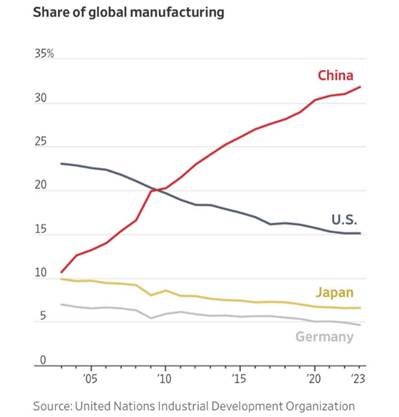
During the past two decades, the US has begun showing many signs of decline in the cultural, economic, and political space. It has been gradually losing market share to China on many fronts, including industrial production.
Can the decline be reversed? Or is it inexorable? The answer, based on the opinion of the academic experts cited above, revolves around how the US makes the “guns vs butter” trade-off. It has many problems to deal with at home: cultural harmony, decaying infrastructure, homelessness, poverty, disease, and stalled economic growth, in addition to political stability and ensuring the rule of law. It also must mend relations with its allies.
That's a tall order! Will the US pull it off? It will depend on the astuteness of its leadership, and a bit on luck. Only time will tell.