

“Without freedom of speech, any nation would remain ‘stunted’ or wither ‘like a rose bush that is planted in a place where there is neither sunshine nor air”
(Quaid-e-Azam Muhammad Ali Jinnah)
In ancient times, monarchs wielded absolute power, employing kangaroo courts to silence dissenting voices. Those who dared challenge palace policies faced public lashings or termination, instilling fear among subjects. To legitimise their rule, monarchs relied on courtiers, paid poets, and state machinery to craft narratives of bravery, loyalty, honesty, and integrity, weaving these tales into the public psyche. This ideological control allowed kings to maintain power and suppress opposition.
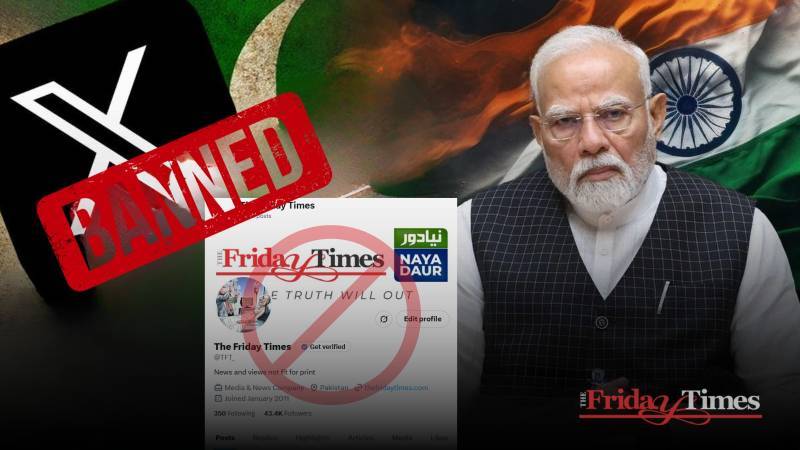
In the digital age, the methods have changed, but the Machiavellian politics remain. Big Tech platforms like Google, Microsoft, and social media sites have become powerful tools for ruling elites to shape narratives and quell dissent. The closure of accounts belonging to individuals and media channels who challenge official narratives has become a new norm. This phenomenon is particularly evident in the case of India's recent actions, following the failure of Operation Sindoor.
According to a news item published in Arab News titled "India tells X to block over 8,000 accounts mainly Pakistani," India has ordered X to block more than 8,000 accounts, the platform said, adding that it was reluctantly complying with what it described as government-imposed "censorship." The order, which X said includes demands to block international news organisations and other prominent users, comes a day after Meta banned a prominent Muslim news page on Instagram in India at New Delhi's request. "X has received executive orders from the Indian government requiring X to block over 8,000 accounts in India, subject to potential penalties including significant fines and imprisonment of the company's local employees," the site's global government affairs team said in a statement. It added that in most cases, the government had not specified which posts from the accounts violated Indian laws, and in many others, it provided no evidence or justification for the blocks.
The Elon Musk-owned platform said it disagreed with the demands but it had begun the process to withhold the specified accounts in India. "Blocking entire accounts is not only unnecessary, it amounts to censorship of existing and future content, and is contrary to the fundamental right of free speech," the statement said. X said it could not make the Indian executive orders public due to legal restrictions, but it encouraged the impacted users to seek "appropriate relief from the courts."
A sweeping crackdown on multiple digital forums, the axe has reportedly fallen on X and Instagram accounts used by political bigwigs and journalists like Raza Rumi, Najam Sethi, Hamid Mir, and Khurram Hussain - known for their independent analysis on national and international affairs, including conflicts. And media houses, to name a few, The Friday Times (TFT), Geo News, and Dawn, along with various YouTube channels, remain blocked.
This digital crackdown on individuals from media channels, the entertainment industry, and cricket celebrities demonstrates a siege mentality. However, it's unfortunate that digital platform owners succumb to political pressure and impose blanket bans on users without receiving credible evidence of crossing the platforms' red lines, if any. Directing users to approach the courts of law for redressal of the issue in question regarding the lifting of imposed bans is nothing but digital callousness.
Digital platforms should have built-in systems to filter out unverified and derogatory content. Moreover, these forums should employ legal experts who can discern wheat from chaff when approached by various state authorities for account closures or removal of toxic pages targeting individuals, states, or state institutions.
With changing times, digital platforms are being leveraged to amplify political agendas or suppress dissenting opinions by those in the highest echelons of power.
Pakistan has decided to send a dossier to powerful world players. The dossier will be presented to foreign capitals by a high-level delegation led by former Foreign Minister Bilawal Bhutto Zardari to expose Indian propaganda and subsequently urge world leaders to hold India accountable for its recent military aggression and targeting of civilian populations.
Reportedly, Microsoft admitted in a statement that its tools were used by Israeli forces during their genocidal campaign in Gaza. However, it also admitted that its services are "general-purpose tools," not intended for harm, and reaffirmed that it has for long defended the cybersecurity of Israel. The tech giant is under scrutiny for its role in Israel's war in Gaza, following reports that its cloud and AI technologies have supported Israeli forces. The tech giant in question denied charges. However, investigations and leaked documents revealed that Microsoft's Azure cloud platform and OpenAI's GPT-4 have been used by Israeli forces, including elite intelligence units such as Unit 8200. Between June 2023 and April 2024, the Israeli army's use of Microsoft's cloud services reportedly surged by over 155%, peaking ahead of the May 2024 Rafah offensive. These tools enabled everything from logistics to real-time battlefield data analysis.
Thus, it can safely be inferred that the digital landscape has enabled governments to exert control over public discourse, suppressing opposition and independent thought. The line between governance and authoritarianism blurs as those in power leverage technology to maintain their grip on power. The global village created by digital connectivity has become a double-edged sword, facilitating both the free flow of information and the suppression of dissenting voices.
One of the many murky methods employed by those in power corridors is that people are being arrested on alleged offenses such as cross-border ties, espionage, and anti-state activities. However, various states and state institutions have historically used digital platforms for politically-motivated moves, manipulated electoral outcomes, and clipped the ideological wings of wider sections of society.
It is pertinent to mention my piece of writing in TFT-ND titled "Digital Colonialism: How Our Data Is Being Misused by Big Tech" in which I wrote: "With changing times, however, colonialism has changed its means and methods to be applied as per the demand of the new colonial edifice. Digital colonialism is looming large over countries as well as multitudes of populations all over the globe. It is undermining our privacy, collecting and selling data, snatching money, suppressing freedoms, and it is a tool to be used for politically-motivated moves and ideological control."
For its part, Pakistan officially lifted the ban on social media platform X (formerly Twitter), as part of its strategy to actively participate in the 'narrative war'
"The US Election 2016 presents the precedent set: Trump's ascendancy to the presidency was the result of psychological warfare initiated by digital tools. Donald Trump, after having hired Cambridge Analytica, launched his candidacy's social media campaign on the line given by CA in light of feedback it gathered from Facebook. Thus, it was used for ideological control, convincing the population who they should consider voting for."
"In Myanmar, Facebook rolled out fake pages of celebrities and political personalities, which were said to be in thousands, forwarding contemptuous content against the Rohingya population facing genocide. After receiving a robust rebuttal from across sections of society from all over the world, Facebook took longer than imagined to pull down toxic pages directed against a particular race. Facebook thus became a mouthpiece of the Myanmar military and politically dominant race in advancing their genocidal content that had caused an influx of about 7.5 million to neighboring Bangladesh in 2018."
Pakistan, in the wake of Indian aggression, officially lifted the ban on social media platform X (formerly Twitter), as part of its strategy to actively participate in the "narrative war" amid rising tensions with India. The ban was initiated around the time of the February 2024 general elections. The Ministry of Interior cited national security concerns and a desire to maintain public order as reasons for the restriction. A small chunk of X users used this social media platform through virtual private networks (VPNs).
The Prevention of Electronic Crimes Act (PECA) Ordinance, particularly the 2025 amendments, is seen as having a broad scope and potential for misuse, negatively impacting the digital rights of Pakistani citizens, including journalists and individuals who use online platforms. These amendments have raised concerns about restricting online freedoms, suppressing dissent, and limiting free speech.
Denouncing dissenting voices and suppressing them isn't limited to Asian countries; it's a trend seen in the broader global political landscape.
The Guardian's columnist Chris McGreal in an op-ed titled "Pro-Palestine views face suppression in US and Israel-Hamas War" writes that "Widespread attempts to suppress pro-Palestinian views in the US after the Hamas attack on Israel have forced the cancellation of major conferences, prompted demands for the dismissal of workers who express support for Palestinians and led to intimidation campaigns against Arab American voices critical of Israeli policies."
Josephine Solanki in the op-ed in Al Jazeera titled "A disturbing pattern of repression is emerging in Europe" convincingly concluded that authoritarianism is creeping into Europe under the guise of cracking down on pro-Palestinian activism.
As we navigate this complex digital landscape, it's essential to recognise the evolving nature of authoritarianism and its implications for democracy, free speech, and intellectual freedom. The struggle for control over narratives and the silencing of opposition voices raises critical questions about the future of governance, accountability, and the role of technology in shaping our societies.
Any political framework should protect citizens' digital rights while preventing digital platforms from being exploited to advance narrow national narratives under the guise of national interests. This balance is crucial to ensure that governments don't suppress dissenting voices or manipulate online discourse, while also addressing legitimate national security concerns.
In practice, this means implementing policies that:
- Safeguard Digital Rights: Protect citizens' freedom of expression, privacy, and access to information online.
- Regulate Digital Platforms: Establish clear guidelines for content moderation, ensuring platforms don't spread misinformation, hate speech, or propaganda that could harm national interests or public safety.
- Prevent Abuse of Power: Ensure governments don't use digital surveillance or censorship to suppress opposition voices or stifle critical reporting.
By striking this balance, governments can promote a healthy digital ecosystem that supports democratic values, national security, and human rights. India's drift to digital dictatorship needs to be addressed intelligently. The truly gifted see trouble before it arrives. In a recent NayaDaur talk show, when Raza Rumi drew the attention of defense analyst Dr Ayesha Siddiqa to the fact that Indian people have started questioning the credibility of Indian media, Dr Siddiqa commented that irresponsible reporting by Indian media has not only dented Narendra Modi's government but also placed a political burden on it, which is detrimental in terms of building up pressure for any future military adventure. The global political spectrum, especially India more than ever, needs visionary political leadership that avoids shooting itself in the foot.
"Intellectuals solve problems, geniuses prevent them," as Albert Einstein said. Digital dictatorship poses a significant threat to democratic principles. If left unchecked, it can unleash multiple crises like social unrest, economic instability, and human rights abuses, etc. To mitigate these risks, it is essential to promote transparency, accountability, and civic engagement in the digital sphere.