

Shakespeare in his play Hamlet wrote “To be or not to be”. Likewise, Pakistan and Pakistanis are facing a similar predicament, as to whether they want to end the stain of 25.3 million out-of-school children who have been condemned to live a life of deprivation, inequity, and poverty. The State's and society's inability to provide universal quality education has taken away the out-of-school-children's dreams, hopes, and happiness. These out-of-school children could have been Pakistan's future Abdus Salam, Arfa Kareem, or Malala. But alas, the future optimism that Pakistan needs the most is lost in the shuffle.
Pakistan has come to a crossroads, where it needs to reset its future trajectory by investing heavily in sectors that generate human capital. This could be possible only if immediate priorities are given to sectors like education, and health. Currently, Pakistan spends 1.97 % and 2.1 % of its GDP on education and health which is the lowest in the region. No wonder Pakistan is ranked 164 and is performing lowest in all key Human Development Indicators—Thence, calling for an education emergency. Moreover, the quality of education in Public schools is abysmal, as the learning poverty rate is close to 77%.
However, this gap can be overcome by embracing innovative strategies that focus more on students' activity in class and their all-around growth. Numerous methods of teaching, like the active teaching method (ATM) or an interaction-based teaching method, in which the responsibility of learning is placed on the students where the role of the teacher appears as a facilitator who guides and paves the way for teaching and learning for students by advancing role-playing, group discussion and teaching classmates exercises.
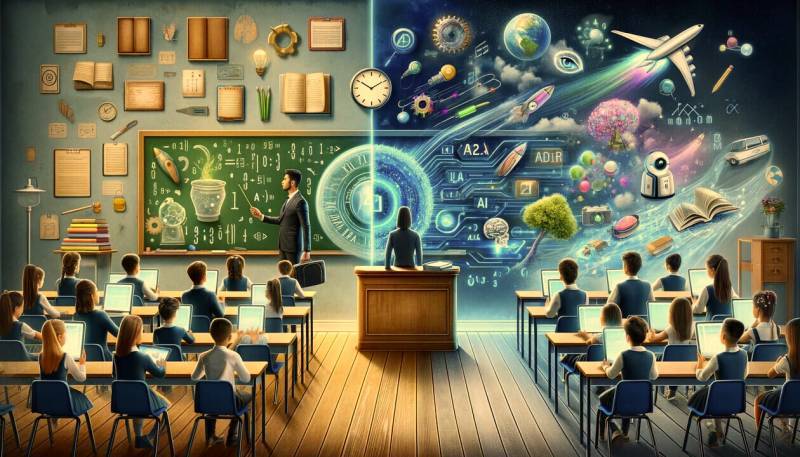
Similarly, incorporating Artificial General Intelligence (AGI) powered tutors alongside advanced large language models (LLM) can enhance students' understanding of complex concepts by deepening and making their learning journey more exciting and effective. Adopting such technologies will surely open new doors for increasing outreach, reducing the cost per student, and enhancing more student-specific learning opportunities.
The ban on YouTube from 2012 to 2016 serves as a stark example—rather than fostering a safe and regulated digital learning space, the ban cut off access to an immense reservoir of knowledge, skill development, and educational resources
However, none of this is achievable if the internet is slowed by dispensation on the pretext of digital security, where internet penetration stood merely at 45.7 percent. If such an environment of curtailment over adaptation thrives Pakistan will risk falling further behind in education and technological advancement. The ban on YouTube from 2012 to 2016 serves as a stark example—rather than fostering a safe and regulated digital learning space, the ban cut off access to an immense reservoir of knowledge, skill development, and educational resources. The consequences were severe as Pakistan fell behind in digital literacy at a time when other nations were leveraging online platforms for innovation and growth. Hence, policies must be adopted that regard and incentivise e-learning education.
Education in the 21st century is increasingly digital, and discouraging AI-driven learning tools may only widen the gap between privileged students and those already struggling to access education. Pakistan already struggles with one of the highest numbers of out-of-school children. In such an environment, AI-driven education, digital classrooms, and mobile-based learning tools could serve as low-cost, scalable alternatives to traditional schooling.
Significant challenges are present for regions like Gilgit Baltistan where internet speed moves at snail speed. As per the Gilgit Baltistan Child Labour Survey 2018-19, there are an estimated 50,000 child laborers out of nine children, one is involved in some form of labor. I have a personal experience with it because many of my age relatives had to discontinue their studies because of poverty. Though they were exceptional, possessing entrapped dreams and hidden potential, they were wasted due to a lack of opportunity. Just imagine if they had the resources and state-sponsored opportunities they could have made a transformational impact on society and state well-being. I was privileged and lucky to study in the best schools and universities, but for the majority, it remains a pipe dream.
However, given the strides being made under the technology, it can be bridged by establishing AI-integrated learning environments and remote education, which can lead to skill-based digital economies. Ideas like setting up AI-powered community learning hubs by NGOs and governments can collaborate to set up AI-assisted centers in villages or urban slums to ensure access to quality education. Likewise, setting up AI-powered WhatsApp bots or IVR (Interactive Voice Response) systems can guide children through learning in their native languages. To make it successful, the government can partner with telecom companies for subsidised access, as seen in Bangladesh and Kenya, and can make this model sustainable through toll-free calls or missed-call callbacks, eliminating the need for smartphones or high-speed internet.
There can be many more solutions, and readers may feel that such initiatives are unrealistic or impractical but at a time when education will be a decisive factor in determining the destinies of nations, Pakistan cannot afford to stand on the sidelines. While the world advances through emerging technologies in education? It must create a conducive environment for innovation, embrace digital learning, and harness new technologies to ensure that no child is left behind in the education revolution.