

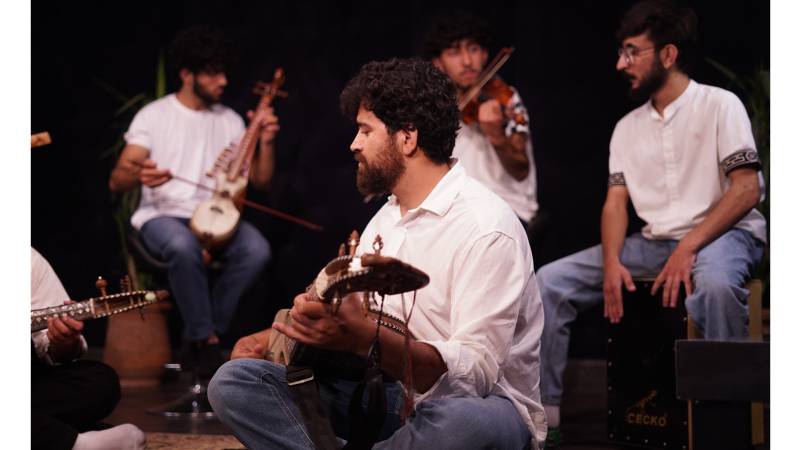
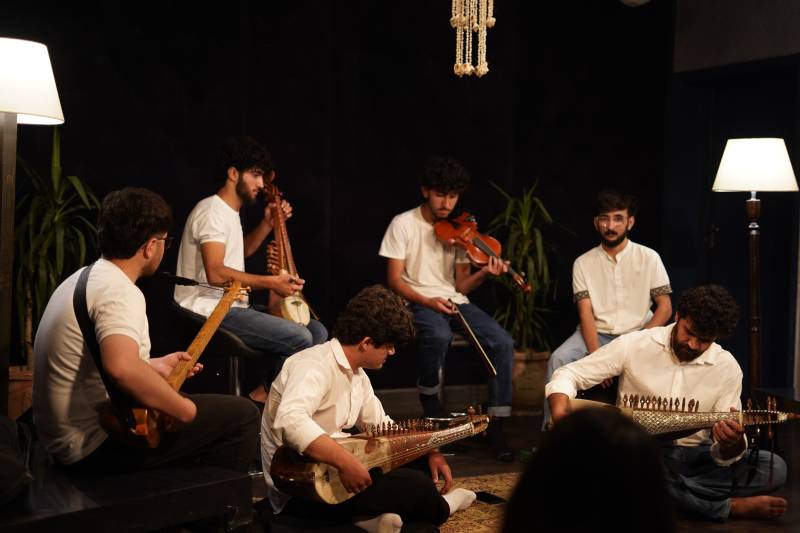
On a quiet Wednesday evening, OLOMOPOLO Media welcomed patrons of the cultural space with the sounds of Hunza in the heart of Lahore. Celebrating mountain music at the Echoes from the Fort, ancient melodies met many modern souls, creating an atmosphere of tranquillity amid the blazing Lahori summer heat. In front of a crowd of music lovers sat six young men holding traditional instruments from the mountainous north, performing acoustically in the cozy setting.
Musicians from the Lief Larsen Music Centre (LLMC) in Hunza shared their ethereal music, which included both traditional and modern classics in the ensemble. They guided the audience through a brief history of music in Hunza and introduced each instrument, tracing its origins. A fascinating geological and genealogical story depicted how instruments in Hunza came to be. They also shared each instrument’s historical counterpart that influenced its current and contemporary design. Traditional instruments like the Xinginee, Chitrali Sitar, and Rubab added a unique emotional element to the pieces. The Dadang (traditional drum) was included for the final ensemble, closing the night in a celebratory manner. The group began the event by performing the sublime tunes native to Gilgit-Baltistan that emanated a spiritual aura. The band’s lead musician and trainer, Mujeeb Ruzik, explained that the music of Gilgit-Baltistan has Central Asian influences. He added that the music centre has also started training students in South Asian classical and semi-classical music. “We arrange residencies with focused training for students especially interested in classical music,” he shared.
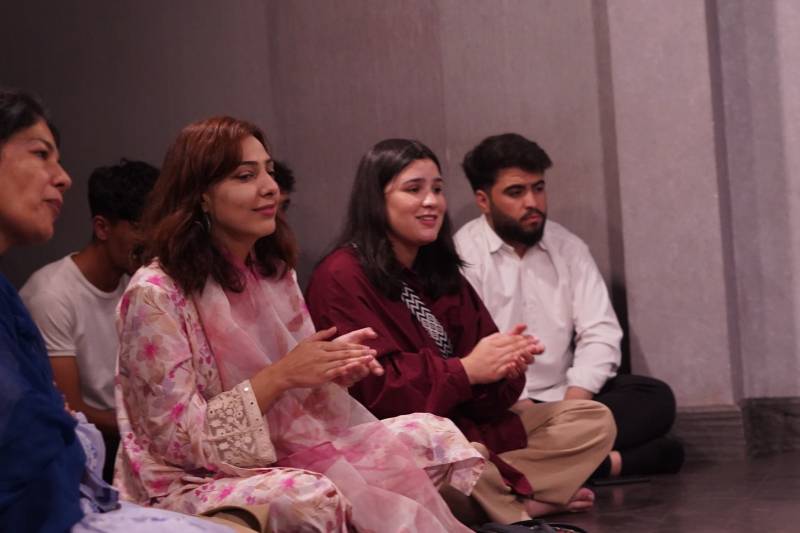
The mesmerised audience clapped with the group during a festive piece called "Bazm," an immersive musical tradition in Gilgit-Baltistan that involves a gathering of friends or family singing and playing instruments together
The LLMC was established in Hunza by the Aga Khan Cultural Service – Pakistan in collaboration with the Aga Khan Music Program and the Royal Norwegian Embassy. It offers training in the different genres of mountain music to the musicians of Gilgit-Baltistan and Chitral. Some of its graduates have continued their musical education at Lahore’s National College of Arts (NCA).
The audience was also given a chance to make requests, while the musicians who came straight from the Royal Garden of Altit Fort also presented a rendition of popular songs, including “He’s the Pirate” from the Pirates of the Caribbean soundtrack, “Bella Ciao” an Italian folk song, and Pakistani music like “Par Channa De” a Punjabi folk song and Pasoori which topped charts in 2022.
Shayaan, who moved from Hunza to Lahore to pursue a degree in artificial intelligence, expressed his joy at experiencing the culture of his land in Lahore. “It felt good to watch a live performance of the music native to my area in Lahore. Events representing Hunza’s culture are rare in this city, and this special evening made me feel connected to my culture,” he stated.
The event titled “Echoes from the Fort, a Celebration of Mountain Music” was made possible by the collaboration between OLOMOPOLO Media and Aga Khan Cultural Service – Pakistan. The idea was to bring traditional music from Hunza to Lahore and celebrate the richness of the country’s diverse music traditions.
The mesmerised audience clapped with the group during a festive piece called "Bazm," an immersive musical tradition in Gilgit-Baltistan that involves a gathering of friends or family singing and playing instruments together.
Rabbania Shirjeel, a multidisciplinary artist from Lahore, noted the cultural significance of such performances. “Events like these are vital for preserving and promoting traditional music and oral history, and they are also a celebration of cultural heritage,” she said. “Such intimate music gatherings are great exposure for the performers, while introducing audiences to powerful cultural expressions beyond the mainstream.”