

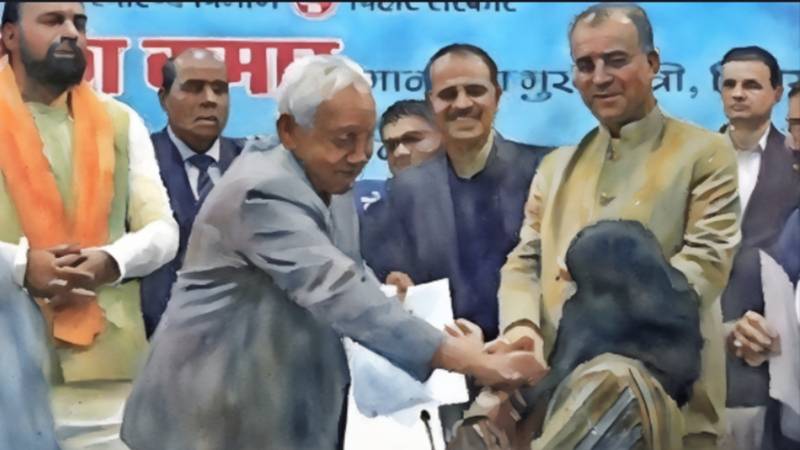
India often presents itself to the world as the “largest democracy”, a country that claims to uphold constitutional values, religious freedom, and women’s rights. Its leaders speak proudly on global forums about pluralism, tolerance, and democratic traditions. However, the reality on the ground often tells a very different story. A recent incident involving Bihar Chief Minister Nitish Kumar has once again exposed the troubling gap between India’s democratic claims and its treatment of minorities, particularly Muslim women.
At a government event in Patna, where appointment letters were being distributed to newly recruited AYUSH doctors, a Muslim woman doctor, Nusrat Parveen, stepped on stage to receive her letter. She was wearing a niqab, a personal and religious choice made by many Muslim women. What happened next shocked viewers across India, Pakistan, and beyond. Nitish Kumar gestured for her to remove her niqab. Before she could respond or give consent he reached out and pulled it himself, exposing her face in front of a large audience.
The moment was humiliating. It was not an accident, nor a misunderstanding. It was a deliberate act by a powerful man against a woman standing before him in a formal, official setting. Even more disturbing was the reaction on stage: laughter, awkward smiles, and silence. A few officials made half-hearted attempts to stop him, but no one firmly intervened. What should have been treated as a serious violation of dignity was reduced to a joke.
This incident quickly went viral on social media, triggering outrage. People across political, religious, and national lines condemned the act. Many pointed out the obvious truth: no one, especially a man in power, has the right to touch or remove a woman’s clothing in public, regardless of personal beliefs or political position. Consent is not optional. Dignity is not negotiable.
What made matters worse was the response or lack of response from India’s top leadership. Prime Minister Narendra Modi and Home Minister Amit Shah have remained silent. Their silence is loud and telling. If such an incident had involved a woman from the majority community, or if it had taken place in a different political context, would the response have been the same? The fact that the chief minister belongs to an ally within the ruling political ecosystem explains much of this quietness.
Adding fuel to the fire was an outrageous remark by Uttar Pradesh cabinet minister Sanjay Nishad. Commenting on the incident, he laughed and said that if there was such an uproar over touching the niqab, “what would have happened if he had touched somewhere else.” The remark was openly misogynistic and deeply offensive. Instead of condemning the act, Nishad trivialised it, reducing a woman’s humiliation to a crude joke.
Perhaps the most heartbreaking outcome of this incident is that Nusrat Parveen has decided not to join government service. Despite being selected after years of hard work, she feels too humiliated to step into a system that failed to protect her dignity
Opposition leaders and women’s rights activists rightly described the comment as shameful. Complaints were filed against both Nitish Kumar and Sanjay Nishad. Yet, as is often the case in India today, accountability seems unlikely. Political power continues to shield those in authority, even when their actions clearly violate constitutional values.
Human rights organisations have also taken strong notice. The Human Rights Council of Pakistan condemned the act as “highly shameful, reprehensible, and inhumane,” calling for an immediate and transparent investigation. The council stated that this was not just an insult to one woman, but an attack on religious freedom, women’s autonomy, and human dignity. It urged international human rights bodies, including the United Nations, to take notice.
Former Indian actor Zaira Wasim demanded an unconditional apology, stating clearly that a woman’s dignity is not a prop for political theatre. Indian politicians like Priyanka Chaturvedi and Aga Syed Ruhullah Mehdi also criticised the act, with some even questioning the chief minister’s mental fitness for office. Social media users across platforms called it an abuse of power and a clear case of everyday Islamophobia.
Perhaps the most heartbreaking outcome of this incident is that Nusrat Parveen has decided not to join government service. Despite being selected after years of hard work, she feels too humiliated to step into a system that failed to protect her dignity. Her family has said they are trying to convince her otherwise, but the damage has already been done. A young Muslim woman, publicly shamed by the state’s highest authority in her province, no longer feels safe or respected enough to serve that very state.
This is not a small consequence. It sends a dangerous message to minority women across India: no matter how qualified you are, no matter how hard you work, your dignity can still be violated, and you may be expected to accept it silently.
Supporters of the ruling ideology often argue that veiling is oppressive. But even if one accepts that debate, it does not justify force or humiliation. A woman’s clothing choice whether a niqab, hijab, sari, or jeans is her own. Removing it without consent is not reform; it is harassment. It is violence disguised as authority.
Ironically, Indian cinema itself has long portrayed such acts as symbols of Islamophobia and cruelty. Films like My Name Is Khan used forced removal of a hijab to highlight post-9/11 hatred against Muslims. That a sitting chief minister failed to understand this basic sensitivity shows how normalised such behaviour has become in today’s political culture.
India’s leaders often criticise other countries, including Pakistan, on issues of democracy and minority rights. But incidents like this expose the hypocrisy. A democracy is not measured by speeches or slogans, but by how it treats its weakest and most vulnerable citizens. When a Muslim woman cannot stand on a government stage without fear of humiliation, democracy rings hollow.
The silence of Modi and Amit Shah is not neutral. It is a political choice. It signals approval, or at least indifference. It reinforces the perception that Muslims, especially Muslim women, are second-class citizens in the “new India.”
This incident is not an isolated event. It is part of a larger pattern where power, majoritarianism, and impunity intersect. What happened to Nusrat Parveen is a reminder that behind India’s global image lies a troubling reality, one where constitutional promises are selectively applied.
India may continue to present itself as a beacon of democracy. But the world is watching. And incidents like this reveal its true face one where power laughs, victims withdraw, and justice waits in silence.