


Under the aegis of the small but budding Blimp Press, Fizza Abbas and Waqas Rabbani – who writes under the pen name Thomas De Verne Hovercraft – are steadily building more than just a publishing house. They’re crafting a literary design studio where every book is not only an expression of artistic ambition, but also a physical object, hand-made with care and intention. From writing and editing to design, printing, binding and packaging, everything is done in-house. The publications by Blimp Press, reviewed below, are a testament to the power of storytelling and independent publishing.
The Lament of the Sunken Ship
In her poetry chapbook The Lament of the Sunken Ship, Fizza Abbas has taken the supposedly trivial, a childhood obsession with shipwrecks, and spun it into a chronicle of wonder, loss and almost defiance.
At its heart, The Lament of the Sunken Ship is a tribute to the Titanic-era fever that swept a whole generation, as the poet herself acknowledges in the introductory notes. While for most it was a fleeting fixation, hers endured, relegated to the backburner; never wholly extinguished. To have carried it for decades and eventually nurture it into a book is rare, not to mention commendable. The chapbook includes poems on 15 ships that were lost at sea: from RMS Carpathia and MS Estonia to the Sultana and Mary Rose, and many more.
But the chapbook is much more than a Titanic-era fixation that persisted. Abbas moves beyond the shipwrecks to honour the ship itself as metaphor and embodiment of shattered dreams and hopes. What makes the chapbook stand out is this attention to what historical accounts of shipwrecks have often omitted: not the disaster itself, but what came before it. She invokes “the trees that once stood tall and unshaken in distant forests, felled, carved, stripped and turned into hulls. Of iron, pulled from the veins of the earth, melted and bent to man’s will, transformed into beams and bolts.” We are called upon to remember the ships not how they sank, but how they once sailed.
The introductory and closing notes, as well as the prose-poem vignettes that precede each poem, in many instances end up surpassing the actual poem in lyricism and poignancy. They read like a crash course in maritime history, entertaining and enlightening for both young readers and adults. From SS Andrea Doria:
“this poem imagines that moment not as disaster but as a fated, fleeting encounter, one ship’s final surrender, not to impact, but to the seduction of the sea. Perhaps not even ships are free from Stockholm Syndrome.”
Or when introducing RMS Lusitania she says:
“This poem gives voice to Lusitania not as an innocent bystander, but as a weaponized witness. Dragged into war without her consent, and sacrificed by the very hands that should have protected her.”
Ool Jalool
The title of Abbas’s second chapbook may not ring a bell with anyone who isn’t familiar with Urdu children’s magazines or Hasina Moin’s iconic TV dramas. Ool Jalool (an Urdu phrase meaning “nonsensical” or “all over the place”) features poems that have been previously published by various online literary journals like The Stone of Madness Press, AGNG Magazine and The Verse Zine, among others.
Where in many narratives, faith arrives as a balm to anchor or redeem, here the poet’s Shia identity doesn’t shield her; rather, it marks her
The ease of accessibility and harmony of pattern running through The Lament of the Sunken Ship finds a sharp contrast here, with poems that are marked by a certain dissonance, exploring themes of trauma, mental health, identity, and emotional resilience amidst the chaos of womanhood. Simply put, if The Lament of the Sunken Ship is a glimmer, then Ool Jalool is a trigger.
There is a marked shift in tone in some poems that begin in hush, only to unravel into stark conclusions, and the reverse is also true. Whatever its order of unravelling, each poem stands on the bones of the last while carving out something new. It is a journey where sorrow and softness co-exist, sometimes all-consuming, sometimes languorously lingering.
Some poems are notable for eschewing a neat, happy-sad binary, even their ‘happy’ sentences laden with the sheer weight of existing, somewhere between self-effacement and self-awareness: “there are some traces of the fairyland/ Where you live with your candy-pink doll/ Down memory lane.”
What’s most striking, perhaps, is that in Fizza’s work, faith does not arrive as a saviour. Where in many narratives, faith arrives as a balm to anchor or redeem, here the poet’s Shia identity doesn’t shield her; rather, it marks her. This is expressed in the poem “Shias are kafir”:
“I rinsed my mouth/ With blood before uttering/ The well-knitted no each time/They pushed me aside/In a school assembly/Calling me a non-believer”
The chapbook very often ventures into the heavily experimental. For readers accustomed to more traditional poetry, it may need getting acclimatised to, but once they do, the power of certain verses is undeniable.
The Day Pakistan Ran Out of Chai …and Brewed a Revolution Instead
Waqas Rabbani writing as Thomas De Verne Hovercraft delivers a novella just over thirty pages long, but it is more effective than much larger texts in its blend (yes, tea metaphors are infectious even to reviewers) of pertinent observation, immaculate research, satire, entertainment and an unwavering hope that lingers well beyond its slim volume.
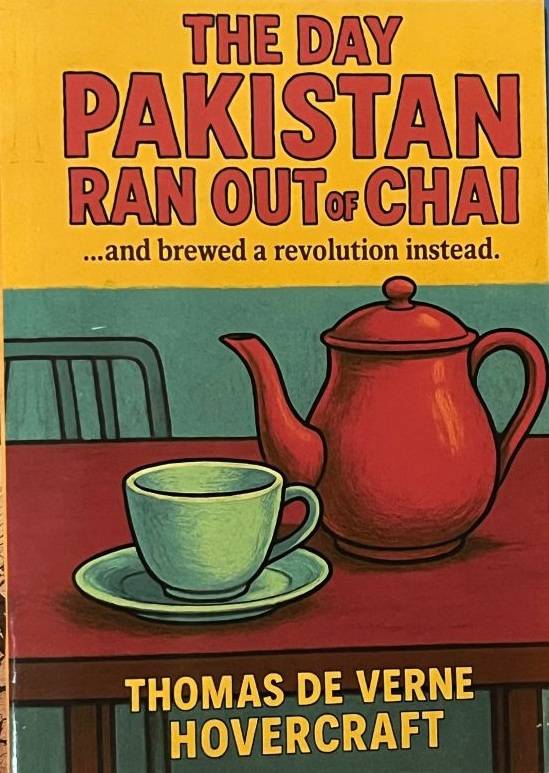
The premise is simple: an IMF restructuring deal abruptly halts tea imports, and a nation that cannot function without its daily cup of chai descends into chaos. But from this absence, something unexpected begins to brew (tea-pun entirely intended)
Through much trial and error, often with hilarious results, a new renaissance of sorts simmers until it reaches full boil (there it is again!) What begins in an hour of crisis culminates into inventiveness that reshapes the cultural landscape of the country, penned most imaginatively. Local blends developed by tea enthusiasts are delightfully named: Sindh Sunburst, Hazara Black, Balti Bloom, Multani Mint. Delightful rituals like tea tastings, annual chai festivals as well as breweries in different parts of the country and national institutes to train professional brewers and blenders are a testament to the spirit of creativity amid an unprecedented national crisis. Even a romance featuring the protagonist unfolds over his painstakingly crafted signature: Bilal’s Balcony Brews.
The novella is entertaining and informative in the tradition of infotainment docu-dramas, yet peppered with delicate turns of phrase that catch the reader off-guard. “Everywhere you looked something green was pushing through concrete. Cracks in sidewalks became seedbeds.” Or: “Tea wasn’t just an economic engine—it had become Pakistan’s new cultural spine.”
At one point a fictional finance minister declares, “Tea is a colonial hangover. Let us embrace local alternatives.” The detractors to an army of enthusiastic brewers assert, “We’re not meant to grow it. This isn’t Japan or China.” While these lines are satirical in tone, one wishes this line of thought had been explored further: that the real revolution may lie in recognising how tea is one of the most visible markers of colonial legacy. How the beverage’s heat inducing properties were never truly suited to the 48 degrees Celsius heat of our plains or, for that matter, our internal climate, partly explaining why we as a people are so intolerant and aggression prone. What if the novella became a rallying cry for reclaiming cooling traditional beverages suited to our climate and inner balance, like nimbu paani, lassi, sattu, sardai, kanji and various sherbets?
Perhaps in a sister novella, Hovercraft could take this further. He certainly has the writing chops, the temperament for immersive research and the range for it.
If the tea metaphors have over ‘steeped’ this review, the blame belongs – not entirely unfairly – to the source material, or at least how infectious it is in reimagining chai not just as a habit, but as a catalyst for change and possibility.
The Day Pakistan Ran out of Water
Set against the tense backdrop of the May 2025 standoff between India and Pakistan, The Day Pakistan Ran Out of Water by Thomas D V Hovercraft blends a dystopian scenario with urgent environmental concerns. While the threat of “water terrorism” by Modi’s government across the border may have been the immediate trigger for it, the novella dives deeper into Pakistan’s water crisis through a compelling blend of fact and fiction. It lays bare the internal neglect, outdated irrigation systems, and worsening climate realities that have led us to the very brink of a disaster of unimaginable magnitude.
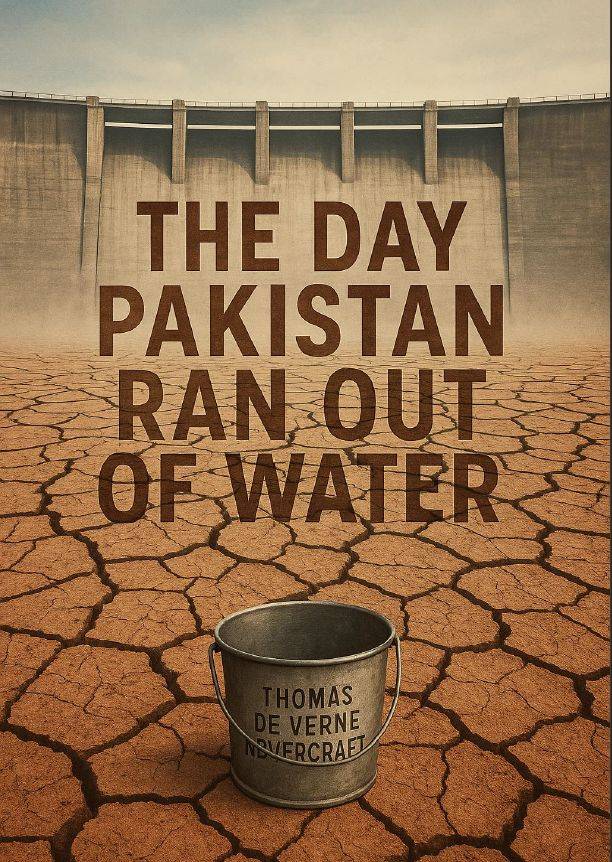
At the heart of the narrative is the fictional Pakistan Hydration Plan or PHP, a grassroots initiative aimed at combating water scarcity by garnering citizen mobilisation. Under the aegis of the PHP, innovative approaches to water scarcity are implemented like greywater recycling, rainwater harvesting, toilets with in-built handwashing mechanism and a critical re-evaluation of outdated methods such as flood irrigation, exposing how they have often done more harm than good by wasting precious resources.
Though the premise is dystopian, the realities it reflects are all too real. Pakistan is among the most climate-vulnerable countries in the world, facing depleted groundwater reserves, erratic weather patterns from glacial melt and resultant flooding and an infrastructure much too ancient and ill-equipped to respond. The novella weaves these realities into its plot, while also presenting solutions that have been successfully implemented elsewhere in the world. In doing so, it charts a path from dystopia to utopia; plausible and entirely achievable.
Despite the gravity of its themes, the story resists despair, offering hope, instead, in collective action, imagination, and innovation. In a particularly powerful shift, even religious rhetoric is reimagined. “Clerics tied the crisis not to punishment, but to responsibility. ‘God gives rain, but only to those who prepare to hold it.’” The line captures a much wished for religious overhaul where faith is used not for populism but to foster positive action.
The Day Pakistan Ran Out of Water isn’t merely a work of fiction but a call for action. It urges readers to reimagine our relationship with water before it is too late. Technically informed but never excessively dense, the writing is immensely readable (the irony of building "dams" while failing to give “damns”) and even enjoyable, provided one is able to look past the hard truths it hits you with. Not that it ever wants you to.
Today, as the country reels under unprecedented levels of rainfall and flooding, one can’t help but wonder: how many of the ideas floated in this story could help us harness the very water that so often devastates us? The novella didn’t foresee the exact scale of Monsoon 2025, but it may well offer a blueprint for surviving what is imminently headed our way.