

As I prepare for my upcoming lecture on the intersection of art and political economy, my recent visit to the Tate Modern in London provided a moment of profound reflection. Standing before Ibrahim El-Salahi’s Reborn Sounds of Childhood Dreams I (1961–65), I was struck by how this haunting masterpiece exists within the walls of a city that once stood at the heart of empire—its power built on the exploitation and cultural subjugation of the Global South.
El-Salahi’s work, painted on damouriya, a hand-woven Sudanese cotton fabric, features spectral figures intertwined with abstract, calligraphic forms. It is a visual representation of memory and displacement—of cultural identity clashing against the forces of erasure. As a political economist and scholar deeply invested in understanding how power, culture, and identity intersect, I could not help but see the painting as more than art. It is an act of reclamation—an assertion of agency in a world that often denies it.
This experience brought to mind Pakistan’s artistic legend, Sadequain. Like El-Salahi, Sadequain’s art defied categorisation. While El-Salahi merges African iconography, Islamic calligraphy, and Western abstraction, Sadequain reimagines classical Quranic calligraphy into modern, surreal forms that offer both social commentary and philosophical reflection. His elongated figures, bearing the weight of existential struggle, reflect the tensions of postcolonial identity.
A few steps away, through the works of surreal masters in the next gallery room, hangs Sadequain’s work—a striking testament to his singular vision. Bold strokes and intricate symbolism blur the lines between the real and the surreal. In that moment, the artistic dialogue between El-Salahi and Sadequain became even more profound. Both artists challenged systems designed to marginalise and erase. Their works are dialogues—conversations that question historical injustices and assert the value of cultural hybridity. What better place to encounter this defiance than London? A city where colonial violence and cultural preservation coexist in uneasy tension, where the political economy of art reflects both the dominance of the past and the aspirations of the present.
Art in this context is not passive; it is an active participant in the process of reclaiming narratives, restoring dignity, and reshaping the postcolonial discourse
Years ago, as a college student, I visited Freer Hall in Karachi and viewed Sadequain’s monumental mural on the ceiling, a vehicle for social expression. This stunning mural encapsulated his belief that art should be both an educational tool and a means to foster a sense of identity. Sadequain believed his murals were meant to educate, inspire, and help instill cultural pride. This vision of art as a catalyst for social change was deeply ingrained in his work, offering both commentary on the postcolonial condition and a platform for the people to reclaim their narratives.
Their art must also be understood within the broader currents of modernism and expressionism—movements that took root in the early to mid-20th century as responses to rapid social, political, and technological changes. Expressionism, with its emphasis on emotional depth and subjective experience, became a means for artists across the world to process the alienation and upheaval caused by war, colonialism, and displacement. Meanwhile, modernism, as a global movement, reflected the profound transformations brought about by industrialisation, urbanisation, and the emergence of new artistic forms that transcended traditional boundaries.
While expressionism originated in Europe, artists from the Global South adapted it to reflect their own historical and political struggles. They transformed its themes of emotional intensity and psychological depth into powerful critiques of colonialism, authoritarianism, and cultural displacement. In doing so, they challenged the Eurocentric narrative of modernism, proving that expressionism was not just a European movement, but a global one. These artists reframed modernist aesthetics, blending them with indigenous traditions, political resistance, and cultural memory.
El-Salahi and Sadequain, though geographically and stylistically distinct, engaged with these global artistic movements while imbuing them with deeply localised themes. Their works do not merely mimic European modernism; instead, they challenge its hegemony by integrating African, Islamic, and South Asian artistic traditions. In doing so, they reveal how art is both a reflection of globalisation and a resistance to its homogenising effects. The fluid exchange of ideas across continents shaped their artistic languages, yet their works remain firmly rooted in the histories and struggles of their respective homelands.
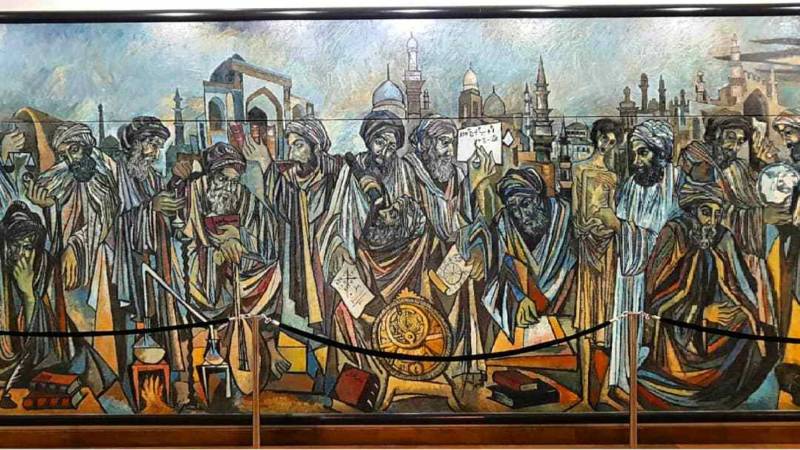
Sadequain’s mural The Earth and the Heavens (1970) visually depicts the cosmic struggle between the earthly and the divine, incorporating both cosmic imagery and symbolic figures that represent the tension between material existence and spiritual transcendence. It merges abstract forms with figurative elements to explore themes of human struggle, identity, and spiritual enlightenment, reflecting Sadequain’s deep engagement with existential questions and postcolonial identity.
Art is both a product of and a response to its geopolitical environment, shaped by the forces of history, power, and identity. The works of El-Salahi and Sadequain embody this dynamic, illustrating how cultural narratives are influenced by systems of dominance and resistance. From the exploitation of natural resources to the marginalisation of diasporic voices, the political economy of art reveals the ways in which power structures dictate what is preserved, valued, and commodified. Their art challenges audiences to reconsider these frameworks, urging a deeper reflection on the intersections of colonial histories, artistic expression, and postcolonial identity.
Their art transcends geographical and temporal boundaries, embodying Parveen Shakir’s poetic longing:
“We ought to have met, in another time, in pursuit of attainable dreams,
below a different sky, upon a different earth,
We ought to have met then, there.”
In this poignant verse, I see a reflection of what El-Salahi and Sadequain’s works represent: a longing for recognition beyond the boundaries of time and place—a reclaiming of identity that continues to resonate even within the very institutions that once sought to erase it.
For scholars, policymakers, and art enthusiasts alike, these masterpieces offer more than aesthetic pleasure; they offer lessons on the intersections of history, identity, and power. They serve as tools of postcolonial reconciliation, forcing societies to confront the cultural losses inflicted by imperial histories while also celebrating the resilience of those who resisted erasure. Art in this context is not passive; it is an active participant in the process of reclaiming narratives, restoring dignity, and reshaping the postcolonial discourse.
As I prepare to weave these reflections into my upcoming lectures, I hope to inspire others to view art not only as a mirror of society but as a force that can challenge, disrupt, and ultimately transform our understanding of identity, history, and justice.
Perhaps Jaun Elia’s words capture the essence of what these artists sought to express:
“How captivating you are, how emphatic I am,
This means we will never be one.”
Like El-Salahi and Sadequain’s works, this verse speaks to the eternal tension between the colonised and the coloniser, the artist and the institution, the self and the other—always engaged in dialogue, but never fully merging. It is in this space of resistance, in the assertion of cultural and historical presence, that their art continues to thrive.