

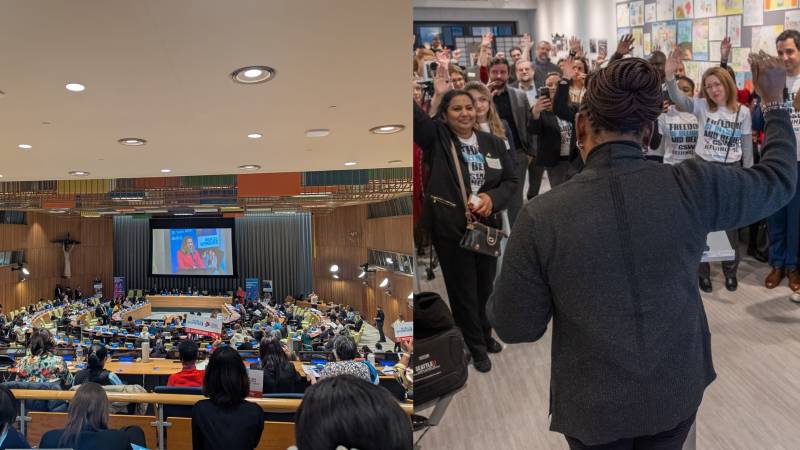
“The power of our collective action has been our guiding star. It is through partnership and the union of our diverse voices that we will forge the path ahead. After all, we are the 'United' Nations, and unity is at the heart of our mission,” said UN Women Executive Director Sima Bahous at the CSW69 (69th Session of the Commission on the Status of Women) side event on Multistakeholder Partnerships. The event, held at UN headquarters, focused on leveraging Generation Equality to advance the Beijing Platform for Action.
Bahous emphasised the importance of intergenerational, intersectional partnerships for gender equality. “Today, despite shifting winds of policy and funding, we must ensure our commitment remains unwavering. Our collective leadership, accountability, and commitment to Generation Equality will light the way for us all,” she said. This powerful call to action set the tone for the dynamic discussions that followed. CSW69 demonstrated the power of collaboration. Governments, civil society organisations, private sector partners, and grassroots movements came together to address some of the most pressing challenges of our time, such as climate change and the fight for gender equality. The event’s central message was clear: partnerships across sectors and borders are essential for progress.
One striking example of this collaborative spirit was the “Women of Faith Leading Change: Going Further, Faster, Together for Climate and Gender Justice” session. This event brought together a diverse group of stakeholders, including representatives from Ireland, Zimbabwe, Sierra Leone, UNEP, and the newly formed multi-faith, women-led network of faith leaders, the “Women, Faith, and Climate Network,” which includes the ACT Alliance. The influence of women of faith networks is immense, with an estimated reach of over 73 million people, including groups like the Mothers’ Union (4 million members across 83 countries), the Buddhist Tzu Chi Foundation USA (6 million women), Brahma Kumaris (600,000 women), and UISG (600,000 Catholic sisters worldwide). It highlighted the crucial role of faith-based women leaders in combating climate change and environmental degradation. As Jamil Ahmad, Director of Intergovernmental Affairs at UNEP New York, pointed out, “Faith-based women leaders are critical agents in the fight against climate change and environmental degradation.” Mary Robinson, former president of Ireland, also emphasised, “It is really important that women of faith have joined us to express the urgency of the climate and nature crises, but do so in a positive language that we are on the cusp of a clean energy world.” This partnership demonstrated that addressing the climate crisis requires not only scientific and policy-driven solutions but also the moral leadership of faith communities, particularly women.
While faith-based leadership continues to grow in importance, a related concern emerged during another session at CSW69 regarding the inclusion of young women in these movements. Matthias Brucker, a member of The Joint Initiative for Strategic Religious Action (JISRA), highlighted the challenge, stating, “We must ensure young people’s voices are heard, especially in religious communities, where clergy are traditionally male and older, often out of touch with the lives and aspirations of young people.” JISRA, an alliance of 50 civil society organisations, advocates for human rights and gender equality, supporting Article 18 of the Universal Declaration of Human Rights and Sustainable Development Goals 16 (peaceful societies) and 5 (gender equality). Their work emphasises the importance of strong partnerships to achieve the Beijing+30 agenda.
Whether through multilateral agreements, faith-based coalitions, or community-driven data initiatives, the event made it clear that no single entity can address these global challenges alone
The conversation around partnerships continued with the session titled ‘Advancing Data for Synergies Between Gender, Climate, and Environment’. Organised by the International Institute for Environment and Development (IIED), UN Women, and other partners, the session underscored the importance of collaboration in bridging the gender-environment-climate data gap. Participants emphasised the need for partnerships between governments and non-state actors in collecting and applying community-driven data. This is essential for crafting more accurate, inclusive, and equitable policies that reflect the diverse experiences of all communities. It further showcased how partnerships can bridge the gender-environment-climate data gap.
Climate change, driven primarily by human activities such as burning fossil fuels, continues to accelerate the warming of the Earth’s atmosphere, oceans, and land. The planet’s temperature is now about 1.2°C higher than in the pre-industrial era, leading to rising seas, stronger storms, unpredictable rainfall, and increased health risks. Vulnerable populations, particularly women and girls, are bearing the brunt of these effects. For example, women in Small Island Developing States, who often serve as primary caregivers and managers of natural resources, are disproportionately impacted by climate change. Addressing these challenges demands urgent action, including the $100 billion in climate finance commitments, a shift to renewable energy, and the promotion of gender equality in decision-making. The green economy could generate $26 trillion in economic gains and create millions of jobs, while ecosystems, particularly oceans, play a critical role in absorbing carbon. Early warning systems and a focus on critical minerals are essential to ensuring a sustainable future.
In this context, the importance of advancing influential partnerships, as demonstrated at CSW69, becomes evident in empowering women as leaders in climate action. The high-level event held on March 13, titled “Empowering Women Globally as Leaders in the Struggle for Climate Change, with a Special Reference to Women of Africa and the Diaspora,” underscored this need. The event highlighted the partnership between the Permanent Mission of Senegal to the UN, the African Renaissance and Diaspora Network (ARDN), and the World Madam Foundation, emphasising the critical role women, particularly from Africa and the Diaspora, play in climate action and sustainable development. It brought together governments, civil society, and international organisations to advocate for gender-responsive climate policies, promote women's leadership in global climate governance, and address key issues such as gender-based violence, food and water insecurity, and economic inequality. This collaboration aims to empower women as leaders in the fight against climate change, fostering transnational cooperation and reinforcing the connection between gender equality and environmental justice.
Ultimately, CSW69 reinforced the importance of partnership in advancing gender equality and climate justice. Whether through multilateral agreements, faith-based coalitions, or community-driven data initiatives, the event made it clear that no single entity can address these global challenges alone. Prioritising women’s and girls’ rights in climate adaptation, amplifying their leadership in decision-making, and ensuring they benefit from green jobs are essential steps forward. The central message from CSW69 is that collaboration is crucial to both combating climate change and advancing gender equality.
Building on this foundation of collaboration, the call to action from CSW69 outlined six critical areas for global commitment: empowering women through a Digital Revolution, ensuring Freedom from Poverty with accessible economic opportunities, eliminating Zero Violence to create a world where women and girls live without fear, promoting Equal Power by elevating women’s voices in decision-making, building Peace and Security for justice and safety, and championing Climate Justice through urgent action to protect the environment. The urgency of climate justice was particularly underscored, as women and girls in vulnerable communities bear the disproportionate impact of climate change.
This call for urgent action highlights the need for collective effort, a sentiment echoed by Rachel Tavernor, Acting Global Advocacy and Development Policy Manager at ACT Alliance, who stated, “The UN CSW69 demonstrated the long journey we still have to travel to achieve gender equality. We can only achieve this through collective action, which is why movement building, multi-stakeholder partnerships, and networking are at the core of our participation. This often requires deep dialogues to find common ground to move forward together, especially in times of increasing pushback. As the African proverb says: 'If you want to go fast, go alone; if you want to go far, go together.”
The path to a just and equitable future demands unity and collective action. By embracing these six critical areas, we can drive real, lasting change, ensuring that no one is left behind in the fight for gender equality and climate justice.