


Click here for the first part of this guide
The Indus people perhaps spoke a proto-Dravidian language and followed a polytheistic religion. Around 3,781 Indus Valley Civilization Sites have been discovered so far. Among the people, complete burial, fractional burial, and cremation were common.
How should the casual visitor or the amateur enthusiast explore the architectural marvels in Mohenjo-Daro today? Which are the key buildings to visit in this place? Which important antiquities and objects were unearthed from the excavations in the past 100 years?
We have tried to provide all these details in an informative summary in this article and the one to follow.
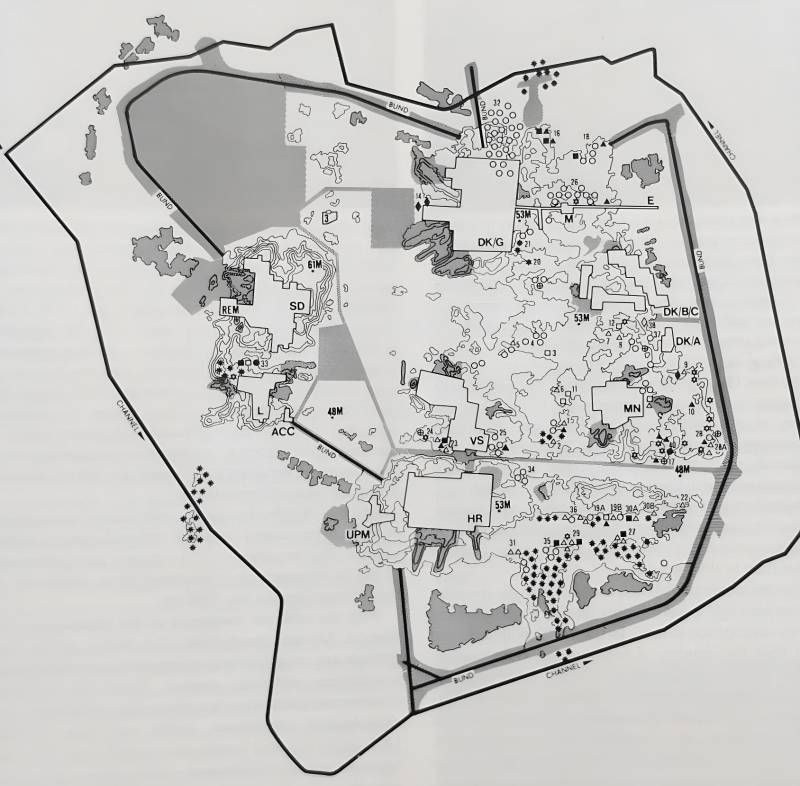
VS Area (Lower City)
A cart track passed through the HR Area and VS Area during the 1920s. Once, there was a principal street of the ancient city of Mohenjo-Daro at this place. The VS Area was first explored by Madho Sarup Vats (MS Vats) in 1923-4. He sank a 10-foot trial trench in the centre of the mound running east and west and a second trench at right angles to the first running north and south. In 1924-5, similar trial excavations were carried out by Mr KN Dikshit at the eastern and western extremities of the mound. Extended scale excavations were again carried out in this area by Mr MS Vats in 1925-6, when Sir John Marshall was himself in charge of the Mohenjo-Daro excavations. The important architectural buildings and structures of the VS Area are the houses, rooms, courtyards, corridors, kitchens, storerooms, wells, bathrooms, guard rooms, apartments, drains, pavements, and staircases. There were also windows, ventilators, brick door sockets, tall rectangular niches, houses of an intermediate period, a thin wall to give privacy to the inmates, a corbelled arch, three ante chambers, a flight of steps, water chutes, and niches.
The most important building of the VS Area is the Dyer’s Workshop. This building is located in VS Area, Section A, Block 1, House 2, Room Number 23. The Dyer’s Shop has a brick floor, dyeing troughs, a well with a platform and a drain. It is assumed that cotton fabric was dyed here in many different colours. Afterwards, these textiles were sent to far-off places such as Mesopotamia and Egypt. A 130-foot-long Broad Street with lanes had cesspits, sinks or cesspools, and receptacles for rubbish. The finding place of charred bones found in vessels was perhaps an example of fractional burial in the city. Remains of several strata, a brick-lined paved cesspit with a funerary deposit, and a fine well with rope marks were found. Pottery kilns and wedge-shaped bricks were also discovered from this area.
Pottery, utensils and shell items discovered from this area are: large cylindrical jars, large storage jars, vases with pointed bases, ritual offering stands, polychrome red, white, and black pottery, a large earthenware jar with funerary vessels, a vase of clay showing ibexes, spouted jars, funerary urns, a pottery tumbler, painted vases, miniature vases, oval vases filled with clay, pottery bowls, bottle-shaped vessels, flat dishes with low rims, large bowls, terracotta potsherds and other objects were found.
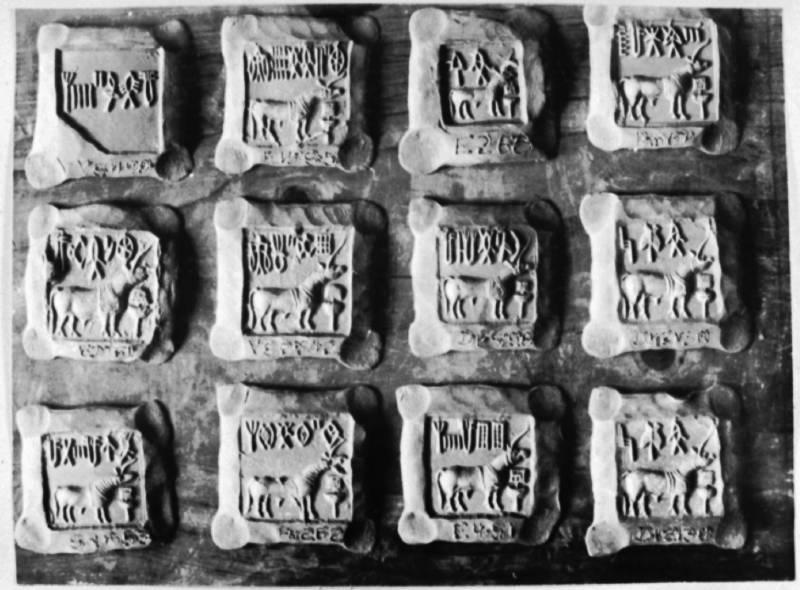
Seals, sealings and copper tablets, etc. A seal with a device half man, half bull of Babylonian appearance, inscribed seals of steatite and copper, unfinished seals, a seal showing a human-headed monster with animal limbs, a sealing of yellow faience showing a male deity on a couch, copper seals, oblong copper seals, terracotta seals, baked clay tablets of triangular shape etc.
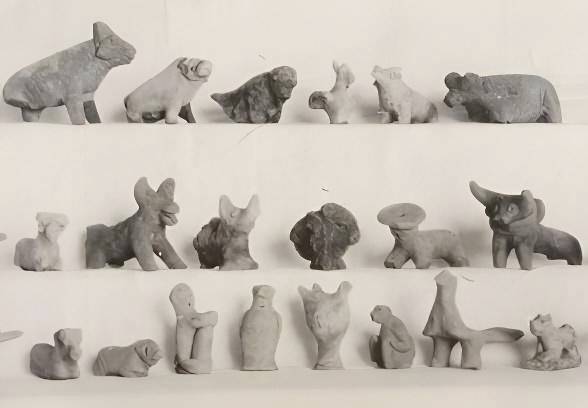
The following statues were discovered: a sphinx-like composed animal, a horned male figure like the Babylonian Gilgamesh, copper statuettes in the round, a statue of a dancing girl (2 inches), a limestone head, a terracotta head with basket-like ornaments, an interesting terracotta bust, an artistic figure of a humpless bull, terracotta female figurines, a pot-bellied terracotta figurine etc.
It is assumed that cotton fabric was dyed by Indus craftsmen in many different colours. Afterwards, these textiles were sent to far-off places such as Mesopotamia and Egypt
Jewellery and personal ornaments included a thin fillet of gold, a convex disc of ivory decorated with a concentric series of circles, beads of faience, paste, cornelian and agate, button-shaped faience ear tops, incised ivory bars, chessman-shaped objects probably phallic emblems, an ivory cylinder, a faience nose ring, reel-shaped beads of faience, faience bangles, broken bangles, shell vases, shell bangles, ivory rods, conch bangles, an ivory baluster, shells used for bangles, ivory cubes, a scent bottle with a cover (VS 2671), copper bangles etc.
The following stone and copper objects were also discovered: stone weights, a shallow copper lamp, rectangular copper pieces, a spearhead, axes, celts, dishes, a rod with a sharp point, a broken copper ring, an object of lead, a polished tablet of basalt, a stone for grinding out dishes, a fragmentary needle, a whetstone of Jaisalmer stone, a phallic emblem of marble, a pierced screen of alabaster, a ring stand, graving tools, stone plates, square slate caskets, chert knives, a headless stone quadruped, the handle of a large spoon, a pierced finial-shaped object of ivory and a basalt adze. A charming little squirrel of faience, a shell ball, a terracotta dog, a floating toy or flesh rubber, terracotta balls, and a faience hare etc.
In 1925-26 a second group of human skeletons was discovered from a death site probably due to a tragedy. This group included the remains of 6 individuals found lying in one of the streets. These skeletons are named as follows: Skeleton No 20, Skeleton No 21, Skeleton No 22, Skeleton No 23, Skeleton No 24, Skeleton No 25 and Skeleton No 26. The young Indian Camp Medical Officer did his best to measure the bones under the supervision of Mr Hargreaves. Some of the animal remains, the antlers of a stag, cremated remains and the shell of a tortoise were also found. A human skull and finger joints, human bones, animal bones, bones and charcoal and ashes, charred date seeds, a lump of mica, decayed date seeds, a fragmentary linga, perforated lattices, slate boxes with compartments, and some chaff of a cereal in a broken vessel.
HR Area (Lower City)
The HR Area was excavated by Mr Harold Hargreaves in December 1925 under the supervision of Sir John Marshall. The Catalogue and Concordance of the Field Register (1924 to 1938) describe the dates of excavation of the HR Area from 17-12-1925 to 8-3-1927. The area is divided into 9 blocks. This area is situated in the south quarter of the main groups of mounds. The excavations were ended in February 1926. This mound was separated by 2 sections called A and B. The HR Area is famous for the discovery of 2 well-built privies (toilets) and a dancing girl statue. The bronze statue of the dancing girl was found in 1926 from House No LV, Room No 40, Block 7, Section B of the HR Area of Mohenjo-Daro. It is 4.25 inches high. The statue has a necklace with 3 pendants. The hair is beautifully tied with a bun at the back. Several bangles were worn on the right arm at the wrist and elbow but the left arm was filled with bangles from wrist to shoulder. The girl is holding a bowl in her hand. The original statuette is displayed in the National Museum New Delhi, India.
The main architectural marvels of the HR Area are the houses, rooms, chambers, courtyards, corridors, kitchens, wells, bathrooms, windows, doors, a flight of steps, drains, pavements, apartments, sleeping rooms, storerooms, a verandah, a rectangular-shaped lobby with a well, a small custodian room, well-built water chutes, brick platforms, a well sunk, outlets, two privies (washrooms), square beam holes. More than this, some underground dwellings (tahkhana) for inmates resorted to escape the summer heat, a small square channel, a private shrine (Block 9), rooms with separate baths, a lavatory where the scavenger could do his work from outside the house, public rooms where owners of houses received visitors (otaks), L-shaped daises or benches in rooms, a tahkhana or basement story for use in summer, a courtyard with a skull and vessels of Burials 3, crude brick filling, possibly a palace, tiny houses, a fireplace, a solid mass of kacha bricks, a brick door socket, square paved floors for ablution, a brick line and drainage pits were also excavated.
First Street (300 feet), South Lane, Deadman Lane, High Lane, were main passages. Public drinking places, a large pot fixed in the floor of the street, rings of brickwork, 18 large-sized rings of limestone from the Sukkur quarries, phallic emblems or limestone capitals, a well with the friction of the ropes, a double row of small structures evidently shops, an unusual structure/temple building in Block 3, chessman stones or yoni and lingas, a corbelled arch, pottery drain pipes, latrines, rounded street corners, alternating rows of burnt and sun-dried bricks, a well with a moulded parapet, a brick cesspool, sewage pits, niches, wedge-shaped bricks, gypsum for walls, and mortar were discovered.
Among business premises, long lines of shops with chambers that were used by shopkeepers to display their wares on both sides of Street 3. Other structures were the potter’s shop, a probable pottery kiln, a coppersmith’s shop with several lumps of unrefined copper and pieces of pottery crucibles. This building is located in VS Area, Section A, Block 1, House 2, Room No 23. The Dyer’s Shop has a brick floor, dyeing troughs, a well with a platform and a drain. It is assumed that cotton fabric was dyed here in many different colours. Afterwards, these textiles were sent to far-off places such as Mesopotamia and Egypt. Other findings are the finding place of oyster shells, watchman’s rooms, retainers’ quarters, a well surrounded by a brick pavement which was with broken earthen bowls with pointed bases, and a latrine or rubbish chute etc.
Various kinds of vases were excavated from this area, for example, decorated with a fawn, ritual offering stands, miniature vases, large earthen jars, terracotta cones, a terracotta carrot-shaped pin, 3 half-baked betel leaf-shaped clay tablets, a potsherd painted with a row of geese, a terracotta quadruped, a perforated pottery jar or strainer, a collection of pottery vessels including several large chatis, lids and small beakers, a pottery rattle, 2 pottery wheels (HR 4843), a pottery prism (HR 3766) with pictographic legends on all three sides, pottery lids, sacrificial spoons, small shell spoons, a kauri shell, a spout of alabaster, a copper lid, a blur faience vase with a narrow mouth, a miniature blue faience jar with a pointed base.
Seals, Sealings and Tablets
A seal showing a rhinoceros, steatite seals with a boss, a seal with a pictograph on the boss at the back, script on a seal from right to left and vice versa, a seal of a lion above and an elephant below with a pictographic inscription, a white steatite rhinoceros seal, a well-executed Brahmani bull with pictographs, a terracotta sealing stamped on both faces with a figure of a rhinoceros and pictographs, a unicorn seal of white steatite, a short-horned bull seal, a fragmentary elephant seal, a seal engraved with the figure of a rhinoceros, a seal of a unicorn with a standard or trough (insane burner), the largest seal of a unicorn (2.7 inches squared) with a pierced boss, a swastika sealing of yellow faience, a unicorn seal (HR 5311) with a palm tree or vase with palmettes, the buffalo device, a white steatite seal of a short-horned bull (HR 4364), anciently repaired with a narrow slice sneaky glued to the top with bitumen, a tablet of copper engraved with a figure of a bull, a square tablet of black steatite with a unicorn device, an ivory bar engraved with a number of pictographs, amulets of copper with pictographic legends and animal devices, faience seals etc.
Among important statues are the limestone head of an image, an alabaster sculpture of a seated man (HR 163/193/226), a white limestone pedestal with an image of a seated composite animal; the body of a bull, the head of a ram and the trunk of an elephant, a bronze statuette of a naked dancing girl (HR 5721), a copper statuette of an elephant, a figure of a male seated in Indian fashion, a white limestone head / smiling face (HR 910), an interesting terracotta (HR 6213) showing a female lying on a bed with her baby at her chest, a limestone fragment (HR 5785), a terracotta female figurine holding an uncertain object in her arms, a seated terracotta male figure holding a terracotta cone between his arms upon his knees, a bust of a terracotta female figurine with the hair coiled in a broad knot upon the crown, a nude terracotta red-coloured figure representing a man standing with both arms hanging down (HR 5368), a fragmentary terracotta female figurine (HR 3690) holding a dish containing cakes or flowers between her hands, a human-headed bull with a long beard and striped shoulders, a copper statuette of an elephant in the round, a crocodile head of shell etc.
The jewellery included a collection of gold, silver and stone jewellery (HR 4212), a gold fillet (length 1 foot 3 inches), 13 amber-coloured glass beads belonging to a necklace, 3 broken bangles of ivory, a metallic ornament of a necklace of zinc, miniature beads, copper bangles, copper rings for toes, copper bracelets, a lapis lazuli bead, silver and copper vases containing jewellery, copper buttons, etched beads, a necklace spacer of copper, bangles of faience, a hollow silver ring wrapped in cloth, shell bangles, a bead of brown glazed pottery, shell inlay, shell ornaments, a large collection of shell pieces, beads.
A hoard of jewellery buried under the floor in the centre of a room containing 4 large hollow round earrings of gold, 2 silver vases, a copper vase with a pointed base which contained a celt and a chisel of copper, 2 discular ornaments of gold, 3 gold forehead fillets or diadems resembling Mesopotamia, 13 pieces of similar fillets, 2 broader fillets of gold with a line of holes for carrying beads, 3 forehead fillets of women, 7 hemispheric hollow hair ornaments, 1 silver bangle, 6 small finger rings of silver, 10 necklaces of gold, silver, faience, semi-precious stones, 282 small gold beads, spacers and terminals, two gold rings, necklace pendants, a plain forehead fillet of gold, carnelian beads, a toe ring of copper, an ivory pin with thin ends, eleven star-shaped beads of faience, a conch object shaped like a bow with 5 shallow holes, a faience imitation of a conch shell, a faience necklace spacer, faience beads, fragments of faience bangles, a button-shaped ear ornament of faience, a miniature ivory bar square below and circular above (HR 5715), faience bangles, charcoal in house debris, a fragmentary carnelian bead etc.
Stone and alabaster objects included ring stones, a grindstone of grey sandstone, chert implements, scrapers, borers, cores, chert flakes, an adze, a blowpipe, ivory, a copper wire chain, stone mace heads, linga-shaped cones, alabaster rings, a copper jar, spearheads, arrowheads, celts, chisels, fish hooks, copper buttons, copper vessels, copper bangles, a copper vase containing copper celts and chisels, 2 silver vases for the storage of jewels wrapped and woven cloth of true cotton, a phallic emblem of white limestone, a spear, a cone of stone, square stone capitals, copper tools, weapons, a small steatite mace head.
A copper jar with 16 bangles, several seals, chert flakes, and stone weights, a broken grinding stone, a well-preserved copper celt, a small copper cylinder closed at one end possibly a part of a stick, a long narrow lance head of copper broken in several pieces, copper spearheads, a yellow Jaisalmer stone handle of a chisel or knife, a copper spoon with a tubular handle, an instrument of the same material consisting of a rectangular blade with a narrow tang, fragments of shell bangles, chert knives, a pierced finial-shaped object of ivory (HR 5409), a large stone cone resembling a linga, linga-shaped cones of conch shells, copper seals, a chert nucleus, a copper antimony rod broken in 2 pieces, a copper antimony stick, a copper amulet, a well-preserved fishing hook of copper (HR 3312).
Among other findings are a curry stone, stone weights, a goldsmith’s weighing scale, etc. miniature/little balls, a broken shell inlay exhibiting a star within a circle, a terracotta dog, a squirrel of faience, a bird-shaped pottery whistle, a terracotta dog with its tongue hanging out, a well-executed tiny squirrel of blue faience, a miniature bust of a monkey of faience, a small bead-like object of steatite with monkeys, a well-executed terracotta monkey, a faience chessman, etc.
A total number of 20 human skeletons were excavated from the HR Area during Sir John Marshall's excavations. Skeleton No 1, on 29th December 1925, Mr Hargreaves excavated 14 human skeletons from House V, Room No 74, in the HR Area B Section. These skeletons included Skeleton No 2, Skeleton No 3, Skeleton No 4, Skeleton No 5, Skeleton No 6, Skeleton No 7, Skeleton No 8, Skeleton No 9, Skeleton No 10, Skeleton No 11, Skeleton No 12, Skeleton No 13, Skeleton No 14, Skeleton No 15, Skeleton No 16. While Skeleton (No 17) was found from Deadman Lane, Skeleton No 18 or skull (HR 2308) in a large potsherd. Skeleton 19 was also discovered during the course of excavations in 1926-27. Fragments of the 20th skull were also found during the Mohenjo-Daro excavation. Dr Dales excavated 5 skeletons from HR in 1964. Cotton textiles, ivory, bone, copper, clay and alabaster plaques, and charcoal were also excavated.
DKI/Moneer Area (Lower City)
This site is a small mound measuring about 250 feet from the north to south and 120 feet from east to west. The mound is bisected by a 9-foot-wide street that runs across it from north to south. DK I or the Moneer Area was first excavated by Mr KN Puri, The Custodian of the Mohenjo-Daro Museum, about the beginning of December 1933. Mr QM Moneer also started excavation work at Mohenjo-Daro in the DKI Area during 1933-34. He started excavations between January 15th and February 6th 1934 with the clearance of the street that had been excavated earlier. Mr QM Moneer was an Indian Archaeologist. He was BA, FLA (London). He served as Superintendent in the Archaeological Survey of India, Western Circle, Poona. This 1-page excavation report is published in the According to the Annual Report of the Archaeological Survey of India for the years 1930 to 1934 on Page No 72.
After the independence of Pakistan, the Directorate of Archaeology was established in 1947 at Karachi, Sindh. The Directorate of Archaeology had 2 circle offices at Rajshahi (Dhaka) and Lahore, each under a superintendent. Mr QM Moneer served as the first Director of Archaeology in Pakistan from 1947 to 1948. He was succeeded by Dr Muhammad Nazim in November 1948 who in turn retired from service after 3 months in 1949. The street in its original level (8 or 11 feet wide), houses, a series of 56 rooms belonging to the late period of Mohenjo-Daro, a covered drain, vertical drains and chutes, the finding place of closed containers/coated vessels with unicorn stamps. Mr KN Puri published a small report on the excavations of this area. He writes that, “Mohenjo-Daro: An area of 150 ft .by 120 ft was excavated in DK Site, Section (I) where some excavation work had been previously done in the year 1933-34. According to the Annual Report of the Archaeological Survey of India for the years 1936-37 following antiquities were discovered at DKI (Moneer Area).”
Over 200 antiquities were discovered from DKI (Moneer Area), two fragments of a shell pin (No 106), one copper fork with three prongs (No 107), two complete and several fragmentary steatite seals, small linga-shaped stone objects, cuboid stone weights of different sizes, two very small crushed beads of gold leaf, a variety of objects of everyday use in shell, stone, terracotta, copper and faience, a copper casket 7 inches high and was sent to the Director General of Archaeology.