

The recent Indo-Pak clash of 7-10 May, including the air battle, is being described as the first conflict of the modern age where – as per the official spokesmen and media defence specialists – long-range air and ground launched weapons, supported by airborne and land-based electronic warfare platforms, were fully and seamlessly integrated via highspeed datalinks with jamming, spoofing and spectrum control devices. This enabled sharing of real-time information and decision control mechanism across all elements of the entire battlefield. Forced into the ring in a prolonged skirmish of four days with a much bigger rival, Pakistan not only survived, which in itself is commendable, it landed more lethal punches than it has received.
At the time of the ceasefire, it was India who was staggering on its feet, facing a still defiant, coherent and jubilant Pakistan. At the same time, introspection reveals that Pakistan has pursued a self-limiting doctrine in this battle. It has inflicted only a limited damage to its arch-rival, whereas it has a capacity that could have – and should have – delivered an even more potent punch, in order to deter India from exercising its hegemonic behaviour against Pakistan.
Being a veteran of the Pakistan Air Force (PAF), this author rejoices in the performance of his ex-service. At the same time, he, having been a military Air Traffic Controller and not sufficiently trained in the art of warfare, claims no expertise in tactical or strategic fields. The evaluation that follows is written purely and entirely as a lifelong student of history.
The idea of the Cold Start doctrine in India was initiated after “Operation Parakram,” which followed the 2001 attacks on the Indian Parliament. The parliament attacks were suspected by the Indians to have been sponsored by Pakistan, but are more likely to have been a false flag operation, a now familiar mode of Indian strategy. Operation Parakram exposed major gaps in India’s military power to carry out large-scale offensives, due to slow mobilization of their troops along their border with Pakistan. Hence, the development of the concept of a short intense war with cessation of hostilities a little short of nuclear threshold. In 2009 the then Army chief, Deepak Kapoor proclaimed that a major leap in their approach to conduct of operations had been the successful firming-in of the 'Cold Start' strategy.
The doctrinal shortcoming of Pakistan has been in allowing the Indian strategy of keeping the air and missile battles limited to the latter’s north-western states. Pakistan should have refused to accept this limit
India has, in this skirmish of May 2025, put the Cold Start doctrine into practice. In fact, it didn't mobilize the army. It was instead relying on air assets – manned and unmanned – and missile forces to deliver payloads across the border. India also negated the difference between the international border and the Kashmir LOC in characterizing its initial targets as terror camps, thus treating Pakistan as a rogue state.
The opening Indian attacks, subsequent retaliation by Pakistan and counter retaliation by India remained limited to Kashmir, Pakistan and the three Indian border states (Punjab, Haryana, Rajasthan) facing Pakistan. It is success of Indian strategy and Cold Start doctrine that it waged a war that was limited in scope and area. The escalatory ladder, which Pakistan laid claim to, actually has been exercised by India. Some of the significant losses incurred by India, rightly celebrated by Pakistan, are nothing but an inconvenience and embarrassment to the much larger Indian designs of softening up Pakistan.
An intense short air war limited to about 200 km of the Indo-Pak border, with a ceasefire short of nuclear deployment, should not become the new norm. That would be a practical derivative of Cold Start doctrine that the Indian army chief presented in 2003. India may be calculating as to how many such well-spaced wars – without ever reaching the point of nuclear exchange – would force Pakistan to its knees.
The doctrinal shortcoming of Pakistan has been in allowing the Indian strategy of keeping the air and missile battles limited to the latter’s north-western states. Pakistan should have refused to accept this limit. Being a small country, hemmed in by its little size and weak economy, Pakistan doesn't have the luxury of conducting a prolonged conventional war against a much larger adversary. At the very outset of hostilities, or even when the Indian attack appeared imminent on the night of 6-7 May, Pakistan should have taken the war to the economic heart of India.
There is a precedent in taking the war to the enemy when it cannot be deterred from aggression. The comparisons given here may be lopsided, yet are appropriate in nature.
First is the case of the Punic Wars of the second century BC between Hannibal-led Carthage and the Roman Republic. Unable to resist the Romans in his small enclave on the of Gulf of Tunis, the enterprising Hannibal marched his army 1,500 km west along the coast to the Pillars of Hercules, crossed over to the European side of the Mediterranean, marched again 1,500 km east along southern Spain and France, crossed the Alps and descended into the territory of unsuspecting Rome. Essentially, then, in undertaking this arduous campaign, Hannibal had taken the battle to Rome itself. Despite fighting for three years against Rome from within Italy, he finally lost. However, the Roman victory came at a heavy price. It transformed from a tranquil republic to an anarchy-infested nation and finally to a stagnant empire. The survival of Rome in this long conflict had been, in the idiom of her own coinage, a Pyrrhic victory.
In June 1967, when Israel was threatened from the east and the west, the Zionist nation pre-empted and took the war to the surrounding Arabs, and transformed the entire neighbourhood forever in its favour.
Similarly, the Vietcong broke out of their sanctuaries in the North Vietnam and took the war to the much stronger American forces in their presumably safe havens in South Vietnam, and recorded a remarkable victory.
From the very inception of hostilities in the late hours of the Wednesday night, when the Indian air force had been humbled and was uncertain of itself, Pakistan, having a clear physical and psychological advantage at that point, should have struck south. That would have brought the war home to the aggressor.
India’s economic centre of gravity is not in the Gangetic plains of the north but in the Deccan to the south of the Vindhya range. A vast majority of foreign business travel and investment in India is not in Amritsar, Chandigarh, Patna or Lucknow. Instead, it is in Surat, Bombay, Pune, Bengaluru, Chennai, Visakhapatnam and Calcutta.
While most of southern India remains under our uncertain non-strategic missile range, the northeast Arabian Sea coastline offered an attractive target. Especially, given the periodic official media reports of our land-, sea- and air-launched missile tests with increasing ranges and accuracy, this should have been feasible.
This author again admits of being unaware of the precise capability of our missiles, and is solely relying on official media reports. Going by those, it should have been possible to disrupt the normal economic activity of Surat and Bombay. An official statement of our intention to target these airports - and then a missile fired at each - would have changed the calculations of every tourist, investor and airline, just as it happened over the entire length and breadth of Pakistan. That would have given India a genuine causa cogitandi (cause/reason to think) in its risky pursuit of hegemony.
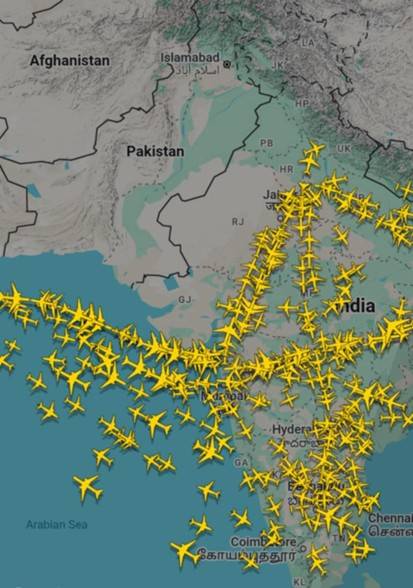
This author often took a cursory look at flightradar24 for the civil air traffic situation during the days of the air battle. The picture depicted empty Pakistani airspace whereas heavy flying activity, therefore a normal life, continued over all of India, except for the four northwestern states bordering Pakistan. It was ample proof that while Pakistan was hurting economically, India was going about her routine activities unhindered.
Here, then, was the Cold Start doctrine in play. Pakistan should have changed that equation. This was one severe shortcoming in Pakistan’s otherwise brilliant response to the completely uncalled for Indian aggression.
One thing is absolutely clearly and repeatedly demonstrated by Pakistan's leadership and public: that our country cannot live under the fear of a hegemon in the form of India. It is our resolve that the nation is not fearful of the changing position of nuclear buttons. Pakistan didn't invest in this technology as a show piece. It is an arsenal to ensure our survival as a proud nation. That was the reason as to why, way back in the 1970s, the then Prime Minister Zulfikar Ali Bhutto vowed that the nation would develop nuclear weapons even if it had to eat grass.
The prospect of death, too, being inevitably more certain than life itself, has not been too much of an issue for Muslims. Hence, in any future conflict imposed on Pakistan by India, it might suit Pakistani doctrine that the aggressor be hit very hard and in unpredictable places. Such a doctrine would ensure that if Pakistan comes to a standstill, India would also come to an abrupt halt for its normal economic and financial life.