

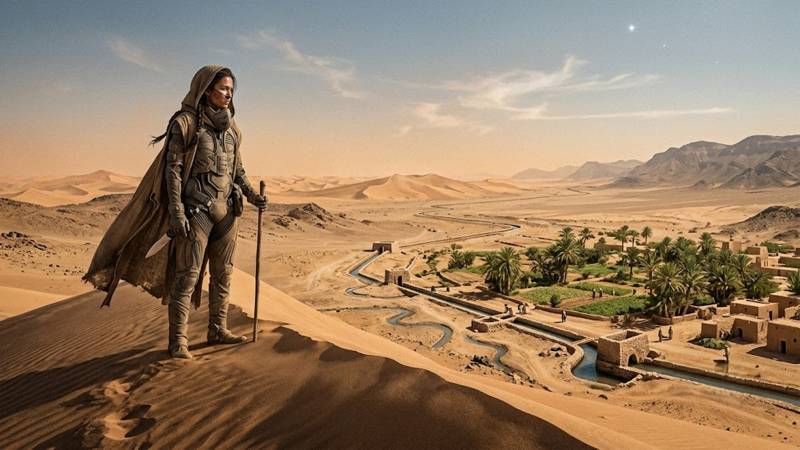
Although Frank Herbert’s epic book Dune holds the justifiably deserved honour of winning both the prestigious Hugo and Nebula awards, it would be an understatement to note that Denis Villeneuve’s magnificent films based on it (“Dune Part 1”, released in 2021 and “Dune Part 2”, released in 2024; the third instalment is due to be released in December, 2026) were instrumental in bringing it to the forefront for even more people around the globe than had formerly been the case. Sensible casting, impeccable direction, a faithful commitment to the plotlines of the novel, not to mention much help from CGI helped make these movies far more memorable and popular than David Lynch’s enterprising 1984 version. Pakistanis found it easy to relate to the native Fremen of the planet Arrakis (sole location in the Dune universe that produces the invaluable drug, mélange), because the original novel was Islamophilic, desert-based, tribal, warlike, and linguistically familiar to them on umpteen levels.
Some people might be aware that prior to writing the third book in the series Children of Dune, more specifically in 1972, Herbert visited a number of countries in the East, including Pakistan and India. His purpose was to study ecology since, as his son Brian Herbert notes in his 676-page biography of his father (Dreamer of Dune; Tor: 2003 and Gollancz: 2023), Frank had always been interested in utilising the planet’s resources to maximum efficiency. Indeed, Brian also comments on how his father attempted to harness solar energy decades before most others did, even though oil fuel was relatively cheap at the time. But what will further interest those who manage to swim through hundreds of pages of this biography is that Dune was, on an unauthorised level, translated into Urdu decades before Shaukat Nawaz Niazi capably translated it into Urdu a couple of years ago—this time around, the translation was an approved one.
These points are simply intriguing when it comes to appreciating the thought processes that fed into the creation of a story that is messianic, global, ecological, spiritual, and now a blockbuster
Also significant, though little-known, is the point that in the late 1950s (several years before Dune was first published by Chilton in 1965), Herbert was part of a United States Department of Agriculture (USDA) initiative whereby the US government tested sites in Portland, Oregon to see if sand-dunes could be turned into arable land. Although many countries overseas were interested in attending workshops and conferences on this experiment, Brian Herbert identifies only four places by name: Pakistan, Chile, Argentina, and…Israel. Given that Pakistan had not recognised the creation of the state of Israel, the coming to the table of these politically disparate nations for this globally enlightening endeavour seems very intriguing. Alas, although Brian does not elaborate further on what these meetings between Frank Herbert and key Pakistani officials working on the environment would have entailed (most probably because they were confidential), it is crucial for Dune-lovers to note that, given the points above, Frank Herbert’s ties to Pakistani lore and culture would have run much deeper than any ties to the Arab countries, none of which he experienced first-hand on the same scale. Brian waxes eloquent about how Herbert’s mainstream fictional novel Soul-Catcher was heavily influenced by Native American lore, especially since one of Herbert’s best friends was Howie Hansen, a gentleman who possessed Quileute Native American roots. Brian also comments extensively on his parents’ marriage and how both Frank and Beverley Herbert loved living in exotic locales such as Mexico and Hawaii, although Herbert also retained a home in his native state of Washington for most of his adult life.
The creator of Dune was remarkably well-read in subjects ranging from philosophy to psychology, but it is highly likely that his inspiration for the hardy and tough-willed Fremen came from areas such as the Sindhi and Rajasthani deserts of the sub-continent. He was obviously impressed enough by Pakistani geography and culture to not only incorporate elements of it into his bestselling epic, but also to actually visit the country, and experience its culture on a much closer scale, some years after he had achieved fame for the first book of the Dune-series. In an arid landscape like that of Arrakis the name of the wife of hero Paul Atreides’s chief lieutenant Stilgar, Harah, constitutes green (“haray”) landscapes (as well as the predominant colour in Pakistan’s flag)—the book is peppered with such allusions and most likely owes its flavour to Pakistani Islamic customs as opposed to those of Saudi Arabia. “Duy yakha hin mange/duy punra hin mange” says the Fremen heroine Chani to the hero at one point early in the novel. The translation of the Fremen words into English: “I have two eyes/I have two feet” indicates that the original is far closer to Urdu than to Arabic (although the novel contains its fair share of the latter language as well, given the implicit emphases on Islam and Herbert’s references to a fictional Zensunni religion). Even Brian’s assertion that Paul is modelled after the 19th-century Sudanese hero Muhammad Ahmed who led a successful revolt against the Egyptians is simply a personal speculation. As far as the basic facts are concerned, his father had far deeper links with Pakistan than with any other Eastern nation.
More than a matter of pride for us situated within Pakistan these days, these points are simply intriguing when it comes to appreciating the thought processes that fed into the creation of a story that is messianic, global, ecological, spiritual, and now a blockbuster phenomenon as far as film is concerned. In his later years Brian’s father contemplated going to Nepal and climbing Mount Everest. But he never got round to it. However, he did realise that perhaps one day, the deserts of Sindh may be converted into arable land—that is, if we care enough about the point. Paul Atreides, the hero of Dune, certainly had this type of mindset. So too, naturally, did his beloved Chani—a native Fremen.