

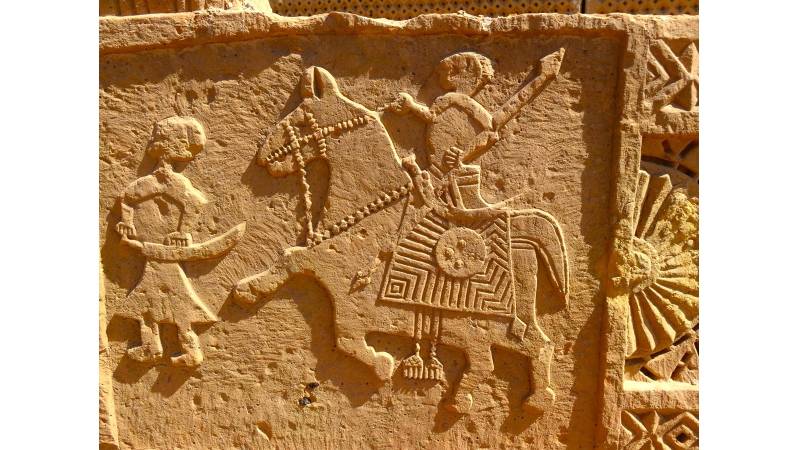
Raj Malik is one of the historic graveyards located 12 km south of Gharo town in Thatta District. It is one of the most famous necropolises of the Kalmati tribe, noted for its figural depictions. Although most of the graves lie in a crumbling condition, the majority still depict magnificent motifs, leaving a spellbound effect on visitors. Some prominent motifs include figural, floral, and geometric designs.
The most notable representation on one of the stone-carved tombs is a hunting scene. It is rare to see a hunting scene on a stone-carved tomb in Sindh. Generally, one finds hunting scenes in painted murals in Sindh. Hunting has always been a favourite theme of Sindhi artists, who painted it on various tombs in Dadu, Kamber-Shahdadkot, Shaheed Benazirabad (formerly Nawabshah), and Sanghar districts. The royal figures and tribal chiefs are shown hunting wild boars and deer in Sindhi paintings. A more striking example can be seen in various tombs constructed during the Kalhora (1700–1783) and Talpur (1783–1843) periods. This does not mean that the Sindhi artisans discarded this theme. Instead, they added new themes to their already existing repertoire, which became a ready reference when they had to paint the tomb of a local noble, chief, or landed elite.
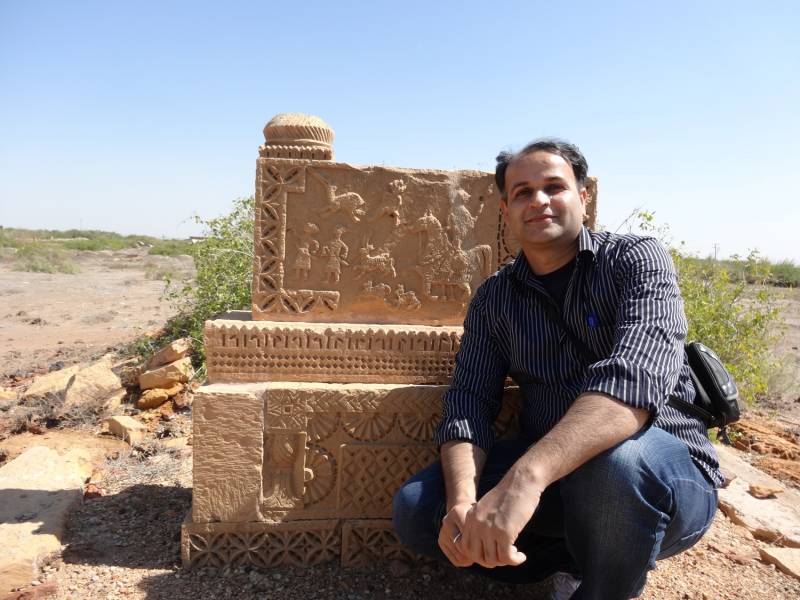
The Art of the Hunt
One of the stone-carved tombs of Raj Malik depicts a hunting scene. It was not easy to depict a hunting scene on a small tomb gravestone, with hunters, their helpers, and prey to be engraved. It depended on the dexterity and skill of the artisans to engrave all these characters within the given space to create a masterpiece. The hunting scene depicted on Raj Malik's gravestone is a masterpiece created by local artisans from Thatta. They focused on the contours of the figures engraved. The tribal chief or royal figure is shown riding a horse and engaged in hunting. He rides a richly caparisoned horse with clearly detailed weapons, particularly a spear, reflecting the artisans' skill.
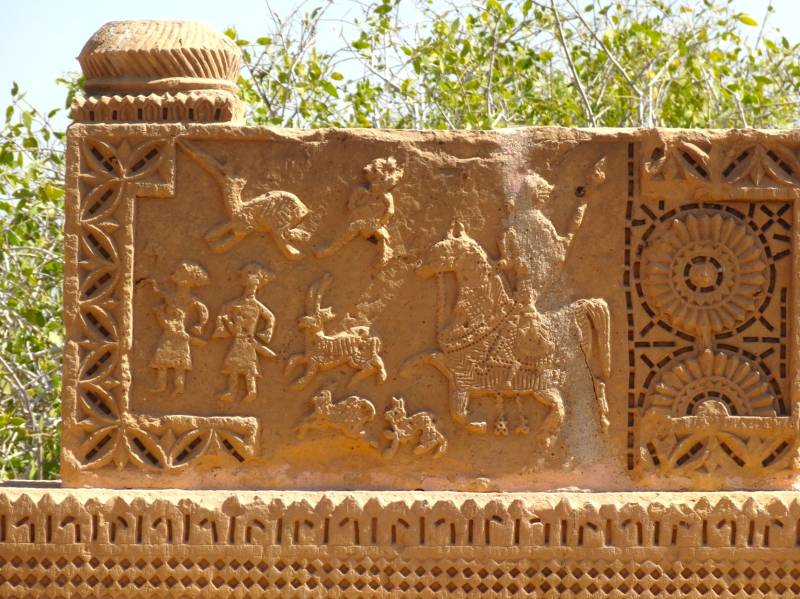
The artist tried to capture every tiny detail, even the suspending tassels of the saddle cloth, which are clearly outlined. The hunter on horseback is depicted hunting deer and other animals. The artisan tried to engrave the animals in a natural style, but due to space constraints on the gravestone, he created two smaller animals, with one shown in a natural style with prominent horns. There are a total of four animals and four human figures, one of whom is mounted on a horse and is actually a tribal chief or other noble engaged in hunting. The second figure is shown chasing an animal for the hunter seated on horseback. Two other figures on foot are shown on the extreme left of the gravestone with swords and an axe. The front figure is holding an axe. This entire scene shows the artisan's skill in portraying a tribal chief hunting animals.
Some carvings preserve glimpses of everyday customs and leisure, revealing how funerary art documented the cultural practices and identity of the communities they memorialised
Such an impressive hunting scene can also be seen at the Shah Hussain graveyard in Thatta District. But the Raj Malik hunting scene is more elaborate, magnificent, and visually more appealing.
Equestrian Depictions and Martial Culture
Apart from hunting scenes, the Raj Malik tombs also feature remarkable equestrian depictions. One dislodged gravestone portrays a mounted rider accompanied by an attendant smoking a hookah. Similar hookah-smoking figures appear on several other tombs at Raj Malik and are also found on the stone-carved graves of the Dars Warayo cemetery in Thatta. Their repeated depiction suggests that hookah smoking had become a familiar aspect of elite social life by the time these monuments were carved. Beyond commemorating the deceased, these carvings preserve glimpses of everyday customs and leisure, revealing how funerary art documented not only acts of bravery and prestige but also the cultural practices and identity of the communities they memorialised.
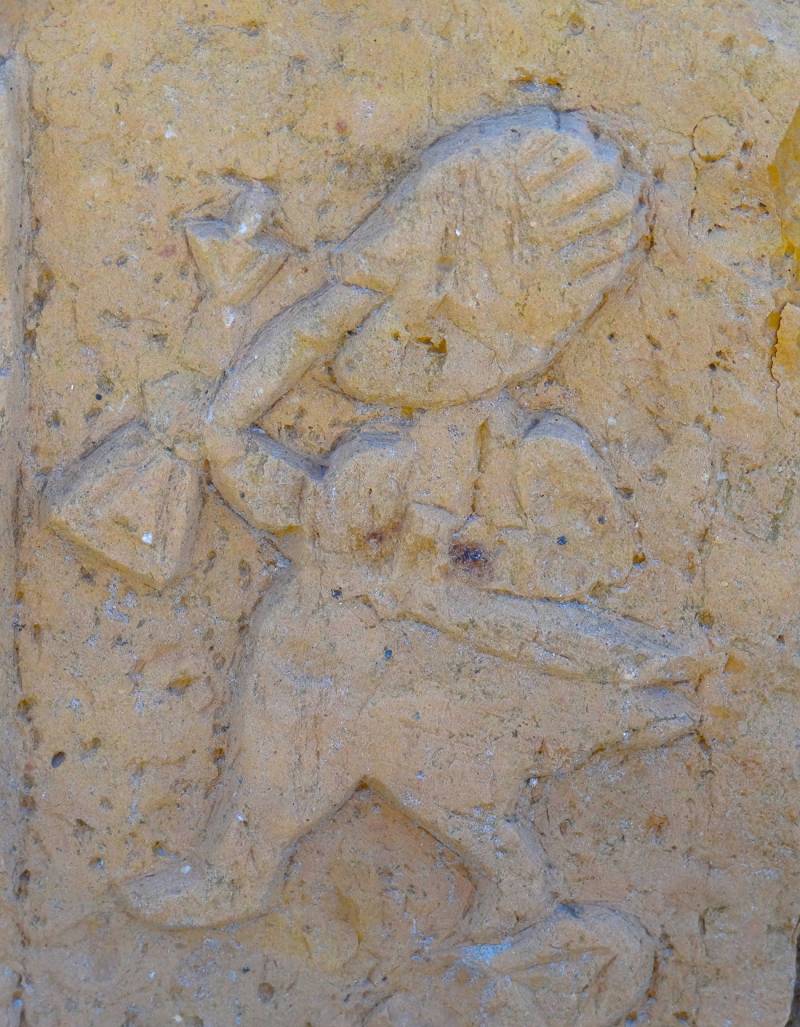
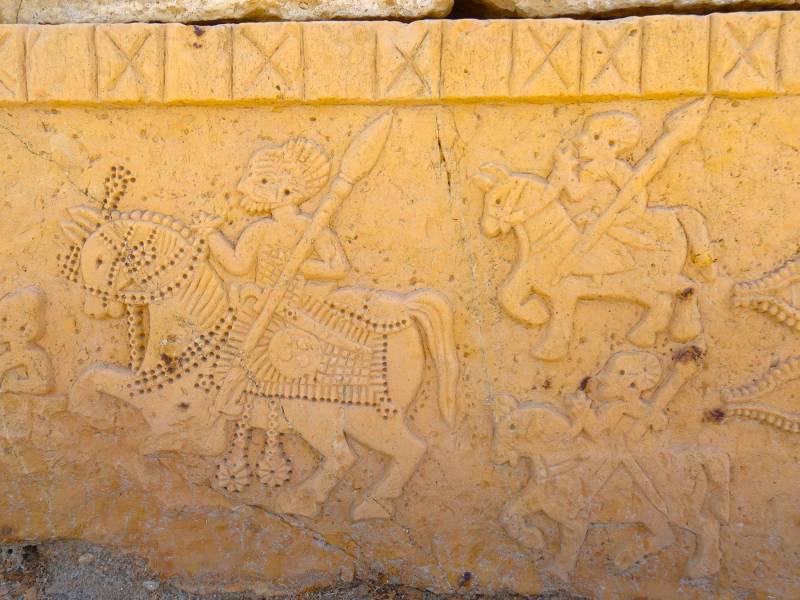
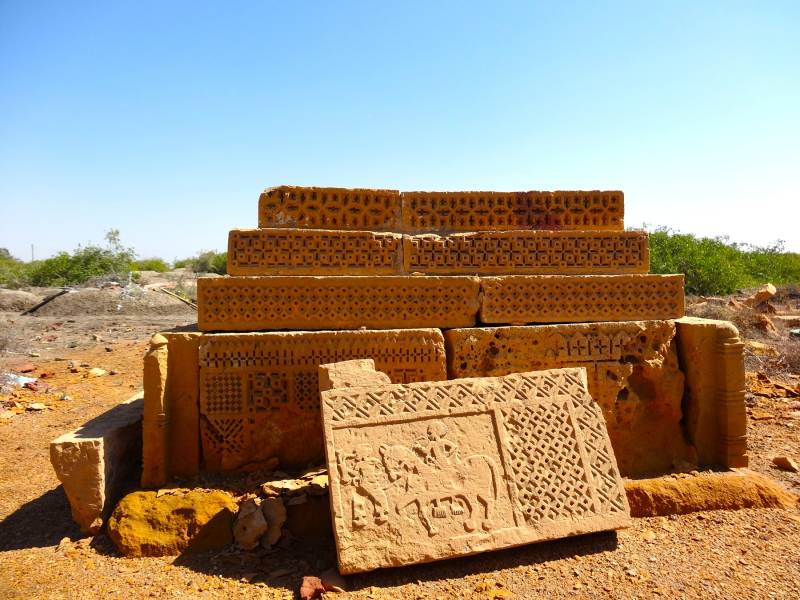
The mounted riders are seen with attendants on Raj Malik tombs. Sometimes they are shown holding weapons, and sometimes holding a hookah. One of the most impressive tombs in the Raj Malik shows three decorative slabs on the northern side of the platform; three graves are located on this platform. The three decorative slabs depict mounted riders, on-foot attendants, and jewellery. A slab on the right depicts the most refined depictions of riders. This slab depicts three mounted riders and three on-foot figures, with jewellery depictions carved behind the mounted figures. This is such a marvellous piece of art seen at the Raj Malik necropolis. One cannot say with certainty that the artisans tried to portray a battle scene. Such equestrian scenes with attendants are commonly found at several tombs at various graveyards in Sindh.
The front rider, who leads two other riders, is on a caparisoned horse with a saddle cloth suspended with tassels, reflecting how skilfully the artisan engraved it. The two other riders are shown smaller than the front rider, reflecting his power and status. The three figures are engraved in front of the three riders. Two of the attendants are portrayed as armed men equipped with swords and axes. Interestingly, their swords remain sheathed, while the axes are held prominently in their hands. This artistic choice may indicate that the axe was regarded as an immediate weapon. At the same time, the sword served as a secondary arm. All this gives valuable insight into the martial culture represented on the Raj Malik tombs.
Axe-holding figures are carved in several tombs not only at Raj Malik but at various other graveyards in Sindh. Apart from axe-holding figures, one can also observe a few gun-holding figures or warriors. Some gravestones depict guns and swords with shields separately. The artisans also tried to engrave a variety of weapons with the figures, whether they are on foot or mounted. Erosion has damaged the third figure on the decorative slab. Two bangles and rings are depicted behind the two riders on this slab.
The Symbolism of Jewellery
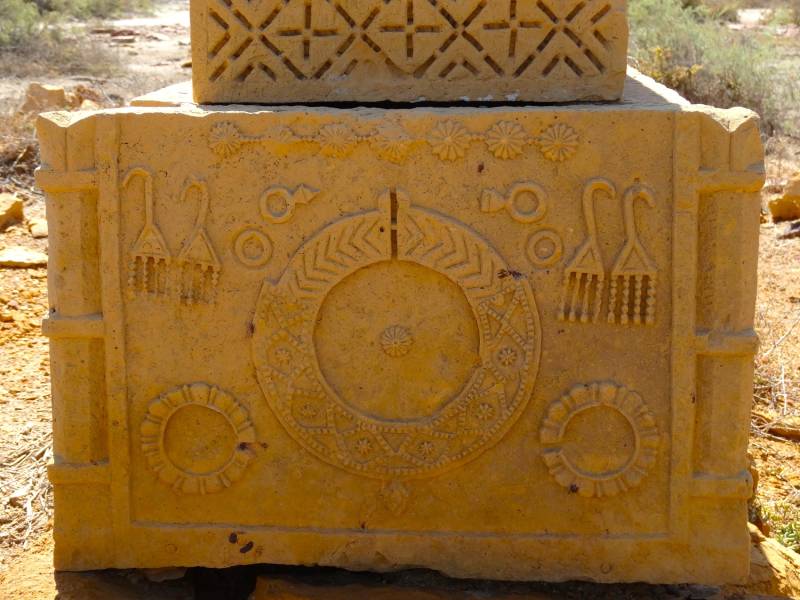
The next slab depicts a variety of jewellery. They include neck, nose, ear, ankle, and arm ornaments commonly worn by women. The necklaces, bangles, earrings, and finger rings are clearly outlined on this slab. The details of each jewellery piece reflect the keen observation of the artisans. These were the jewellery items worn in the 16th, 17th, 18th, and 19th centuries in Sindh. The artists tried to show almost all the jewellery items on this slab.
The artisans displayed remarkable skill in arranging the jewellery motifs across the surface of the tombstones. Rather than overcrowding the slab, they carefully selected the central area for the most prominent ornaments. Necklaces usually occupied this focal space, complemented by earrings, nose rings, armlets, bracelets, and anklets, creating a balanced and visually harmonious composition. Yet no fixed design was followed on every grave. Each artisan exercised creativity in deciding how to use the available space and which ornaments to depict. Some tombstones feature elaborate necklaces, while others are adorned only with bangles or a more limited selection of jewellery. The aim was not to reproduce a standard pattern but to represent the most prized ornaments in an aesthetically pleasing arrangement.
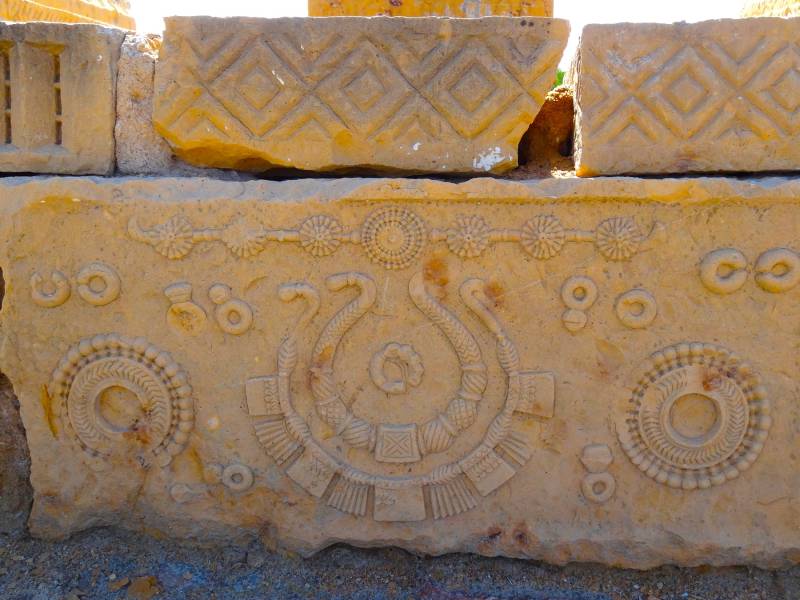
These compositions reveal the artisans' keen sense of proportion, symmetry, and visual balance. Every motif was thoughtfully placed at the Raj Malik necropolis, reflecting years of experience, technical skill, and artistic confidence. Patrons sought out craftsmen whose reputation rested on their ability to transform stone into elegant works of funerary art, and each tombstone became a testament to that mastery.
The jewellery motifs carved on the Kalmati tombstones therefore speak of more than personal adornment. They express the identity, taste, and social aspirations of the communities that commissioned them, while also preserving the artistic identity of the craftsmen who created them. Through their imagination, patience, and exceptional craftsmanship, these artisans transformed ordinary stone into enduring monuments that continue to captivate and inspire each new generation to admire the beauty and symbolism they left behind.
A Vibrant Stone Tapestry
The next slab on the left depicts a mounted rider escorted by four attendants—two on either side. Among the figures on the right, one is shown leisurely smoking a hookah or chillum. Beneath him stands an armed attendant carrying a gun. On the left, the two attendants are equipped with an axe and a firearm, respectively. These carefully carved figures create a vivid scene that combines martial imagery with everyday life, revealing both the prestige of the mounted rider and the cultural world in which he lived.
Apart from riders, gun-holding and hookah-smoking figures, attendees, and hunting scenes, one can also find a gravestone that depicts a hero returning with recovered cattle. Such scenes of heroes depicted with recovered cattle are commonly found on memorial stones in Tharparkar. It is rare to see such imagery on stone-carved tombs in Sindh.
Beyond the figural and jewellery motifs, the tombstones are richly embellished with geometric and floral designs that fill almost every available space. The intricate patterns create a striking visual effect, recalling the vibrant designs of a traditional Sindhi ralli (appliqué quilt). Viewed from a distance, these Kalmati tombs appear almost as though they have been draped in a beautifully stitched ralli, transforming stone into a surface that evokes the warmth, colour, and artistry of Sindh's celebrated textile tradition. This remarkable interplay of stone carving and textile-inspired design reflects the extraordinary imagination and craftsmanship of the artisans who created these monuments.