

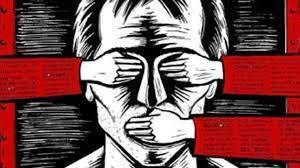
Modern societies frequently invoke free speech as though the right to utter opinions guarantees liberation. Yet freedom of articulation is hollow without autonomous cognition, disciplined reflection, and epistemic responsibility. Expression emerging from unexamined assumptions, inherited prejudices, or reactive sentiment cannot legitimately claim independence. Hannah Arendt, in The Human Condition, identifies speech as inseparable from the internal life of judgment and conscience.
Political discourse devoid of introspection transforms liberty into spectacle, subverts rational deliberation, and amplifies conformity. The twentieth-century rise of fascist propaganda in Europe or McCarthy-era rhetoric in the United States exemplifies the perils of expression divorced from critical thought.
Historical philosophers underscore the interdependence between thought and expression. John Locke, in An Essay Concerning Human Understanding (1689), insists that reasoned reflection is the foundation of moral and social agency. John Stuart Mill, in On Liberty (1859), argues that liberty is meaningful only when individuals engage in rigorous examination of competing claims, confront potential errors, and cultivate intellectual humility. Montesquieu, in The Spirit of Laws (1748), demonstrates that institutional arrangements shape the quality of discourse, illustrating that liberty cannot exist in isolation from structural conditions.
Linda Zagzebski, in Virtues of the Mind (1996), supplements this understanding by showing that intellectual virtues such as open-mindedness, attentiveness, and courage are prerequisites for epistemically responsible communication. Speech that neglects these virtues is not liberating but performative, reproducing societal dogmas under the guise of autonomy.
Cognitive psychology confirms that human reasoning is vulnerable to heuristics and biases that privilege salience, emotion, and immediacy over deliberation. Daniel Kahneman, in Thinking, Fast and Slow (2011), demonstrates how availability heuristics generate misperceptions, while Nassim Nicholas Taleb, in The Black Swan (2007), highlights the disproportionate influence of rare but alarming events on collective judgment. Jonathan Haidt, in The Righteous Mind (2012), shows how moral intuitions often precede reasoning, reinforcing group biases unless deliberately examined.
Misconceptions, such as exaggerated narratives of criminality, social threat, or health crises, persist because emotional resonance overrides evidentiary accuracy. Genuine freedom of expression presupposes cognitive cultivation, emotional regulation, cultural reinforcement of critical thinking, and epistemic discipline that counteract instinctual distortion.
To speak freely, individuals must first think freely, and to think freely, societies must invest in education, knowledge production, independent media, and civic virtue
Structural conditions are equally critical for authentic expression. Jürgen Habermas, in The Theory of Communicative Action (1984), defines an ideal speech situation as one in which participants are free from coercion, deception, and epistemic inequality. Michel Foucault, in Discipline and Punish (1975), illustrates that knowledge and power are inseparable, and institutional control over information constrains meaningful discourse.
Shoshana Zuboff, in The Age of Surveillance Capitalism (2019), details how algorithmic curation and digital platforms manipulate attention and shape perceptions, effectively constraining thought before speech. Media monopolies, viral misinformation, and digital echo chambers are contemporary instruments of epistemic domination, not merely inconveniences. Societies that preserve mechanical rights to speak while allowing information environments to be captured by concentrated authority fail to protect the conditions of authentic liberty.
Education functions as the primary safeguard for internal freedom. Systems emphasising rote memorisation or doctrinaire instruction produce citizens skilled in recitation but unprepared for critical deliberation. Curricula that foster logic, philosophy, and civic literacy cultivate the intellectual virtues that render speech meaningful. Similarly, public institutions—including independent media, libraries, scientific communities, and civic associations—serve as societal scaffolding, creating environments in which free thought can flourish. Liberty is relational, dependent not only on individual cognition but on the epistemic ecosystem in which discourse occurs.
Interpersonal ethics constitute a further dimension of freedom. Loretta J. Ross, through her concept of call-in culture, emphasises dialogue grounded in patience, attentiveness, and moral sensitivity. Philosophers such as Robert Audi, in Epistemic Authority (2011), and Miranda Fricker, in Epistemic Injustice (2007), show that credibility, careful listening, and respect for interlocutors are essential for discourse that genuinely illuminates truth. Absent these qualities, speech is performative, reactive, and destructive, producing noise rather than understanding. Civic virtue, empathy, and intellectual humility are indispensable components of a society capable of sustaining rational deliberation.
Contemporary theorists reinforce the stakes of epistemic integrity. Cass Sunstein, in Republic.com 2.0 (2007), warns that digital echo chambers fragment knowledge communities, fostering polarisation and constraining deliberative reasoning. Neil Postman, in Amusing Ourselves to Death (1985), emphasises that entertainment-driven communication diminishes the capacity for critical engagement.
Yuval Noah Harari, in 21 Lessons for the 21st Century (2018), identifies misinformation and cognitive manipulation as existential threats to social cohesion and collective judgment. Speech cannot remain free if societies fail to cultivate epistemic literacy, safeguard truth-oriented institutions, and resist cognitive capture.
Critics might argue that emphasising the cultivation of thought risks paternalism, constraining the very liberty it seeks to preserve. Yet the argument is not for limiting speech itself but for investing in the conditions that make speech genuinely emancipatory. The restriction lies not in prohibition but in promotion of reflection, critical faculties, and supportive institutions. Free thought is inseparable from free speech; both require deliberate scaffolding.
The moral and political responsibility of citizens is therefore inseparable from the exercise of freedom. Kantian ethics, articulated in Critique of Practical Reason (1788), insists that autonomy, rational deliberation, and moral courage are prerequisites for ethical action. By analogy, autonomous thought and reflective judgment are necessary for speech to be morally and epistemically defensible.
Citizens are not merely recipients of liberties; they are co-architects of the epistemic and institutional frameworks that enable authentic discourse. Noise and assertion without deliberation are incompatible with liberty, producing epistemic chaos rather than social emancipation.
Freedom of speech, properly conceived, is not the absence of external constraint but the cultivation of internal, relational, and institutional capacities. It is the product of moral apprenticeship, cognitive discipline, and social scaffolding. To speak freely, individuals must first think freely, and to think freely, societies must invest in education, knowledge production, independent media, and civic virtue.
Anything less reduces expression to spectacle, undermines intellectual autonomy, and transforms liberty into amplification without understanding. Genuine freedom depends on cultivated minds operating within environments that reward reflection, accountability, and truth-seeking. Without these conditions, expression becomes a hollow performance rather than an exercise in emancipation.