

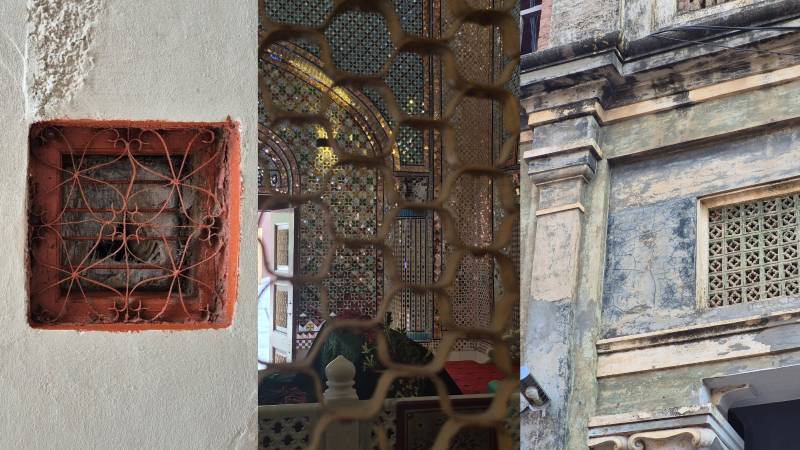
The city greets you with winding, narrow lanes, the wafting scent of old wood from doorways left half-open. The inhabitants are warm and proud; their havelis are open for all. I am almost tempted to peer inside, like the fairy tales of my childhood—a magical doorway with a secret garden beyond—but propriety stills my hand.
Our modern sensibilities dictate that polish and perfection are the measure of worth: smooth walls, straight lines and carefully curated façades. Bhera does not meet these expectations, nor does it pretend that it would. Layers of peeling paint, cracks in plaster that reveal bricks placed by hands long gone but not forgotten. Through its current disorder, Bhera reveals a beauty far older and more enduring than any convention could define.
Accompanying a delegation from Hast O Neest, led by Ustad Taimoor Khan Mumtaz, we embarked on a day-long journey visiting masjids and mohallahs, the winding streets leading to another local treasure trove of culture. This was my first acquaintance with Bhera, the city, and not Bhera the motorway service area. While Taimoor Sahib offered insight into regional architectural craftsmanship, Mr Jafar Majid, our local tour guide, enriched the experience with stories drawn from local customs and traditions. From this, it was clear that Bhera is not a city that was simply built; it is a city accumulated. Waves of Muslim, Hindu and Sikh settlers left their marks like handwriting behind, stitching themselves into the urban fabric of this venerable city.
Bhera is undergoing renovation via the “Magnificent Punjab” Heritage City Project initiative. For centuries, Bhera has worn its age without apology. At the heart of the project, a fine line between preservation and erasure is being trodden. Ruins are not just signs of neglect; they are textures of memory. Each crack in the façade, or each faded motif etched onto the masjid walls, is a historical document in itself.
Despite the architectural wonders of northern Punjab around us, the sights that drew me in the most were the signs of life. Rusted hinges, colourful bits of paper tied to the jali of a window, bright technicolour trash candy wrappers heaped upon an ashen pile of debris. Something is moving and soulful about how the occupation of a space takes on a life of its own, as if it were a living, breathing person. Bhera is crooked, bright and unabashed.
Scratches, mismatched bricks and traces of older paint have become a quiet archive of lived and shared narratives, perhaps even the stories of travellers like us
In this sincere desire to preserve the town, one cannot help but wonder what is being protected and what might be lost as a result. Renovation projects aim to make the tapestry of history legible: to straighten a wall, repaint a façade and impose uniformity where none ever existed. I firmly believe that a house has its own ecosystem. Every building has a soul. The fissures in the walls are the veins; the lifeblood is fuelled by the stories and histories of saints, warriors and poets who lodged within these houses. Through the rubble and the debris, a new life emerges. Walls are storytellers in their own right. Scratches, mismatched bricks and traces of older paint have become a quiet archive of lived and shared narratives, perhaps even the stories of travellers like us. These subtle details contribute more to Bhera’s atmosphere than any polished façade could.
To ensure that the cultural identity and authenticity of Bhera remain intact, the local populace should have the highest say in how they wish to preserve their history—not just oral, but physical and tactile: these tangible four walls that surround them. To involve residents in decision-making is the highest sign of respect; to repair without replacing the original texture of their existence, a functional rather than cosmetic overhaul.
To them, these are not signs of neglect; they are signs of living. Even the broken steps of old staircases remember the rhythm of hurried feet. There is a fine line to tread between preservation and tidying away the soul of the city. The purpose of renovation is to strengthen physical foundations, not overwrite the poetry of imperfection. What drew my attention were the older walls and woodwork; the depth of visual complexity and rustic beauty they provide cannot be imitated by fresh plaster or renewed paint.
Ultimately, what lingers with me from this trip is not merely the architecture alone, but the life that moves through it—through the residents and the chaotic evidence of their existence. The feeling that Bhera continues to speak and breathe, unfolding its stories to anyone who dares to take the path less trodden and pause long enough to listen. Renovation will come, as it must, but its true success will lie in allowing the city’s spirit to retain its unhurried essence. Bhera has never needed perfection to be beautiful; its grace lies in the quiet conversation between past and present, and in how we choose to carry this conversation into the future. Each brick has its own part to play, if we trust its walls to guide us.