

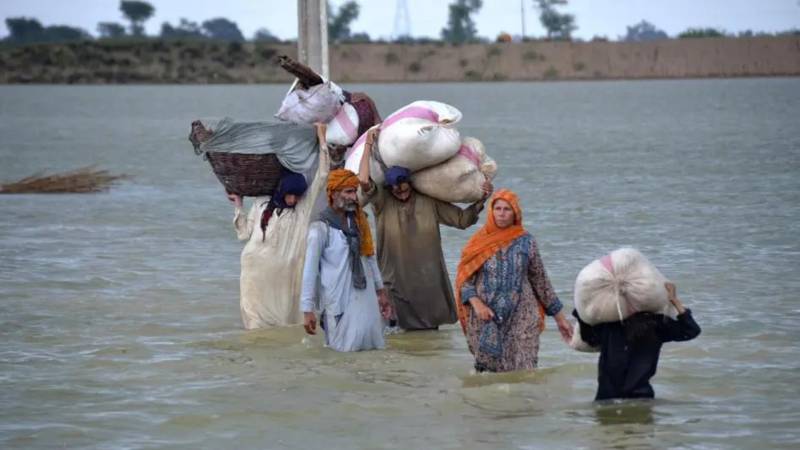
Since the floods of 2010, Pakistan’s people have endured not only the wrath of nature but the betrayal of those entrusted to protect them. The Federal Flood Commission (FFC), established as the nation’s guardian against flood devastation, has become a symbol of incompetence and corruption, hiding behind the convenient excuse of climate change. Whenever rivers burst their banks and plains turn into oceans, the Commission’s spin masters shift blame upward, pointing to the skies, while the rot beneath their feet remains concealed. Billions upon billions have been squandered in the name of protection, yet protection has never come.
The floods of 2010 were a watershed moment. Pakistan sought salvation in science, appealing to the Netherlands after the flood of 2022—the world’s masters of water—to provide guidance. Six years later, in 2016, the Dutch delivered a judgment both simple and devastating: the FFC did not know how to design site-specific embankments, the most basic element of flood defence. Instead, they copied outdated designs across landscapes with no regard for gradient, flow, or terrain, repeating the same fatal errors like a ritual of negligence. The truth was unmasked, but those who held power chose concealment over correction, preferring to continue the theatre of excuses.
That silence led directly to the horror of 2022. When unprecedented floods swept through Pakistan, the Dutch warnings came alive in dreadful clarity. Embankments ruptured, spurs crumbled, bunds dissolved into the current. What should have been lines of defence turned into instruments of death. The lamentable state of these embankments—without maintenance, without repair, without monitoring—was a primary cause of the disaster. Funds had been earmarked every year for their upkeep, yet the water revealed their true condition: hollow monuments to theft.
The Dutch had not only condemned embankments. As early as 2016, they warned that barrages and bridges with low flood-passing capacity created choke points, causing upstream floods that battered flood protection works. Eight years later, those same flaws magnified the fury of 2022.
It was not the sky that betrayed Pakistan. It was the ground. It was corruption, not climate change.
Despite repeated infusions from the World Bank, UNDP, JICA, and USAID, the FFC remains an institution of paper, incapable of protecting life on the ground
The most glaring evidence came from the World Bank and IDA-financed Sukkur Barrage restoration project, valued at $286 million. Approved in 2015, it was meant to replace 18 critical gates by 2020. Yet by 2022, it lay unfinished, crippled by delays, scandals, and bribes. A shocking 15 of its 42 gates were non-operational when the floods arrived. Instead of releasing the rising waters of the Indus, the barrage became a stranglehold, suffocating Manchar Lake and drowning the lands around it. The devastation was not a natural inevitability but the direct child of theft and incompetence.
A complaint filed by the Chinese firm executing the project exposed the grotesque underbelly: the Project Director demanded an apartment in Dubai’s Burj Khalifa as personal payment. This single request, obscene in its audacity, offered only a glimpse of how public funds are siphoned away while citizens are left to drown. Pakistan’s global reputation too was dragged into the mud; partners and investors recoiled at the naked bribery, their trust shattered.
The degradation of institutions was further exposed when, in the aftermath of the floods, the FFC’s own chairman wrote to USAID, begging for training at the U.S. Army Corps of Engineers. After nearly five decades of existence, after billions poured into its coffers, the Commission admitted it did not know its craft. Instead of competence, there was only dependency, and instead of vision, only selfishness. The Asian Development Bank’s $50 million Kotri Barrage gate restoration project stands as another empty shell, money spent with little to show, a symptom of systemic decay.
This is why the constant invocation of climate change is a fraud. To insist that Pakistan’s floods are only the product of a changing climate is to erase the truth of decades of graft, negligence, and deliberate mismanagement. Climate change has become the FFC’s most reliable alibi, a way to open the tap of donor generosity while evading accountability. Each disaster becomes a funding opportunity, each drowned village a bargaining chip for more aid, and each international conference another platform to plead helplessness.
But the record is clear. The Dutch identified fundamental flaws in 2016, and the 2022 floods revealed that nothing had been corrected. The catastrophe was worsened by man, not nature.
Nowhere was the betrayal more heartbreaking than in Balochistan. There, ten dams collapsed under the weight of the floods, despite the presence of the Dam Safety Council, formed in 1987 to prevent such tragedies. These dams failed not because of water’s might alone but because they were built with weak cement, substandard material, and corrupt intent. The government tried to shift blame onto contractors, but the Contractors’ Association fought back, revealing the truth: half of every dam’s cost had been stolen by engineers, bureaucrats, and ministers. The floods tore not only through villages but through trust itself, leaving survivors not just homeless but betrayed.
The farce of “capacity building” adds insult to injury. Donor funds for training and development have too often turned into foreign tours, where officials pocket per diems and return empty-handed. Despite repeated infusions from the World Bank, UNDP, JICA, and USAID, the FFC remains an institution of paper, incapable of protecting life on the ground.
To continue under the FFC is to invite more death, more destruction, more betrayal
Justice Mansoor Ali Shah, now of the Supreme Court, saw this clearly when he authored A Rude Awakening after the 2010 floods. That tribunal report condemned embankment breaches, exposed the failures of irrigation authorities, and offered detailed reforms. Yet the report was buried, left unpublished for years, a victim of the very neglect it sought to cure.
In 2019, an international panel of experts produced another comprehensive study, the National Flood Protection Plan, with recommendations to modernise embankment standards and introduce site-specific designs. They pleaded for change, noting that Pakistan was still using four-decade-old copy-paste designs for vastly different terrains. Their warnings, like Shah’s, were ignored. By 2022, the price was $30 billion in damages, much of which could have been avoided had those recommendations been acted upon.
Floods, of course, are not new. The Indus has drowned cities since Mohenjo-Daro. Since independence, Pakistan has endured devastating floods in 1950, 1973, 1976, 1988, 1992, 2010, and now 2022. Over 12,300 lives have been lost, and $38 billion destroyed. Yet the FFC, despite billions in aid and decades of existence, remains paralyzed. Its structures—embankments, spurs, gabions—stand as hollow monuments, breaking apart with each season, while officials insist it is the climate alone at fault.
The 2022 floods were a calamity without precedent, cascading from the arid hills into the plains, swallowing Balochistan and Sindh whole. They revealed what had long been true: Pakistan’s flood management system is not merely weak; it is willfully broken. The most horrific dilemma in Pakistan is a tragedy beyond words: those entrusted with steering the nation’s climate policy possess little grasp of science itself. Their ignorance hides behind the polished language of glossy reports and the grandeur of five-star hotel seminars, where borrowed phrases echo like hollow chants. After the catastrophic floods of 2010, the spin masters of the FFC revived these paper experts, who cloak themselves in narratives of doom and declare climate change a curse from the heavens—yet when it comes to real solutions, their knowledge is empty.
Sustained only by the oxygen of foreign funding, they speak of reducing greenhouse gases, of flood zoning, of carefully designed mitigation structures that should account for slope, flow, and site. Yet in practice, nothing has taken shape on the ground. What remains is a legacy of advocacy without substance, of voices louder than their science, of promises unbacked by engineering. And so the nation continues to drown, while its so-called guardians drift above the waters, held afloat only by recycled words.
A tragic irony lingers. In 2008, a real-time monitoring system was pioneered at the Planning Commission to track development projects, ensure accountability, and maintain quality. Had such a system been implemented for flood management, even trillion-dollar investments could have yielded safety. Instead, projects remain opaque, corruption unchecked, and outcomes catastrophic.
The lesson is clear, though endlessly ignored. Floods are natural, but disaster is manufactured. Climate change is not the sole enemy; corruption is. Incompetence is. The refusal to implement zoning laws, to demarcate floodplains, and to enforce regulations has turned Pakistan’s most fertile lands into death traps.
And so the story repeats. Each flood washes away not just homes and crops but trust in institutions. Each recovery is delayed not by lack of funds but by theft of them. Each international plea rings hollow, for the world now knows the truth: the floods are not only the work of nature, but of a Commission that has traded its mandate for profit.
Pakistan stands at a crossroads. To continue under the FFC is to invite more death, more destruction, more betrayal. The Commission must be dissolved or merged into WAPDA, which at least has a record of competence in water management. Without such reform, the next flood will come not as a surprise but as an inevitability, its waters carrying not only silt and ruin but the stench of corruption.
The people of Pakistan deserve honesty. They deserve embankments that stand, dams that hold, and leaders who do not pocket their survival. Until that honesty arrives, the floods will keep coming, and with them the sorrowful truth that it was not the river that drowned Pakistan—it was the betrayal of those sworn to protect it.