

They say life is full of chance encounters. Sometimes, a single moment, one person, one meeting, one ordinary day, can change everything. The path we thought we were on disappears, and we find ourselves walking into stories we never dreamed of. Something like that happened to Pran. One unexpected meeting tilted the compass of his life forever. But before that moment, let’s turn a few pages back.
It was 12 February 1920. In the narrow, vibrant lanes of Delhi’s Ballimaran, a place of poets, paan shops, and old havelis, a baby boy was born in the home of Kewal Krishan Sikand, a civil engineer by profession. The family was prosperous and cultured, with four sons and three daughters. Pran was the name given to the boy.
Because of his father’s profession, the family never stayed in one place for long. The rhythm of Pran’s early life moved with the rhythm of trains: Dehradun, Kapurthala, Meerut. Each city left its own impression, but Delhi remained the soil of his roots. He was a good student, sharp with his books and observant by nature. Yet what truly caught his attention was the magic of photography. He had a quiet fascination with light, shadows, and faces. In Ballimaran, he would often wander into A. Das & Co., one of Delhi’s best-known photo studios. One day, he gathered the courage to speak to the owner and confessed his passion. The owner, sensing the sincerity in the boy’s voice, gave him a place as an apprentice.
While Delhi nurtured his eye, it was Lahore that would stir his destiny. In the late 1930s, Lahore was not just a city; it was a living, breathing world of language, literature, theatre, and song. Its air carried the smell of printing presses, kebabs, and fresh ink. It had the openness of a city that welcomed dreamers. Pran arrived in Lahore in search of better prospects. He was only nineteen, tall and striking, his eyes alive with curiosity, his smile gentle but knowing. He loved paan, and on one otherwise ordinary day, he went to his favourite paan shop to get his usual. That was the day everything changed.
He was savouring the paan, lost in its tang, when he felt someone’s eyes on him. A man approached him and said, “Would you like to act in films?” Pran chuckled, half amused, half curious. “If you can get me in, I’ll do it,” he replied, almost playfully. The man was Wali Mohammad Wali, a screenwriter in the film industry. The following week, Wali took him to Pancholi Art Studios, one of the most prominent film studios in Lahore.
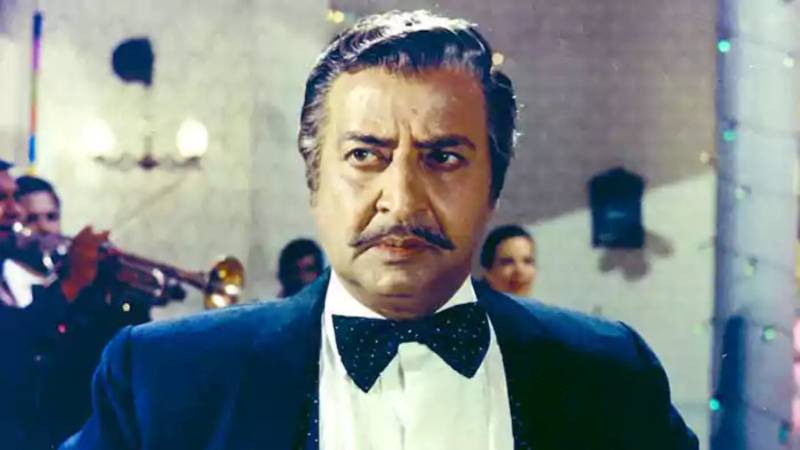
His performances earned him the title of “Villain of the Century,” a recognition few could match
At that time, Dalsukh Pancholi was making a Punjabi film called Yamla Jatt. Pran was cast in it. A very young Noor Jehan, not yet the legend she would become, was also acting in the film as a child artist. It was in that moment, standing outside a humble paan shop, that nineteen-year-old Pran was pulled into the whirlpool of cinema, an industry waiting with open arms, carrying the promises of fame, fortune, and a place in people’s hearts.
After Yamla Jatt, Pran was cast in two more films: Chaudhry and Khazanchi, both released in 1941. These were films that did well, and his face began to be noticed. In 1942 came Khandaan, a film that would become a landmark in his early career. He was cast as the lead opposite Noor Jehan, now fifteen. Because Pran was much taller, she had to stand on bricks for their close-up scenes. Khandaan was a success, but even as he played the romantic hero, Pran sensed that something wasn’t quite right. In a later interview, he admitted he never enjoyed singing duets around trees or dancing for the camera. That wasn’t him. His instincts pulled him elsewhere. And so, he chose the shadows, the role of the villain.
By the mid-1940s, Pran had found stability in his career. In 1945, he married Shukla, and together they had three children. Life seemed to be settling into a rhythm. But history had other plans. In 1947, Partition arrived like a storm. Pran was not in Lahore when the violence erupted. When he returned a few days later, the city he loved had changed beyond recognition. Lahore, the same Lahore that had welcomed him, was now scarred and broken. He stayed for three days. Then he left, heartbroken, and returned to Bombay.
His career was in ruins. He had to start from scratch. It was not easy. But fate still had a place for him. Through the support of close friends, Saadat Hasan Manto, the famous short story writer, and the actor Shyam, Pran was cast in Shahid Latif’s film Ziddi. It was a small role, but it lit the spark again. From there, a new journey began.
Pran brought discipline to an industry known for chaos. He was never late. People would set their watches by his arrival on set. Off camera, he was courteous, cultured, even soft-spoken. But the moment the camera rolled, he transformed. His eyes glinted with menace. His lips curled into a villain’s smile. His voice turned cold. When he blew smoke rings into the air, people in the audience could feel their spines tighten. Even co-actors admitted to feeling a shiver in his presence. Pran’s on-screen menace became so iconic that it spilled into real life. People began to fear the name. In the 1950s, 60s, and 70s, families avoided naming their children “Pran.” That was the weight of his performances.
And yet, the roles kept coming. Pilpili Sahib, Halaku, Madhumati, Jis Desh Mein Ganga Behti Hai, Shaheed, Inkaar, Ram Aur Shyam, Aansoo Ban Gaye Phool, Purab Aur Paschim, Johny Mera Naam, Victoria No. 203, Be-Imaan, Zanjeer, Majboor, Amar Akbar Anthony, Don, Sharabi, and Duniya. And the list kept growing. He adapted with every era. From the black-and-white films of the 1940s to the explosive action flicks of the 1980s, Pran stayed relevant. He saw villains evolve, from punches to sticks, from pistols to machine guns. He kept pace with every change.
His performances earned him the title of “Villain of the Century,” a recognition few could match. With Manoj Kumar, he gave some of his most memorable performances, Upkar, Purab Paschim, Be-Imaan, Sanyasi, and Dus Numbri. He won the Filmfare Award three times for Best Supporting Actor, for Upkar (1967), Aansoo Ban Gaye Moti (1969), and Be-Imaan (1972). In 2001, he received the Padma Shri. In 2013, he was honoured with the Dadasaheb Phalke Award, Indian cinema’s highest accolade.
Even in the dazzling world of Bombay cinema, Pran never forgot Lahore. The scent of its streets, the cadence of its language, the magic of its evenings, all stayed with him. And perhaps what remained most deeply etched was that one coloured evening in the old city. That dusky moment, standing at a paan shop, tasting something sweet and sharp, when life quietly leaned in and whispered, “Come with me.”