

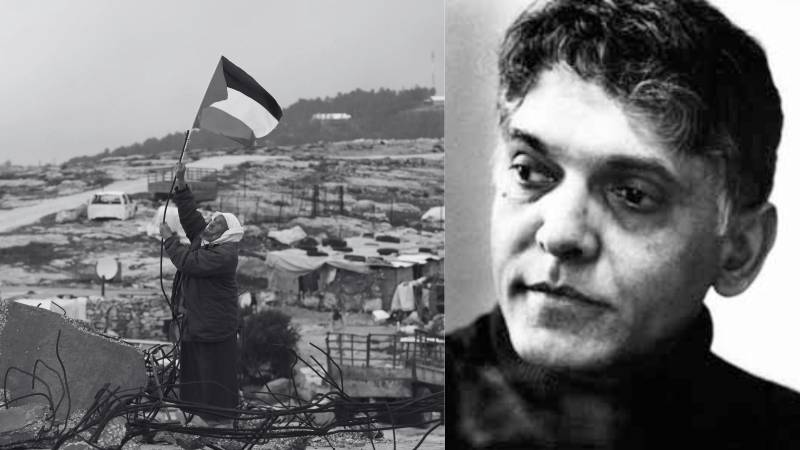
Eqbal Ahmed, the renowned Pakistani intellectual, scholar, and activist, offered a profoundly moral and anti-imperialist perspective on the Palestine-Israel conflict, one rooted not in sectarian loyalty, but in a deep understanding of colonial history, justice, and human dignity. His views remain relevant today as the conflict persists, mired in layers of historical injustice and geopolitical complicity. Throughout his writings and speeches, Ahmed consistently framed the Palestinian issue as one of a colonised people resisting an expansionist settler colonial project backed by global powers, particularly the United States. Unlike many commentators who focused on the religious or ethnic dimensions of the conflict, Eqbal Ahmed emphasised its political and historical context. To him, the displacement of Palestinians and the establishment of Israel in 1948 marked a continuity of colonial logic similar to the dispossession of Native Americans, the Algerians under French rule, or the South Africans under apartheid. He believed that the root cause of the conflict was not religious animosity, but the violent seizure of land and suppression of indigenous people.
One of Eqbal’s most powerful critiques was of the West’s double standards. Eqbal challenged the idea of global peace and how the West reacted differently at various instance, he noted how Western liberal democracies, especially the United States, emphasised human rights at home while financing Israeli occupation and turning a blind eye towards the Palestinian suffering. He was deeply critical of American foreign policy, which, in his view, enabled Israel’s expansionist ambitions by providing unconditional diplomatic, military, and financial support. This support, Ahmed argued, strengthened Israel to pursue settlement expansion, engage in military aggression, and undermine any real prospects for a two-state solution.
Eqbal Ahmed also had a sharp eye for the failures of the Arab regimes. He criticised many Arab leaders for using the Palestinian issue rhetorically while doing little to practically support the cause. In his analysis, these regimes often suppressed democratic movements in their own countries and used Palestine as a distraction. At the same time, he was not uncritical of Palestinian leadership either; he criticised the approach of the PLO and Arafat, especially after the Oslo Accords, which he saw as a betrayal of the Palestinian right of return and self-determination. He viewed the peace process not as a sincere path to justice but as a managed surrender designed to placate Palestinians while maintaining the status quo.
To remember Eqbal Ahmed is to remember that intellectual integrity requires courage, the courage to speak uncomfortable truths, to challenge power, and to align oneself with the oppressed even when it is unpopular
A key contribution of Eqbal Ahmed was his attempt to reframe the language of the conflict. He consistently used the vocabulary of resistance, colonialism, and liberation rather than one of terrorism or religious conflict. He compared the Palestinian resistance to other national liberation movements, from Vietnam to Algeria, arguing that oppressed people have a right to resist occupation. He warned against reducing Palestinians to either terrorists or victims, consistently insisting on recognising their agency, culture, and historical experience. In his numerous lectures across American universities, Ahmed sought to educate the Western public about the real nature of the conflict. He believed that public opinion in the West, especially in the U.S., was a critical battlefield. The portrayal of Palestinians in Western media, he noted, was deeply biased, often depicting them as irrational aggressors while omitting the structural violence of occupation, checkpoints, home demolitions, and siege.
Eqbal’s strength lay in his ability to speak with moral clarity without falling into simplistic binaries. He acknowledged the historical trauma of the Jewish people, including the Holocaust, but argued that this suffering should not justify the subjugation of another people. He often quoted Jewish intellectuals like Noam Chomsky, Israel Shahak, and Hannah Arendt to demonstrate that moral opposition to Israeli policies did not equate to anti-Semitism. In fact, Eqbal warned that amalgamating criticism of Israel with anti-Semitism was a tactic used to silence legitimate dissent and shield oppressive policies from scrutiny. His vision for a resolution was rooted in justice, coexistence, and decolonisation. While he sympathised with the idea of a two-state solution, he increasingly grew skeptical about its feasibility, given the encroachment of settlements and fragmentation of Palestinian territories. He favored a more radical yet humane solution: a binational democratic state where Jews and Palestinians could live as equals, with equal rights, shared sovereignty, and mutual recognition. He acknowledged that this idea was utopian in the current political climate but believed it represented the only truly ethical and sustainable resolution. Eqbal remained critical of a two-state solution, citing the fear of hostility that would continue to exist across both sides. He argued that nations built on the notion of hostility and strife would not be able to develop harmony and would create further complexities in their relations.
Eqbal’s advocacy extended beyond academic and intellectual circles. He stood with Palestinian students, participated in protests, and consistently used his platform to amplify marginalised voices. He understood that solidarity with Palestine was not just a political position but a moral obligation for anyone opposed to injustice and colonialism. In today’s world, where the Palestine-Israel conflict remains unresolved and marked by ongoing violence, displacement, and geopolitical manipulation, Eqbal Ahmed’s voice continues to echo with remarkable clarity. His insistence on contextualising the conflict historically, his critique of empire and power, and his unwavering commitment to justice make him a guiding light for scholars, activists, and ordinary citizens seeking a just peace.
To remember Eqbal Ahmed is to remember that intellectual integrity requires courage, the courage to speak uncomfortable truths, to challenge power, and to align oneself with the oppressed even when it is unpopular. In an age of polarisation and propaganda, his legacy reminds us that peace without justice is merely submission, and that the struggle for Palestine, like all struggles for liberation, must be rooted in truth, empathy, and moral clarity.