

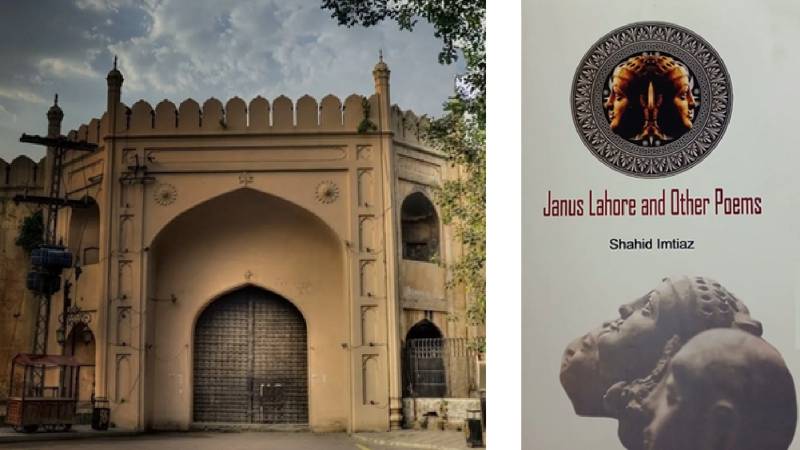
Lahore’s air is imbued with creativity. If a person spends a considerable part of his life in this city and remains in touch with the literature of the soil, he eventually attempts to express his affection for this majestic metropolis through some form of creative expression. Be it painting, prose or poetry, the Lahori side of a creative individual is duly reflected in his work, transforming his bond with the city into an everlasting affair. Similar is the relationship of Shahid Imtiaz, whose poems on Lahore and other themes have recently been published. Quite interestingly, he has titled his anthology Janus Lahore and Other Poems. In Roman mythology, Janus is the god of “beginnings, gates and doorways” and the month of January is named after him.
Dr Shahid Imtiaz is an academic based in Lahore. He is currently serving as the Head of the Department of English at Riphah International University. His other work, also centred on Lahore, is written in prose and titled Amorphous Lahore: Colonial and Postcolonial — A Journey Through History and Fiction. Apart from the first two chapters, the book is based on his PhD thesis and is, as the title suggests, an amalgamation of historical and fictional narratives.
The opening page of his new book bears a brief dedication that reads, “To the city of Lahore,” reflecting Imtiaz’s abiding love and affection for the metropolis. This is followed by an eminently encouraging introduction penned by Dr Waseem Anwar, Professor of English and Director ICPWE, and a preface by Dr Rizwan Akhtar, an acclaimed poet and Professor of English at the Institute of English Studies, University of the Punjab. While Anwar muses over the poetic traditions of the past and present and appears hopeful that Taufiq Rafat’s legacy of the “Pakistani Idiom” will be carried forward by upcoming generations of poets, Akhtar maintains his razor-sharp focus on Imtiaz’s poems and offers a critical opinion on some of their run-of-the-mill elements.
Calling it a 'City of Sinful Delight,' Imtiaz captures the essence of Lahore as a metropolis that keeps changing its masks from time to time
Imtiaz’s poems are personal and political, nostalgic and forward-looking. Some subtly point towards the battles his heart fought on account of unrequited love. In his first poem, Escape, he writes: “Now forever that we are apart/ My life again I will try to start/ Like a painter starting a new art/ I will build a fortress around my heart.” Resolved and determined, he believes that life — or more precisely, love — can be given another chance. But he is of the view that, when giving love a second chance, one should fortify the heart and build strong emotional walls around it, with the sole intention of never letting anyone in unless the heart permits it.
However, in the very next poem, What Is It, which appears to continue the emotional thread of the first poem, though it does not directly do so, he questions his fickle heart, now overcome with sorrow and the pain of separation. He writes: “I feel the pangs of separation,/ The agonies of distance,/ But deep in my heart,/ There is a desire,/ Desire for you.” Imtiaz is perhaps in the grip of emotions that overwhelm one in the immediate aftermath of separation, when memories return in relentless waves. Even the ordinary acts of sitting together and merely being in each other’s presence begin to feel extraordinary. Towards the end of the poem, Imtiaz appears uncertain about naming this feeling and writes: “What is it?/ What is it?/ I don’t know yet,/ I don’t know yet,/ Perhaps you have the answer.”
Expressing his political conscience, Imtiaz has also penned poems on cities whose inhabitants have long borne the brunt of violence unleashed upon them by brutal and inane governments. Given the human rights violations of recent years, it does not take much guesswork to identify those two places as Kashmir and Gaza. In the poems Kashmir Bleeds and Gaza The Immortal City, he laments and lambasts the cold indifference of world leaders who otherwise portray themselves as torchbearers of peace and justice. Meanwhile, his bond with Lahore continues to resonate throughout the collection. He has also written a brief yet impactful poem, Janus Lahore, in which he aptly refers to Lahore as “A City of Sinful Delight” and a metropolis that keeps changing “masks” from time to time.
Imtiaz’s poetry is largely inspired by the works of the Romantic poets, and this influence is duly reflected across several poems. He accords less importance to platonic love and instead relies more on the physical presence, or close proximity, of the beloved. At times, his amorous verses feel somewhat abrupt and hurried. Yet, since such emotions unfold differently for different individuals, this may well be regarded as an idiosyncratic trait of his poetic temperament. On the whole, the anthology offers a collage of poems that reflects the poet’s emerging voice and marks a promising debut.