

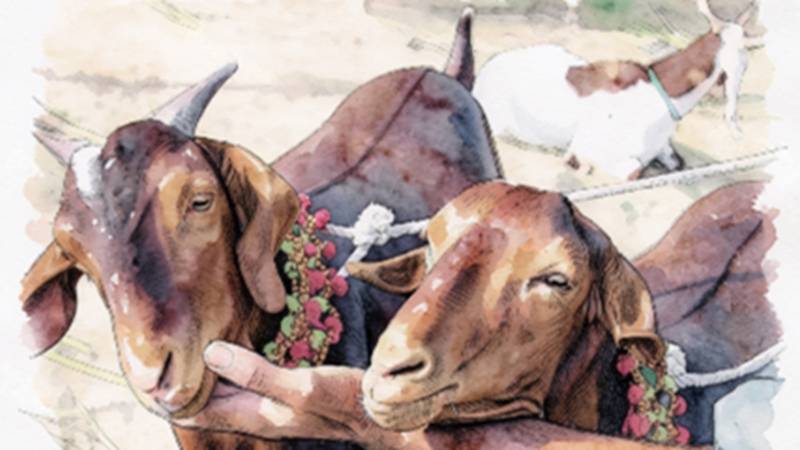
Every year, on the 1st of Zilhaj, we step into Islam’s holiest and most sacred 10 days, the ones that embody veneration, the Haj pilgrimage, and the commemoration of the Abrahamic sacrifice, while signifying the end of the Islamic year.
As the sacred days culminate into Eid-ul-Azha on the 10th of Zilhaj, we celebrate Hazrat Ibrahim’s (AS) extraordinary sacrifice; it is a devout remembrance and re-enactment of the extent and purity of Ibrahim’s obedience to Allah and his love for the Creator, as Muslims sacrifice goats and cows on the day.
According to media reports, around 7.5 million animals are expected to be sacrificed throughout Pakistan on Eid-ul-Azha this year, which is close to the annual average every Eid.
Going by our animal rights record as a nation and how we abuse animals in different capacities and at different places, not much good is expected or witnessed when it comes to how we treat or tend to sacrificial animals as well.
This is why educational campaigns through multiple channels of mass and digital communication, alongside awareness-raising prior to Eid-ul-Azha, are perhaps essential to emphasise the Islamic significance of not only offering a sacrifice, but also fully following the doctrines of kindness, compassion, and care towards sacrificial cows, goats, sheep, and camels. This must be observed at every step until the final act of sacrifice has been performed and the offal and remains are taken care of.
This should be so to ensure that a religious act is not turned into a mere ritual, steeped in inhumanity, abuse, and neglect—a sorry spectacle that loses its sanctity without us ever realising how we may have squandered the blessings of an otherwise venerated practice of Islam.
We celebrate Hazrat Ibrahim’s extraordinary sacrifice, but going by our animal rights record, not much good is expected when it comes to how we treat sacrificial animals
In the manner in which sacrificial animals are treated—starting from the way they are huddled, transported, kept, and fed, to the time they are finally slaughtered in front of each other without much regard for the Islamic decrees that precede invoking Allah’s name on our qurbani (slaughter)—we, unfortunately, flout the very injunctions we are ordained to uphold. By carrying out qurbani in this way, we lose the gist of what is much more than a ritualised act.
In fact, our streets become extensions of behind-closed-doors slaughterhouse abuse, as the horrors that are enacted in the meat industry on a daily basis are re-enacted in our backyards and on the streets every Eid-ul-Azha. Visible to the eye but ignored by our collective conscience and senses, this makes us more insentient and insensitive as a race than the sacrificial animals—in fact, all animals that we usually treat as being insentient.
It is we humans who are insentient when we fail to acknowledge the sentience of animals and other living beings and species, as neither humanism nor Islamism tames our tarnished ways. And we unleash all of this while believing all along that compassion towards all kinds remains one of Islam’s most fundamental teachings.
Pakistan, as a member of the World Organisation for Animal Health, recognises the sentience of animals and their universal freedoms related to freedom from hunger, thirst, and malnutrition; fear and distress; and physical discomfort like pain, injury, and disease. But recognition and ratification hardly penetrate into the realms of reality.
All animal laws emphasise that animals are sentient, though after witnessing the abuse they are put through, even on revered occasions meant to purge the human spirit, one just wishes they were not.
While fulfilling a religious decree, how is it even possible for us to believe that we are realising God’s command by sacrificing an animal without first holding the sacrificial animal sacred and as a symbol of the spirituality it is meant to reflect, especially as we constantly subject it to mistreatment and abuse on its way to the gibbet?
From savage transportation to not ensuring a pain-free slaughter, we do not pay heed that it is haram, or forbidden, to beat, whip, or drag sacrificial animals, or to leave them ill-fed and thirsty.
Qurbani is a test of our humanity and is not only about the final moment of swift slaughtering of animals, but of providing care, compassion, and comfort throughout the animals' days and moments with us.
With very high temperatures having hit most parts of the country, animals often stand exposed to the sun, risking collapsing from heat and dehydration, or are crammed into overcrowded vehicles to and from animal markets, with no space for them to even budge, let alone sit.
One most horrible example of man’s cruelty and savagery is captured in a video doing the rounds on social media. It shows a dozen or two goats tied flat onto the roof of what looks like a Toyota Hiace van, with the animals’ heads and limbs dangling on the sides of the vehicle, as they are transported to the city in such high temperatures.
While we condemn animal owners and transporters for not providing the animals with adequate rest, ventilation, or protection from the heat or other weather extremities, such methods of animal transportation surpass all levels of persecution.
Even while hauled in trucks and trailers, the ropes and twines used to tie the animals are usually so short that they are forced to stand all along and hold up their necks in awkward, penalising positions. This amounts to torture while also contributing to undue fear and trauma.
The care and caution that need to be taken at the final moment of slaughtering are also often disregarded. The slaughtering knife should be hidden from the animal, must not be sharpened in front of them, and should be so sharp as to make one severing cut in a single swift motion, so the animal feels the least amount of pain, according to the virtues of qurbani in Islam.
Dragging or roughly shoving the animal to the place of slaughter is disallowed. Water is to be offered to the animal before the slaughter, and it should not be slaughtered when hungry. Also often overlooked is the decree to slaughter one animal out of the sight of other animals waiting to be slaughtered.
While general animal abuse remains rampant in Pakistan, including in the meat and dairy industry, laws exist, sans the capacity to enforce their provisions. A lack of political and institutional will and commitment has rendered animal welfare laws, like the archaic Prevention of Cruelty to Animals Act 1890, futile.
Even as the law prohibits causing “unnecessary pain or suffering” to animals and penalises beating, cruelty, and overloading, the punishments for violation are low and barely awarded, hence resulting in little to no deterrence.
Islam and its teachings explicitly mandate the humane treatment of animals, including those designated for sacrifice. Whether a sacrifice riddled with the sins of mistreating sacrificial animals and abusing their rights will ever be accepted by Allah is a question that we should be putting to ourselves.
Sacrificial animals literally give their lives to help us fulfil a religious edict and realise our duty towards our faith. Food, water, shelter, comfort, and loads of kindness are the bare minimum we can do in return; if not from a human or legal perspective, it is certainly a mandatory part of our religious obligation regarding what qurbani signifies.