

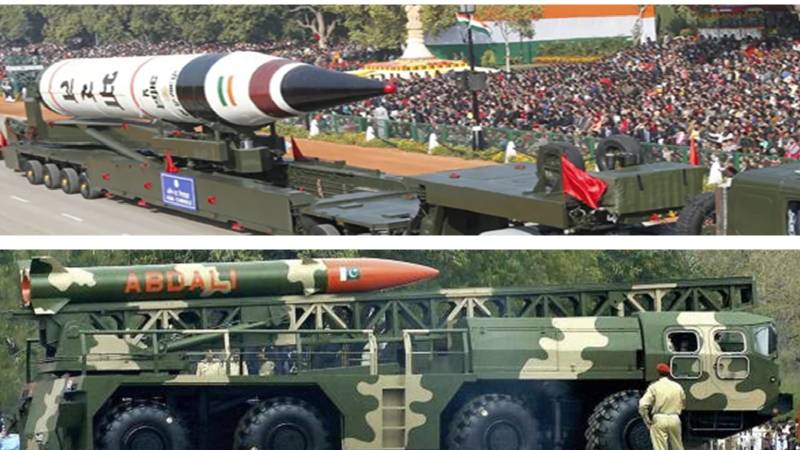
In a recent essay, Professor Paul Avey of Virginia Tech discussed whether nuclear weapons act as a deterrent to war. I discussed the issue with him.
***
Ahmad Faruqui: Pakistan and India fought over Kargil in 1999. However, unlike the 1965 war in Kashmir, which turned into a full-scale war along the international border, the Kargil war remained confined to Kashmir. Did the presence of nuclear weapons prevent escalation?
Paul Avey: Probably yes. India feared that if it escalated the conflict, it might provoke Pakistan into using nuclear weapons. Pakistan attacked India presuming that its nuclear arsenal would deter a major Indian response. At the same time, Pakistan signalled its limited intentions to India.
AF: Do nuclear weapons act as a deterrent?
PA: Evidence points in that direction. But we don’t know the magnitude of the deterrence and what capabilities it takes to deter in every case. Few would argue that nuclear deterrence is 100% effective.
AF: Can the presence of nuclear weapons allow nations to limit the size of their conventional forces?
PA: It depends on other policy choices and comes with potential trade-offs. In the United States during the Cold War President Dwight Eisenhower pushed a policy that emphasised nuclear deterrence in part because it would cost less than building and sustaining enough conventional forces to offset the Soviet challenge. One of the critiques of a heavy reliance on nuclear forces though was that in a crisis leaders would only be able to choose between backing down or nuclear escalation. Countries also typically have other national security needs which nuclear weapons are ill-suited to address.
AF: Some argue that 100 nuclear weapons suffice as a deterrent. A larger number cannot be used because the harmful effects will spill over into the country that launches the attacks. Do you agree?
PA: Multiple factors determine the scale of the harmful effects: warhead yields, the type of targets (eg, isolated military units or against cities), the location of the countries, and whether both sides have nuclear arsenals. I think the possibility of even a few strikes influences the thinking of the most senior leaders in a country.
But there are disconcerting scenarios. For instance, if a country had 100 nuclear weapons but most of those were for short-range weapons, an opponent might target the small number of longer-range platforms to remove the biggest danger. An attack could include a mix of nuclear and non-nuclear weapons. It might be necessary to go beyond the number of warheads alone to tell us how an intense dispute would unfold.
I think that during a war, a theatre military commander might be able to use a nonstrategic, or tactical, nuclear weapon against Indian forces with or without authorisation. That could increase deterrent credibility, making a fight less likely, but at the risk of accidental nuclear escalation
AF: Is India concerned that China has 500 nuclear weapons?
PA: Yes, although tensions between China and India go beyond the nuclear arsenals. India’s nuclear program includes longer-range nuclear missiles. More broadly, India’s interest in the Quadrilateral Security Dialogue with the United States, Japan, and Australia is in part a response to concerns with China.
AF: Pakistan does not have a no first-use policy. Being the smaller of the two adversaries, it lives in dread of an all-out air-and-ground invasion by the larger adversary. If that invasion were to occur, it reserves the option to use tactical nuclear weapons that target Indian forces on the battlefield. If India senses that Pakistan is about to use nuclear weapons, it may fire missiles into Pakistan to take out nuclear weapons. How plausible is that scenario? What can be done to prevent it?
PA: In some ways the terror of that scenario is what creates the deterrent effect. Seeing the possibility for escalation – on the battlefield and potentially further – could cause both sides to be more cautious. But there is no guarantee that escalation will never occur.
The best way to address the challenge is to make progress on the underlying political disputes. If there’s less disagreement, then nuclear weapons have less to deter. The prospects for dangerous scenarios decrease.
AF: If the situation deteriorates, and Pakistan fears it’s going to lose the war, a general may initiate strategic strikes deep inside Indian territory to wipe out its industrial infrastructure and force a cessation of hostilities. Can that possibility be ruled out?
PA: I can’t say for certain one way or the other. I think that during a war, a theatre military commander might be able to use a nonstrategic, or tactical, nuclear weapon against Indian forces with or without authorisation. That could increase deterrent credibility, making a fight less likely, but at the risk of accidental nuclear escalation.
AF: How much influence does the US have in preventing a nuclear war? Soon after the 9/11 attacks in the US in 2001, militants attacked the Indian Parliament. India, suspecting Pakistani involvement, moved several army divisions to its border with Pakistan. Pakistan responded in kind. At one point, a million soldiers were deployed on both sides of the border. Both sides had nuclear weapons. It is said that US intervention prevented a full-scale war from breaking out. What’s your take on what could have gone wrong?
PA: The ultimate danger in any nuclear crisis between countries with sizable arsenals and capable delivery systems is that it ends up in nuclear destruction.
AF: India has a no first-use policy when it comes to nuclear weapons. Pakistan, being the smaller state, does not. It reserves the right to strike first. How is that likely to play out if a ground war breaks out along the international border, either triggered by a terrorist incident in India, along the lines of the attack in Mumbai in 2008, or a terrorist attack in the Pakistani province of Baluchistan, along the lines of what happened this month when the BLA attack a passenger train and took hostages?
PA: We have no examples of how nuclear escalation would play out between two countries with nuclear weapons. The optimistic take is that uncertainty makes a big fight less likely. The pessimistic take is that a lot of things can go wrong, precipitating a nuclear disaster.