

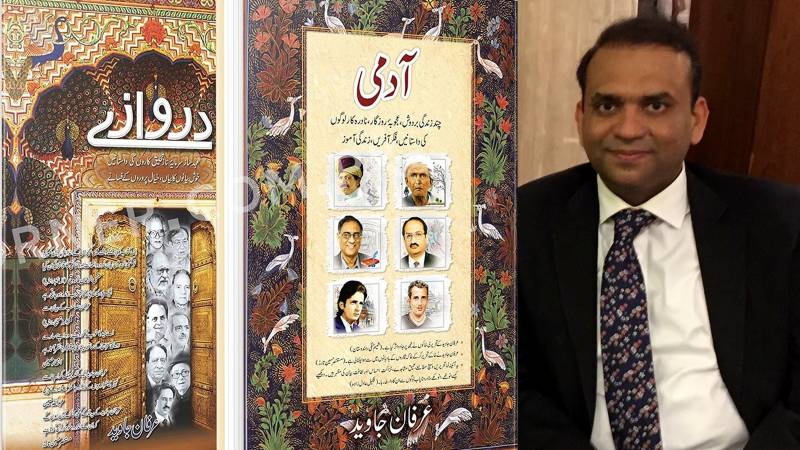
In a cultural moment saturated with opinion, visibility, and relentless self-assertion, the human being has become strangely elusive. We encounter positions more often than persons, performances more than interior lives. Public speech is abundant, yet inwardness is scarce. In this climate, Irfan Javed’s Aadmi arrives not as an intervention but as a correction. It is not a loud book, nor an eager one. It does not seek relevance through urgency, nor does it court attention through polemic. Instead, it practises something increasingly rare in our literary and cultural life: patience.
Although Aadmi is frequently described as a collection of sketches, this designation only partially captures what the book achieves. Javed quietly unsettles the expectations attached to the sketch form, not only within contemporary Urdu prose but also when read alongside Western traditions of literary portraiture. From Montaigne’s introspective essays to Hazlitt’s character studies, from Lytton Strachey’s ironic miniatures to the observational portraits of Joseph Mitchell, Western literary sketches have often relied on wit, argument, or a pronounced authorial stance. Even at their most humane, they tend to foreground judgement—moral, political, or psychological. The portrait arrives bearing a thesis.
Irfan Javed moves differently. His portraits resist both irony and verdict. Where Strachey sharpened personality into brilliance, and Montaigne turned the self into a philosophical experiment, Javed deliberately steps back. His authorial presence is recessed, almost effaced. The effect is closer to sustained listening than interpretation. Aadmi does not announce what its subjects signify; it allows meaning to surface slowly, through texture rather than argument, through duration rather than emphasis.
This restraint becomes even more striking when Aadmi is situated within the broader tradition of Urdu sketch writing itself. Historically, this genre has occupied an ambiguous space between memoir, satire, and moral observation. From its early development, Urdu sketch writing often relied on exaggeration, wit, and recognisable social types, capturing manners, habits, and public quirks rather than interior lives. Even at its most refined, the genre has tended to privilege conclusiveness over suspension: the sketch usually arrives at a point, a judgement, a smile, or a settled impression.
In this sense, Irfan Javed is not merely working within the sketch tradition; he is quietly revising it. Aadmi stretches the sketch into duration. It refuses anecdotal closure and resists the genre’s habitual drift towards evaluation. Instead of asking how a person appears, Javed asks, without stating the question directly, how a person endures. The sketch becomes less a portrait of character than a record of presence.
Javed withholds even sympathy as an organising principle; what he offers instead is attention without reassurance
This revision of form is inseparable from the kinds of lives Javed chooses to observe. A crucial dimension of Aadmi lies in the range of literary and intellectual figures it brings into view, most notably Asif Farrukhi, whose presence anchors the book in a recognisable world of writers, editors, translators, and cultural intermediaries. Farrukhi appears not as a monument of achievement but as a working intellectual (engaged, generous, inwardly burdened, and acutely aware of the fragility of literary life).
Around him gather other figures from similar milieus: minor editors, unpublished writers, translators, readers, and thinkers whose labour sustains literary culture without ever commanding its spotlight. What unites these characters is not failure or rebellion, but a quiet persistence in the face of diminishing returns. Javed resists turning them into emblems of loss or decline. Instead, he records their presence with restraint, allowing dignity, fatigue, and ethical seriousness to emerge without narrative amplification.
This approach places Javed in an intriguing relationship with earlier Urdu practitioners of the form. Unlike the satirical brilliance of Patras Bokhari, whose sketches transform social types into vehicles of wit, or the affectionate irony of Rashid Ahmad Siddiqui, whose portraits gently discipline eccentricity, Aadmi refuses humour as a stabilising device. Nor does it follow the empathetic warmth of Krishan Chander, where sympathy often carries an ideological undertone. Javed withholds even sympathy as an organising principle; what he offers instead is attention without reassurance.
The figures who populate Aadmi (whether recognisable literary names or marginal, almost anonymous presences) are not assembled to prove a sociological point. Nor are they shaped into symbols. In much modern Urdu prose, individuals are often asked to stand in for collective experiences: Partition, loss, decline, resistance. Even in Saadat Hasan Manto’s most psychologically precise work, characters are ultimately pressed into the moral furnace of history. Similarly, Intizar Husain’s figures often drift through time as carriers of civilisational memory.
Aadmi does not attempt to define what a human being is. It performs the more difficult task of refusing to close the question
Javed resists this symbolic burden. His characters are not representatives of decline or nostalgia; they are not metaphors for a wounded society. They remain stubbornly particular. They are not asked to carry history on their backs.
What binds these lives together is not a shared worldview but a shared distance from dominant social rhythms. These are individuals who exist slightly out of sync with a world increasingly organised around productivity, visibility, and measurable worth. Yet, unlike the romanticised outsiders of European literature, or even the spiritually charged marginals of Urdu modernism, Javed’s men are not idealised. Their loneliness is not redemptive. Their withdrawal is not wisdom by default. Fatigue, contradiction, inertia, and quiet failure remain fully visible.
In this sense, Aadmi marks a departure from the moral urgency that shaped much twentieth-century Urdu prose. Where writers such as Qurratulain Hyder expanded individual lives into sweeping historical panoramas, and Bano Qudsia often framed inwardness within metaphysical certainties, Javed refuses both grandeur and resolution. His characters do not arrive at insight. They remain unfinished.
This refusal is central to the book’s distinction. In both Western literary portraiture and the Urdu sketch tradition, there is often an implicit moral architecture guiding the reader, sometimes overt, sometimes disguised as compassion. In Aadmi, the moral frame remains deliberately incomplete. Javed withholds judgment not out of neutrality but out of ethical seriousness. To simplify a human being, even sympathetically, would be to violate the very act of attention the book is committed to.
The critical force of Aadmi lies precisely in this restraint. Javed’s prose does not argue; it observes. It does not persuade; it records. Small gestures, hesitations, silences, habits, and patterns of withdrawal carry the weight of the book’s critique. Without ever stating it explicitly, Aadmi exposes the cost of a society that increasingly values usefulness over inwardness. Where much Urdu prose still gravitates towards declaration or moral summation, Javed allows opacity to remain. Ambiguity here is not aesthetic hesitation; it is a moral position.
For readers in Pakistan, this approach feels particularly resonant. We inhabit a cultural space where public speech is frequently loud, certainty is rewarded, and interiority is easily dismissed as irrelevant. In such a context, Aadmi feels quietly countercultural. It insists, without slogans or sentiment, that the human being cannot be reduced to ideology, opinion, or productivity. Its silence is not evasive; it is resistant.
Seen within the arc of Irfan Javed’s broader literary career, across his fiction, critical essays, and reflective prose, particularly Ajaib Khana, Aadmi feels like a distillation rather than a departure. Long-standing concerns with memory, marginality, and the quiet violence of social normalisation appear here stripped of ornament. The prose feels lean, almost exposed, as if everything non-essential has been removed to protect the act of seeing.
It is, therefore, especially fitting that Aadmi has recently received a major literary award. The recognition feels timely and deserved, not merely as an acknowledgement of a single book, but as an affirmation of a literary temperament that values attentiveness over spectacle. In a literary culture often driven by noise and immediacy, Aadmi quietly reasserts seriousness.
Ultimately, Aadmi does not attempt to define what a human being is. It performs the more difficult task of refusing to close the question. In a time that prizes certainty, Irfan Javed offers hesitation; in a culture that rewards noise, he offers quiet clarity. And in doing so, Aadmi reminds us why literary portraits still matter, not because they explain people, but because they insist on seeing them.