

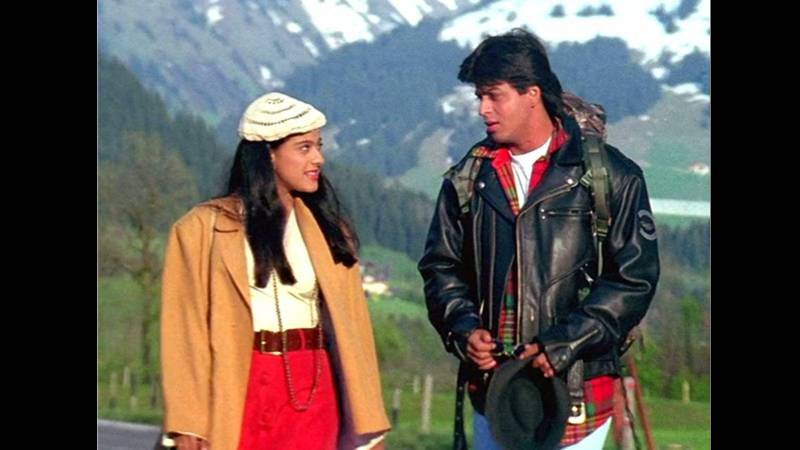
Once upon a time there was Madhuri, who taught us that Ek, Do, Teen went beyond just numbers.
Then came the Khans, rolling on to our screens one after the other – becoming just as big household names – as they were the heroes of their films, in question.
So, if you recall: Amir Khan was in Qayamat Se Qayamat Tak (QSQT, henceforth) that was released in April 1988 and beautifully narrated the love story of Raj and Sima. This was a relationship that bloomed amidst familial disapproval and societal barriers. QSQT did very well as a movie and its hero Aamir Khan was possibly the most handsome thing to have hit the hearts of young desi girls of the time.
Just over a year later (in December 1989), Salman Khan – as Prem, with his long hair and pigeon – brought Maine Pyar Kiya to audiences. We thought that Prem would remain our eternal movie crush and if my memory serves me well, the pigeon was called Handsome. Several years later, Salman Khan would originally refuse the role of Prem in Hum Aapke Hain Kaun (HAHK, henceforth). He did eventually sign on for this role and HAHK proved to be a massive success – essentially a defining moment for Salman Khan, showing his prowess as an actor.
When Raj told Simran to 'palat,' a 30-year phenomenon began. The film's power wasn't just in its European locales and catchy songs, but in its portrayal of a diaspora fiercely holding onto its roots
But only one of the Khans would become a badshah and his Dilwale Dulhaniya Le Jayenge (DDLJ, henceforth) would become such a cult film that one movie hall in Mumbai: Maratha Mandir Theatre, continues to show it daily since its release on 20 October 1995.
20 October 2025: 30 years to “palat, palat, palat.” 30 years to Raj and Simran and their legendary love story. 30 years to DDLJ, henceforth: that became our coming-of-age movie.


What made DDLJ so special? Of all of Bollywood’s romance themed movies, why is it that the 30-year-old DDLJ continues to have a daily show at the Maratha Mandir Theatre: every day since its release on 20 October 1995? Was it its unconventional storyline? Or conversely, its powerful, yet seemingly contradictory messages that were portrayed?
A little backtracking will show that the two key themes of DDLJ include following your heart regardless of ensuing challenges and being respectful of our elders – specifically our parents. In our (otherwise) everyday lives, most would agree that finding a cross between balancing our personal lives and keeping our families happy comes off as an “oxymoron.” This so-called oxymoron would most likely be felt by millennials growing up with baby boomer parents in desi households. But, movies such as DDLJ give us hope that everything will work out for the best in the end.
This three-hour-and-several-minutes-long romantic comedy is about a young Indian couple from London (very aptly part of the narrative), who meet during a Spring Break road trip around Europe. Simran, a young woman from a super strict and ultra conservative family, has an arranged marriage scheduled in India. But when she meets Raj (a young trouble maker), he falls for her and pursues her. After singing and dancing across Europe, they fall head over heels in love for one another—despite opposition from their families. Raj then chases Simran to India in hopes to break up her arranged marriage and to be with the one he loves.
Recall that DDLJ was released with the tagline of “Come fall in love.” Following how their romance panned out, Raj and Simran also introduced us to a different kind of romance in Bollywood. Not the rustic Sholay type love that had enthralled audiences 20 years before DDLJ’s release, nor today’s Student of the Year type of hip hop love. To be fair, though: I still enjoy watching both Sholay and Student of the Year.
Everyone would agree that “DDLJ” is a love story. But it is also about compromise – on multiple levels.
Allow me to explain.
When desi sensitivities with non-resident desi sentiments were added to Raj and Simran’s equation, DDLJ became a cult classic that withstood the test of time. This love story was essentially the heart-melting love story of London-bred, desi-at-heart couple who decide to get married with their parent’s permission. Their way of romancing adhered to ‘traditional’ family values – where audiences witnessed a friction between Eastern customs and Western modernity and the triumphing of the former without shattering the love that Raj and Simran shared. And this is exactly how and where the film achieves its ‘victory’: being a love drama that safely smuggled a conservative, traditional outlook.
But DDLJ goes very much beyond the happily ever after love drama between Raj and Simran. It is also the story of 1980s and ‘90s diaspora: desi immigrants who moved out during this era and despite living in foreign countries, held on to the traditions that they left back home and desperately tried to replicate in their current settings.
Recall that the movie came was released when South Asia had started opening up to foreign cultures. DDLJ shows this transition as something that shouldn’t be feared but rather accepted and was perhaps exemplified by Raj. Unlike Simran, Raj was brought up by a father Dharamvir Malhotra (played by Anumpam Kher) who was not very conservative. Dharamvir wears very Western clothes and is not very bothered by Raj failing in college. Raj is as comfortable on a British rugby field, as he is in a Parisian club and a Punjabi kitchen. In this view, Raj aligned his respectability to being Hindustani at heart, despite having lived his entire life outside of India.
This is a very vital theme in the movie, and perhaps one more reason why DDLJ is so iconic. It showed that South Asians were not alienated from the society and culture that they moved out from, but were (rather) an integral part of it: embodying an overlap between Western and respective South Asian traditions – where the said overlap ensures that neither society or culture is at odds with the other.
And this is where DDLJ’s charm lies: in its timeless appeal and idealistic wholesome message about how things can ultimately work out: that things do not have to be at odds with each other, but rather can coexist and even prosper together.