

“The soul that sees beauty may sometimes walk alone”— Johann Wolfgang von Goethe
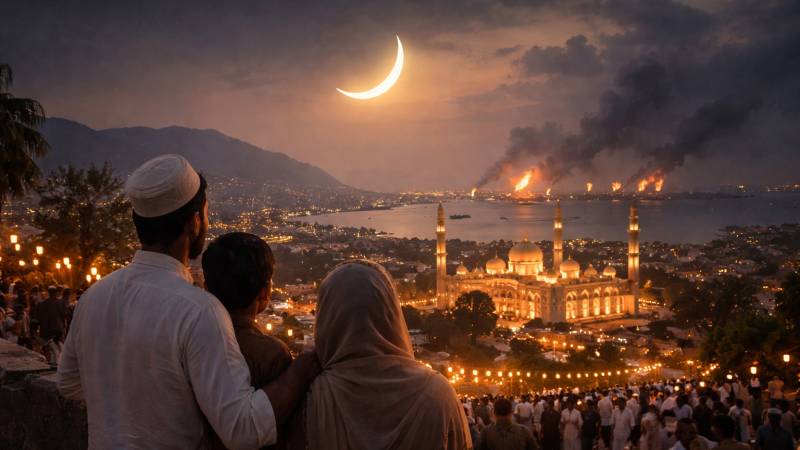
As the month of Ramzan draws to its conclusion in March 2026, the sliver of the Shawwal moon prepares to ascend over the rugged horizons of Pakistan. Traditionally, this sighting triggers a symphony of release—the “vibrant colours” of bangles, the aromatic “finesse” of vermicelli, and the rhythmic embrace of long-lost relatives.
However, as we stand on the precipice of Eid-ul-Fitr this year, the celebratory atmosphere is filtered through the “smudged spectacles” of a world in profound, visceral agony. The joy that usually permeates the air feels uncharacteristically heavy, as if the very atmosphere is laden with the soot of a regional conflagration that refuses to be ignored.
To celebrate Eid in Pakistan today is to engage in a complex act of cognitive dissonance. While our local markets attempt to bustle with the “parrot-like” repetition of festive commerce, the digital windows in our pockets provide a harrowing, real-time ledger of a Middle East being torn asunder. We are no longer isolated by geography; the “chaos” in the Gulf is not a distant murmur but a “provocative statement” that challenges the very essence of our festivities.
The current geopolitical landscape of 2026 has transformed the Middle East from a cradle of civilisation into a theatre of “unprecedented attacks”. Reports of strikes across the Strait of Hormuz, impacting global shipping and energy, have already begun to ripple through the Pakistani economy, manifesting as skyrocketing inflation and a “lukewarm” festive cheer in our own bazaars. When the Strait of Hormuz—that vital artery of the world—is constricted by conflict, the pulse of the common man in Pakistan skips a beat.
In the universities and “everyday encounters” of our society, there is a growing realisation that our “orthodox cerebration” must give way to a more “luminous” understanding. As noted by Islamic Relief, millions of families across the Middle East are spending this holy season in “grief, fear, and uncertainty”.
In Lebanon, families will spend Eid sleeping on the streets, fleeing the “battering” of southern territories, while in Iran, the “heart of the military apparatus” faces an existential struggle. How then do Pakistani observers, equipped with “original thinking”, reconcile the sanctity of their own Sheer Khurma with the reality of those for whom the crescent moon brings no respite?
If our minds are only prepared for the “palatable” aspects of Eid—the food, the clothes, the holidays—we miss the “broader horizon”
To look at the Middle East “without bias” is to see past the “heated exchange of allegations” found in “innumerable television channels” and instead see the human cost. The “dissenting voice” of the youth in Pakistan is beginning to echo this sentiment. They see the “smudged stains” on the canvas of the global Ummah. They recognise that while the UNHCR struggles to manage the displacement of over 300,000 souls in the region, our own celebrations risk becoming “stereotyped” and “cliché” if they remain devoid of genuine empathy.
In a move that mirrors the philosophical shift towards “original thinking” rather than “rote” observance, the Pakistani government has indicated that upcoming national events will be observed with “simplicity” in solidarity with the Middle East. This austerity is a tangible manifestation of a society trying to clean its “tinted spectacles”.
The “fact of the matter” is that the eye sees only what the mind is prepared to comprehend. If our minds are only prepared for the “palatable” aspects of Eid—the food, the clothes, the holidays—we miss the “broader horizon”. The “chaos” in the Gulf, the attacks in Manama, Abu Dhabi, and Tel Aviv, and the humanitarian crisis in Gaza and Yemen are not just news items; they are the “murky stains” that demand a “luminous” response from the Pakistani soul.
Knowledge, in its purest sense, can only be attained if the mind is free of the bias that “their struggle is not our own”. Those capable of setting aside the prejudice of distance and national interest are the ones who gain an “objective comprehension” of this Eid. They understand that the “vibrant” colours of our own festivities are dulled by the “abusive discourse” of war that currently defines the Gulf.
As we prepare for the prayers at the Eidgahs, let us not be like the onlookers who see only “murky stains” on a canvas. Let us instead be the ones who discern the “delicate strokes” of shared humanity. We must listen to the “provocative statements” of history and recognise that, much like Socrates, our “dissent” from the status quo of apathetic celebration might be what is truly required for a “revolution in the minds of the youth”.
Life’s broader horizon makes sense only to those willing to learn from those who “challenge their forejudged principles”. This Eid, the principle being challenged is that “joy” can exist in a vacuum. It cannot. Our joy must be a “conscious act”, a “treatise” written in the language of support and prayer for those in the Middle East—from Tehran to Beirut, from Kuwait to Basra.
We must strive to make a “significant impact” through new definitions. Let Eid 2026 in Pakistan be defined not by what we consume, but by what we comprehend. Let us be the “truly unique and knowledgeable” ones who see the world for what it is, and yet choose to hold onto the light of the crescent moon as a symbol of hope—not just for ourselves, but for a region in desperate need of a “humanitarian truce”.
Only then can we say we have looked at the painting of our lives without the “smudged spectacles” of indifference.