

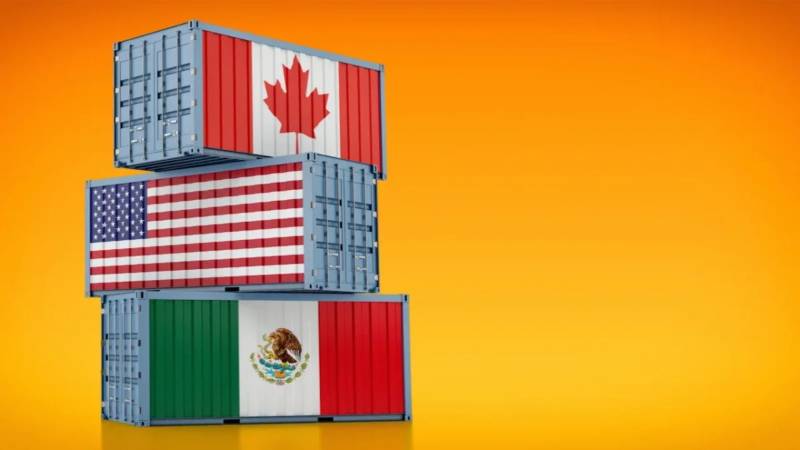
Looking at the global landscape, there will be hardly any example of a neighboring countries’ trade partnerships that can match the scale and significance of the one between the United States and its North American neighbors. As per the Bilateral Relations Fact Sheet issued by the U.S. Department of State, Mexico was the United States’ top goods trading partner in 2023 with total two-way goods trade at $807 billion, surpassing China. In comparison, U.S. goods trade with Canada totaled $782 billion, while trade with China totaled $576 billion. The U.S. imports nearly $400 billion in goods from Mexico annually, including automobiles, machinery, and agricultural products. Meanwhile, Canadian imports exceed $350 billion, with major contributions from oil, automobiles, and industrial machinery. Given these high trade volumes, a 25% tariff threatens billions of dollars in economic activity, increasing financial pressures on businesses and consumers alike. The 25% tariff on imports from Canada and Mexico will disrupt supply chains and increase consumer costs. This policy will not only increase the prices but will also make production more complex and create economic uncertainty.
From an economic standpoint, tariffs function as a tax on consumers. Importers pass higher costs along the supply chain, leading to inflated prices for everyday goods. Research from Yale’s Budget Lab estimates that tariffs could reduce the average American household’s purchasing power by approximately $1,000 per year. When combined with broader inflationary trends, these costs place significant pressure on consumer spending and economic growth.
The tariffs will primarily impact key trade sectors such as automotive, electronics, and agriculture. The supply chains under the United States-Mexico-Canada Agreement (USMCA) support mutually beneficial trade leading to freer markets, fairer trade, and robust economic growth in North America. However, the imposition of new tariffs poses a big threat to these established business models. The most significant impact will be borne by the automotive industry as the U.S. assembled vehicles often use such components that are imported from Canada and Mexico and these tariffs will elevate the manufacturing costs. Companies like General Motors and Stellantis are reevaluating production strategies, with some considering a shift to U.S.-based manufacturing. However, such moves carry a cost in the form of high vehicle prices and low consumer demand.
An economic conflict between two countries starting from the imposition of tariffs by one country can escalate into a trade war
Manufacturers and industries relying on Canadian and Mexican raw materials will also face a rise in costs, leaving them with three options: to bear the increased expenses, pass the burden on to consumers in the form of higher prices, or restructure their supply chains which is time-consuming and results in inefficiencies. Businesses are responding with a mix of concern and adaptation. Large corporations are adjusting supply chains, raising prices, and lobbying for policy changes. Some companies are planning to invest in domestic manufacturing, an approach that is not feasible for all keeping in view the financial costs associated with it. Investors are cautiously waiting for the implications of tariffs on financial markets.
An economic conflict between two countries starting from the imposition of tariffs by one country can escalate into a trade war. The tariffs will also add to the inflationary pressures on an already fragile economy. To control inflation, the Federal Reserve will have to adjust the interest rates which will potentially slow down the economic expansion and the borrowing will become more expensive for businesses and consumers.
On the other hand, Canada, Mexico and China have threatened retaliatory tariffs, which could escalate the trade war and hurt the interests of U.S. exporters. Historically, trade wars have resulted in economic uncertainty, raising costs for businesses and consumers, and slowing economic growth. The balance of trade in North America will be deteriorated and U.S. industries may lose market share if this trade war gets prolonged.
The economic impact of these tariffs on all parties is estimated to unfold over the next three to five years. The impacts would be more severe for Mexico and Canada due to their larger share of trade with the U.S. The Peterson Institute for International Economics (PIIE) estimates that, over five years, 25% tariffs would reduce Mexico’s and Canada’s GDP by 1.7% and 1.2%, respectively, with inflation rising by up to 2.3% and 1.7%. While U.S. GDP is expected to suffer less, tariffs would impact key industries such as autos, agriculture, and energy, affecting equities and credit of companies facing higher import prices.
This aggressive policy will have international geopolitical consequences. The U.S., being a global trade leader, may lose its credibility and relationships with other nations may get strained. American businesses could face long-term competitive disadvantages if Canada and Mexico ally and expand their trade relations with other nations. The uncertainty due to these tariffs will deter foreign investment, slow down economic growth, and hurt the confidence of business owners as well as consumers.
Looking ahead, the situation is still evolving, with potential policy shifts and trade negotiations shaping the long-term impact of these tariffs. The business community and consumers will have to strategically adapt to this evolving scenario by exploring diverse supply chains, implementing cost-cutting measures, adopting alternative sourcing strategies to survive the risk of rising costs, and managing the rise in prices by budgeting carefully and prioritising essential spending. Business resilience, consumer behavior, and diplomatic negotiations will all play a role in determining economic outcomes.