

We continue to be reminded of America's War of Independence against Great Britain, the horrible Civil War that took nearly a million lives, the two World Wars, the Korean War and the Vietnam War. Myriads of books have been written on these wars. Hollywood has glorified the good role that America played in these wars.
And, of course, we don’t need to be reminded of the wars that America has fought more recently, ostensibly the War on Terror it has waged after 9/11 in Afghanistan, Iraq, Libya and Syria, just to name a few. These wars are the subject of a forthcoming book by Peter Bergen, “All the Presidents’ Wars.”
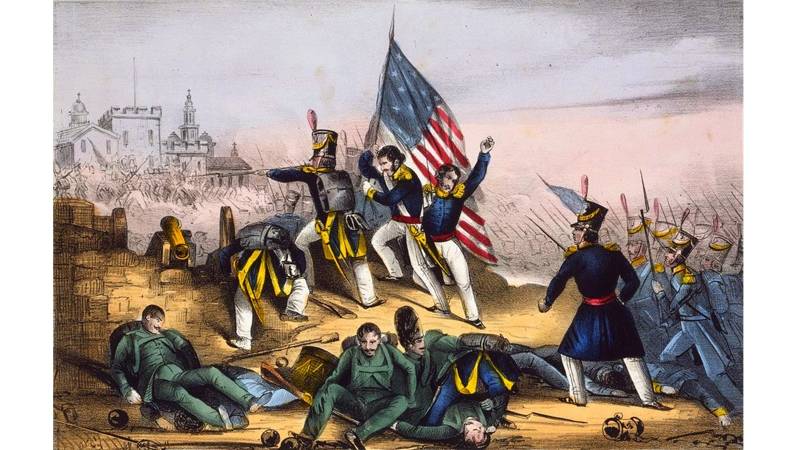
But America’s war against Mexico, fought 180 years ago, is rarely mentioned. It is the war that time forgot. It was the first war that America waged against another republic. It is a war that changed the map of the United States and expanded its land mass so that it extended from the Atlantic Ocean to the Pacific Ocean.
It was the first war in which the press joined the American troops as they fought the war, both in the states that now comprise the American west and southwest, and in Mexico. It was also the first war in which public sentiment revolted in the US as news arrived about the savagery committed by the American troops in what is now Mexico.
To be honest, I did not know much about that war until, about ten years ago, I was touring a museum somewhere in the American southwest. I could not believe what I was looking at. It was a map of the US-Mexican border that existed before 1846. It was very different from the map that we see today. California, Arizona, New Mexico, and parts of Nevada, Utah and Texas – these were all in Mexico.
On the side of the map was a quote from General Ulysses S Grant. He was the general who accepted General Robert E Lee’s surrender at Appomattox, Virginia in 1865 marking the end of the Civil War, and later a two-term US president.
“I do not think there was ever a more wicked war than that waged by the United States on Mexico.” He said it was the most unjust war ever waged by a stronger nation against a weaker nation and noted that had he not been a youngster at the time, he would have resigned his commission.
The year 1848 marked the first time that the fear of incorporating supposedly ‘inferior races’ into the United States limited the nation’s territorial expansion
These remarks inspired me to read his Personal Memoirs. Published in 1885, they cover a lot of ground. He is honest and blunt in his descriptions of the events that shaped his life, as a young lieutenant and later as a general in the army and as the president of the US. And it is in those pages that he describes how President James Polk deliberately sent troops into the disputed territory between the Rio Grande and the more northerly Nueces River in what is now Texas to provoke a fight with the militarily weaker neighbour, Mexico. Grant viewed the invasion as an imperialistic land grab, driven by the desire to expand US territory rather than to right any actual wrongs.
Commenting on the state of the Mexican army, Grant wrote:
“The Mexican army of that day was hardly an organisation. The private soldier was picked from the lower class of the inhabitants when wanted; his consent was not asked; he was poorly clothed, worse fed, and seldom paid. He was turned adrift when no longer wanted. The officers of the lower grades were just a little superior to the men. With all this I have seen as brave stands made by some of these men as I have ever seen made by soldiers.”
In 2022, I was touring a naval museum in the coastal Mexican town of Puerto Rico when I came across an exhibit that read as follows:
“The United States, which had already grabbed Texas, had its eyes on California and New Mexico as well. So, on May 11, 1846, the Government of James Polk declared war on Mexico. Following a military barrage, it took possession of the territory and later worked out a treaty to legitimise its purchase. US troops furthermore controlled both coasts, most significantly the port of Vera Cruz, where General William Scott’s troops were encamped, and from which it launched an offensive that took Mexico City on September 14, 1847. The Treaty of Gaudalupe Hidalgo was signed on February 2, 1848, ceding 55% of Mexican territory to the US.”
A very troubling question began to swirl in my mind. How was it that a democratic republic that had gained independence from a colonial European power just 70 years ago had now embarked on a war of conquest in the worst tradition of imperialism? I finally found the answer in Amy S Greenberg’s book A Wicked War. It is not a military history of the war but a history of politics that led to the war.
She discusses the central role that James Polk, a one-term president, played in initiating and executing the war. He was a firm believer in the Manifest Destiny doctrine.
The term was coined in 1845 by journalist and editor John L O'Sullivan. Writing in the The United States Magazine, and Democratic Review, O’Sullivan argued that it was America's “manifest destiny to overspread and to possess the whole of the continent which Providence has given us”. While the phrase was new, it is safe to say that the underlying motivations—rooted in American exceptionalism and the desire for territorial and commercial growth—had been guiding the nation since its founding.
Proponents of the ideology believed that the expansion of the United States was not only inevitable but fundamentally virtuous. They sought to spread the blessings of liberty, federated self-government, and economic opportunity to lands occupied by other nations or indigenous peoples. Advocates also justified continental expansion to secure natural resources, develop new trade routes to the Pacific, and prevent European powers from halting American growth.
She says that Polk did not believe that attacking Mexico would start a full-scale war. “He was counting on some bullying, and just a bit of brinkmanship, to create a messy little incident that would do the trick.” He thought poorly of the racially mixed Mexican population and felt their leaders were both corrupt and cowardly. With great confidence, he felt that when faced with war, they would sell California to the US. On the 9th of July, the US army conquered Yerba Buena which is now called San Francisco. But Mexico did not yield the rest of the territory. A full-scale war had begun, contrary to Polk’s expectations.
Greenberg also discusses the role Henry Clay, a high-profile politician, played in opposing the war. He was an American lawyer, statesman, and diplomat who represented Kentucky in both the United States House of Representatives and the United States Senate. He was the seventh House speaker as well as the ninth secretary of state. Clay unsuccessfully ran for president in the 1824, 1832, and 1844 elections.
He correctly foresaw that the war would deepen the divisions in the US and potentially precipitate a Civil War. He gave a landmark speech against the war in Kentucky.
She discusses how Abraham Lincoln, then a Congressman from Illinois and future iconic president who is credited with saving the union, challenged the premises of the war, demanding that the spot where American blood was supposedly spilled by Mexicans be disclosed. He called it “a bold falsification of history.”
In her assessment, she says this war stands out in American history because of three reasons. First, it was the first American war against a neighbouring republic. Second, it was the first war that started with a presidential lie, which asserted that American blood had been shed on American soil by another country. And third, it was the first war which generated a feeling of guilt among many Americans.
The American public had turned against the war for several reasons, not all of which were admirable. Many were motivated by racism, unwilling to offer citizenship to the people of Mexico. The year 1848 marked the first time that the fear of incorporating supposedly ‘inferior races’ into the United States limited the nation’s territorial expansion.
Nevertheless, she notes, “the cumulative effect of national antiwar agitation generally, and congressional antiwar agitation in particular, …was to limit both the duration of the war and Polk’s demands for Mexican territory.”
Greenberg says the war raised several troubling questions about the United States which are as relevant today as they were back in the mid-nineteenth century. After dismantling a neighbouring republic for the sake of aggrandisement, could it claim to be the dispenser of justice in international affairs? After Polk provoked a war and then lied to Congress about it, could presidents be trusted to behave honestly in matters of life and death? And, most troublingly, after annexing more than half of Mexican territory, could the American Republic still contrast its acts with the imperialist oppression of its then-nemesis, Britain?
Greenberg says that victory against Mexico spurred expansionists in the north and south of the US to push for more land, in Hawaii, in Central America, the Yucatan, and particularly Cuba, further exacerbating sectional tensions. The stage was set for the South’s secession. These tensions escalated into the Civil War which broke out in 1861.
More than a century and a half has elapsed since that war ended in 1865, but the American desire to expand territory has not ended. Today, we are repeatedly hearing claims being made to acquire Greenland, for the safety of the US, to encourage Canada to join the US as the 51st state to ensure its safety and potentially to invade Cuba to save it from its communist rulers.
Denmark has repeatedly said that Greenland is not for sale and consistently reminded the US that it already has several military bases stationed there. Yet the issue was raised once again at the NATO summit in Ankara, Turkey.
Canada has shown absolutely no interest in joining the US, and even if it were to ever do so, which is not even a remote possibility, it is a vast country that would bring seven additional states to the US, not just one, along with several territories.
And Cuba is bracing for an American invasion.
It seems that the archaic 19th century doctrine, Manifest Destiny, has not been confined to the dustbin of history. As argued in a prior column, old-fashioned imperialism continues to guide the work of those who walk in the halls of power in Washington, DC almost two centuries after the American invasion of Mexico.