

Click here for the first of three letters
Dear Sam,
Last month, I wrote to you as a longtime fan to critique your stance on the Israeli-Palestinian conflict. While my open letter sparked a lively debate within the Making Sense community—and led to a refined version on my Substack—I am still hoping to reach you directly.
My critique of your reductive litmus test—“If Palestinians dropped their weapons, there would be peace. If Israelis dropped their weapons, there would be genocide.”---remains mostly unchanged. It can be summarised by a quote from Andrew Sullivan, made in 2020 as a response to the Woke condemning America and shutting down debate, which applies almost perfectly as a rebuttal to your stance on Palestinians:
“This view of the world certainly has “moral clarity.” What it lacks is moral complexity. No country can be so reduced to one single prism and damned because of it.”
In this letter, I want to address some related topics about how you frame Islam.
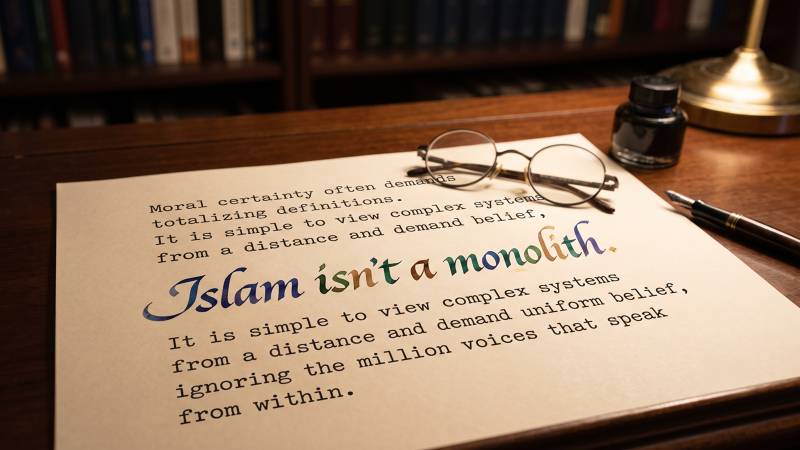
Speaking of Islam as a regressive monolith makes you appear uninformed or prejudiced
To illustrate, take what you say about Islam in your podcast from 2023: “Under Islam, the central message about women is that they are second-class citizens and the property of the men in their lives.” You make these broad claims without evidence, as though they are self-evident. To engage with your argument meaningfully, I’ve provided the verse I believe you should have cited:
“Men have a degree over them [women].” (Quran 2:228)
I was born and raised in Pakistan, so I know this is the verse mullahs often point to when claiming dominion over women. But the literal meaning is not the end of the story; it’s the beginning. To stop at the literal meaning and claim—as you and the mullahs do—that this is the entirety of Islam ignores the millions of Muslims and serious scholars who disagree.
Liberal scholars emphasise that this verse pertains specifically to divorce proceedings and must be read alongside the preceding sentence in the same verse: "And women have rights similar to those of men over them in a just manner" (Quran 2:228). They argue that Islam's early decrees were revolutionary for 7th-century Arabia, and that freezing those standards in time betrays the overarching spirit of the text, which aimed to bend the arc of history toward justice.
Equating Islam solely with its most literal reading is akin to arguing that the strict textualist interpretation of the US Constitution is the only valid way to understand American law
Equating Islam solely with its most literal reading is akin to arguing that the strict textualist interpretation of the US Constitution is the only valid way to understand American law. Just as liberal legal scholars view the Constitution as a living document whose foundational principles must be adapted to modern realities, progressive Islamic scholars approach the Quran with a similar evolutionary lens. This non-literal approach is not simply a convenient "apology" designed to sanitise the religion; it is a robust, well-established intellectual tradition that recognises the need to rely on the broader spirit of a text to keep pace with human moral progress.
If your monolithic and regressive framing of Islam has something to do with the number of Muslims who believe in literalism—and I agree that too many Muslims are literalists—then you should be promoting a non-literal interpretation of Islam, not proclaiming the literalist interpretation as the only interpretation.
The fix is simple: add a qualifier. Specifying whose interpretation of Islam you are critiquing would ensure your arguments remain nuanced and unbiased.
When you speak of Islam as a regressive monolith, you’re hurting the reform movement within Islam that you say you support
You often say that “Islam needs a reformation.” Leaving aside your tendency to treat the religion as a monolith, I agree that some of Islam needs reform (not a reformation akin to Christianity). Polling by the Pew Research Center reveals staggering prejudices in the Muslim world. Take Pakistan: 75% of the population believes draconian blasphemy laws are necessary, and 76% support the death penalty for leaving Islam.
But what’s crucial about these numbers isn't just the illiberal majority—it’s the 25% who reject those views. These are your natural allies: Muslims who actively want reform. When you speak of Islam as a regressive monolith, you alienate these very people. Islam remains a cherished belief system for them, and dismissing it entirely is both offensive and counterproductive.
Even if the literalists represent the majority and hold political dominance, you must at least acknowledge the reformist faction if you are genuinely interested in change. Otherwise, it appears you aren't actually looking for reform, but are instead inadvertently fanning the flames of extremism on both sides. When far-right Israeli extremists read your sweeping condemnations of Islam, what do you think they walk away with? They feel vindicated in their hatred. Is that the outcome you want?
I suspect many moderate Muslims view your sweeping generalisations as "Islamophobic." While I see it as carelessness rather than malice, I understand their reaction. These individuals are already fighting extremists who use faith to justify hate; by dismissing Islam as a monolith, you ironically validate the literalists' claim that their rigid interpretation is the only true one. This leaves moderates feeling attacked from both sides.
By remaining silent on alternative, liberal interpretations of the faith, you hand the literalists the ultimate prize: uncontested ownership of Islam. In doing so, you are shooting both yourself and your allies in the Muslim world in the foot.
In explaining Jihadism and its influence on Hamas and Palestinians, you fixate on scripture while ignoring factors, such as poverty and politics, that would complicate your reductionist position
Take, for example, your recent post regarding Hamas and the Palestinians. You wrote, "Israel's behavior is not what explains the suicidal and genocidal inclinations of a group like Hamas. The Islamic doctrines of martyrdom and jihad do. These are religious beliefs, sincerely held.
While it is true that these extremists are literalists, reducing a complex geopolitical conflict to a neat, one-dimensional religious problem ignores the massive driving forces of poverty and politics.
If the text itself is the primary engine of jihadism, why does extremism ebb and flow so dramatically? Throughout history—across the Abbasid, Andalusian, and Ottoman empires—Islamic practices have oscillated between periods of tolerance and dogmatic intolerance, all without the scripture changing.
I witnessed this dynamic in my own lifetime. In the 1950s, 60s, and 70s, Pakistan had literalist mullahs, but near zero suicide bombers or massive terror networks. The explosion of extremism in the 1980s wasn't sparked by a sudden mass re-reading of the Quran. It was driven by a military dictatorship that—fueled by foreign funding from Saudi Arabia—weaponised Islam to fight proxy wars. Mass indoctrination was made possible by poverty and illiteracy, with destitute parents often surrendering their children to radical madrassas simply to ensure they were fed.
Real reform in the Muslim world will not arrive solely through textual reinterpretation; it will come on the back of cultural, economic, and political progress. If you genuinely want to reform Islam, advocating for poverty alleviation, open trade, and educational reform is far more impactful than debating Quranic verses. For instance, peace and open travel between India and Pakistan would do tenfold more to dismantle extremist ideology than any theological debate, as it would strip the military of its justification for funding proxy jihadists.
The Torah and the Bible contain many violent passages, but centuries of Western political stability and economic growth have largely rendered such literal interpretations moot. The Islamic world is no different. And neither is Palestine. By ignoring the realities of occupation, blockades, and political hopelessness, and blaming extremism almost exclusively on Islamic scripture, you are making an error.
Closing Thoughts
I offer these critiques in the hope of connection, not division. In my final letter, I will explore how to confront the challenges within the Muslim world and advocate for reform with nuance. Persuasion requires a gentle tug, not a shove into the cold waters of truth. While changing hearts and minds is never guaranteed, I believe this approach offers a more promising path forward.
Until then, I wish you well.
Sincerely,
T A Ahmed