

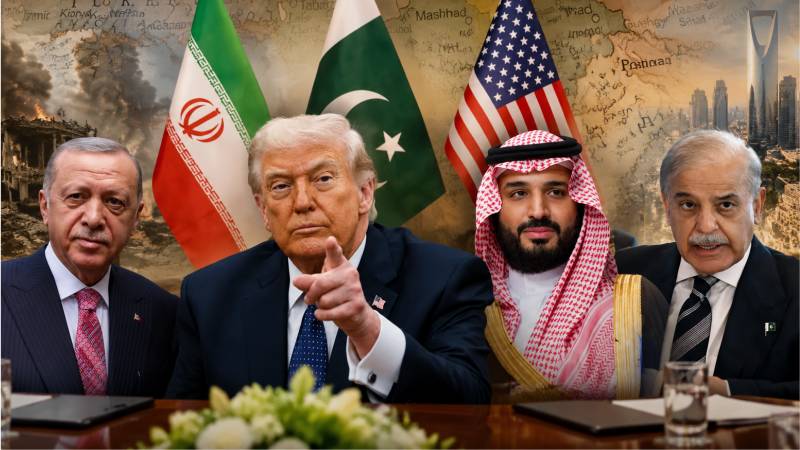
In my last piece https://www.thefridaytimes.com/08-Aug-2026/iran-war-ending-anytime-soon I argued why it is unlikely that the Iran war is going to end anytime soon. It was the same day that the trilateral Makkah Joint Defence Agreement was signed between Pakistan, Saudi Arabia and Turkiye. That same evening, in an interview https://www.youtube.com/watch?v=wBKw2Pwe2Yc, I raised a number of questions regarding the scope and nature of this agreement. My scepticism was based on the fundamental point that all three signatories had different threat perceptions, and it was unlikely that one would want to be drawn into the fight of another. I also argued that a 'tester' would come along to assess the strength and meaningfulness of this agreement.
Houthis struck Saudi oil facilities the next morning, and subsequently Israel struck Turkish bases in Syria on 19 August. I had also voiced my concern about some kind of Indian tester against Pakistan via Afghanistan. But after the US envoy Sergi Gore's controversial statement on Kashmir, this might as well come from the LoC itself.So, the war is not ending. On the contrary, it is expanding horizontally.
In the midst of this, Pakistan's accumulated national debt is touching one hundred trillion rupees. In the remainder of FY 2026–27, Pakistan needs to pay $18 billion in principal, while interest payments are projected at $3.5 billion. Pakistan had also requested a Bilateral Exchange Stabilisation Support Facility worth $10 billion from the US, with a maturity of up to five years. In return, the US envoy made a controversial statement on Kashmir, followed by President Trump issuing a warning on Truth Social, in which he warned that any country providing Iran "any financial lifeline will face TREMENDOUS Economic consequences." This includes oil smuggling among other things, "It all needs to stop NOW. You know who you are." It is no secret that oil smuggling from Iran takes place via Balochistan, and we know it is Pakistan. So, why this warning for Pakistan?
An Israeli newspaper alleged that Pakistan had forged an oil deal with Iran, in exchange for guarantees to stop strikes on Saudi bases. On the other hand, Islamabad has maintained close coordination with Beijing throughout the entire span of the mediation process. If Trump's expectation was that Pakistan would help the US penetrate Iran to advance its military objectives, that has clearly not happened. Pakistan's growing military ties with China, and the commercial loans worth $28 billion acquired from Chinese banks, in addition to obligations under CPEC agreements, make it highly unlikely that Pakistan would oblige Washington's wishes even if it wanted to.
But after the US envoy Sergi Gore's controversial statement on Kashmir, this might as well come from the LOC itself. So, the war is not ending. On the contrary, it is expanding horizontally.
The controversial remarks about Kashmir by the US envoy in India, Sergi Gore, come amid this developing scenario. On the one hand, they win Indian voters ahead of Trump's November elections; on the other, they send a message to the Pakistani establishment that punishment might be inflicted on them for not complying with American plans entirely, the LoC tester. Messages began popping up on X from Arab sources around 15-16 August suggesting that Turkey's President Erdogan is pressuring Pakistan for the release of Imran Khan. If that is true, Trump should have taken credit for his release right away, to win the votes of Pakistanis who had backed his presidency in the hope that he would push for Imran Khan's release. I would hold off on this speculation until Trump himself makes a statement on the matter. However, I am equally sceptical about relief for Khan on the pretext of the 28th Amendment, as it is being discussed. Now shift the lens to the Strait of Hormuz, which Trump has declared US territory.
Right after this move, American geopolitical and defence analysts started talking about the possibility of the US using tactical nuclear weapons against Iran. Using nukes in the strait itself seems unlikely, as it would badly affect the US-Israel ally the UAE, which sits right at the centre of the waterway. If used against Iran's mainland, the target could instead be somewhere less populated but of high strategic importance. It's best not to speculate further. So, if we put all these pieces together, what do we get?
The MJDA is being tested. Trump isn't happy with Pakistan, which desperately needs cash to stabilise its economy and currency amid mounting loan and interest obligations. Trump's envoy in India sent a strong message to Pakistan, and Israel targeted its new defence partner Turkey's bases in Syria. He has drawn a red circle around Iran, and a yellow one around Pakistan. Those tempted to carry out a cost-benefit analysis, arguing that such a massive action would jeopardise the world economy, badly affect the US economy itself, and kill the petrodollar, and so on, should recall 1929. Prior to the Second World War, America was in the grip of the Great Depression. The war started in 1939, the very year the Depression ended. Those who argue that trade relations and economic dependency can prevent war should recall the years preceding the First World War, 1914–1918.
Britain and Germany were each other's major trading partners despite their rivalry, with Britain also depending heavily on imported food and raw materials protected by its navy. France was deeply tied to Russia through massive capital investment that financed Russian railways and industrialisation, a financial relationship that also underpinned their military alliance. Austria-Hungary depended economically on Germany, its main ally and largest trading partner, while also being tied to the Balkans as key markets and sources of raw materials. Russia relied on foreign capital, mainly French and Belgian, to fund its industrial growth, while exporting grain to Western Europe. Overall, Britain, France, Germany and Russia were bound together in a dense web of trade and cross-border investment that made their economies mutually dependent even as political and military tensions grew. But all these economic ties and trade relations did not prevent the war. The fate of the region hangs in the balance. Once the heat increases, we might witness many ties, agreements and trade relations melting down, some burning to ashes.