

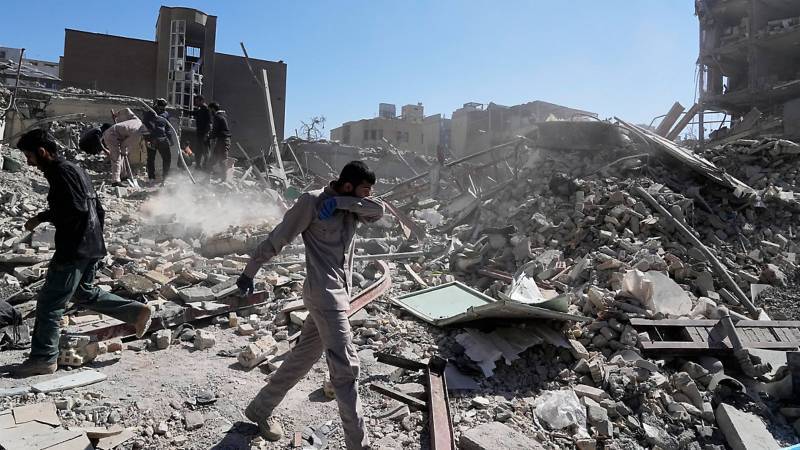
Wars rarely announce themselves as harbingers of systemic transformation. They typically begin cloaked in the vocabulary of security, deterrence, and national survival. Governments present them as contained responses to immediate threats, calibrated actions meant to restore equilibrium rather than upend it. Yet history demonstrates with relentless clarity that the consequences of war seldom remain confined to the battlefields where they originate.
Military confrontations frequently unleash geopolitical reverberations that reshape the architecture of global power. The escalating confrontation involving Iran, the United States, and Israel increasingly appears to belong to this category of transformative crises. What initially presents itself as a regional conflict now carries the unmistakable potential to mark a turning point in international politics, one whose ramifications may extend far beyond the Middle East.
For several decades, the international system rested upon a delicate equilibrium that, despite its imperfections, offered a degree of predictability. The United States functioned as the pre-eminent military power, projecting influence across key strategic regions through alliances, forward deployments, and an unparalleled network of security partnerships. Global trade expanded under a relatively stable set of rules and institutions, while energy flows from the Persian Gulf sustained industrial growth and economic dynamism across Asia and Europe. This arrangement did not eliminate rivalry or conflict, yet it provided a framework within which states could anticipate the behaviour of others and manage disputes without precipitating systemic upheaval.
Today, that predictability is steadily eroding. The confrontation surrounding Iran has illuminated the fragility of the structures that once underpinned the global order. Regional crises, once perceived as geographically limited disturbances, now possess the capacity to disrupt the interconnected networks that sustain contemporary economic and political life. Nowhere is this interdependence more evident than in the Persian Gulf, a region that occupies a central position in the world’s energy architecture.
The mere possibility of disruption to the Strait of Hormuz, through which a substantial proportion of global oil supplies transit, has already sent tremors through international markets. Oil prices have fluctuated sharply, maritime insurers have raised premiums for tankers navigating the region, and shipping companies have begun reassessing logistical routes that were long considered routine. Investors, ever sensitive to geopolitical volatility, have grown increasingly cautious. In an era of deep economic interconnection, the geography of conflict is inseparable from the geography of commerce.
Yet the significance of the crisis transcends the volatility of energy markets. The confrontation is accelerating a broader transformation already underway in international politics: the gradual fragmentation of the global system into competing blocs. The United States and its allies have framed their approach to Iran primarily through the lens of deterrence and regional security. Their objective, articulated in both diplomatic and military terms, is to prevent the consolidation of Iranian influence across the Middle East and to maintain the strategic balance that has long favoured Western alliances.
If this trajectory continues, regional conflicts may become catalysts for broader systemic realignments, accelerating the transition towards a more fragmented and volatile international order
Iran, for its part, has sought to situate its position within a narrative of resistance to Western dominance. Although it does not command a formal alliance structure comparable to that of the United States, it increasingly benefits from a degree of strategic sympathy among states that regard the Western-led international order with scepticism. Russia and China, while exercising caution to avoid direct military entanglement, perceive in the unfolding crisis an opportunity to challenge American influence and to advocate for a more pluralistic distribution of power within the international system. Their diplomatic posture reflects a broader aspiration to promote a multipolar world in which no single state enjoys uncontested primacy.
Consequently, the confrontation surrounding Iran should not be interpreted merely as a dispute among regional actors. It is also a contest between competing visions of global order. One vision remains anchored in the institutional architecture and alliance networks that emerged after the Cold War, with the United States occupying a central role in maintaining stability. The alternative envisions a more diffuse configuration of power, in which regional actors assert greater autonomy and Western predominance gradually recedes. The crisis has become one of the arenas in which these rival conceptions are being tested.
The ripple effects of this geopolitical contest are already evident across regions far removed from the immediate theatre of conflict. South Asia provides a particularly instructive example. Many countries in the region rely heavily on energy imports from the Middle East to sustain economic growth and industrial development. Any disruption to Gulf energy flows, therefore, carries immediate consequences for their domestic economies. Rising oil prices exacerbate inflationary pressures, strain fiscal balances, and complicate efforts to maintain economic stability in societies already grappling with developmental challenges.
Moreover, the relationship between South Asia and the Gulf extends beyond the domain of energy. Millions of workers from countries such as India, Pakistan, Bangladesh, and Nepal reside in Gulf states, where their remittances constitute an essential component of national income for their home economies. Instability in the Middle East thus reverberates through labour markets and household incomes across the subcontinent. What may appear to be a distant geopolitical confrontation becomes, in practice, a matter of immediate economic and social consequence for millions of families.
Europe confronts its own set of vulnerabilities. The continent is still navigating the economic disruptions triggered by the war in Ukraine, which dramatically altered the structure of European energy dependence. Efforts to diversify energy sources and reduce reliance on Russian supplies have required significant economic adjustments. A prolonged crisis in the Middle East, particularly one that intensifies volatility in global fuel markets, threatens to complicate these adjustments. Higher energy prices risk fuelling inflation, slowing economic recovery, and exacerbating political tensions within European societies already grappling with the aftershocks of recent crises.
Beyond these regional implications lies a broader challenge to the resilience of global supply chains. The pandemic exposed the fragility of production networks that span continents and rely upon uninterrupted flows of goods, energy, and transportation. Geopolitical tensions have since compounded these vulnerabilities.
Airspace restrictions, maritime risks, and fluctuating energy costs serve as reminders that globalisation is sustained not merely by economic efficiency but by an underlying presumption of stability. When that stability erodes, the intricate machinery of global commerce becomes markedly more susceptible to disruption.
Perhaps the most consequential dimension of the present crisis, however, lies in its potential to normalise confrontation as a routine instrument of international politics. Diplomacy, once regarded as the primary mechanism for resolving disputes, increasingly appears subordinated to military calculation. Strategic competition among major powers has intensified, and the threshold for coercive measures has correspondingly lowered. If this trajectory continues, regional conflicts may become catalysts for broader systemic realignments, accelerating the transition towards a more fragmented and volatile international order.
History offers instructive precedents. The transformations that followed the First World War fundamentally altered the political landscape of Europe and the Middle East. The end of the Second World War produced a bipolar order defined by the rivalry between the United States and the Soviet Union. The conclusion of the Cold War ushered in a period of American predominance that shaped international institutions and norms for decades. Each of these transitions emerged from periods of intense conflict that reconfigured the distribution of power and influence.
The choices made in the coming months will influence not only the trajectory of the Middle East but also the character of the global order itself
The current confrontation does not inevitably portend a comparable upheaval, yet it is undeniably reinforcing trends that were already reshaping global politics. The erosion of unipolarity, the emergence of new centres of power, and the increasing politicisation of trade, technology, and energy networks collectively signal a world moving towards a more contested and pluralistic configuration. The Iran crisis serves as both a symptom and an accelerator of this broader transformation.
None of these observations implies that the security concerns of the states involved lack legitimacy. Governments bear an undeniable responsibility to safeguard their populations and defend their strategic interests. Yet the historical record demonstrates that military conflict rarely resolves the deeper political disputes from which it arises. Wars may alter territorial boundaries or shift the balance of power, but they seldom eliminate the underlying grievances that gave rise to hostilities. Instead, they often entrench antagonisms and generate new sources of instability.
The challenge confronting the international community, therefore, lies in recognising the broader implications of the present moment. Continued escalation risks deepening geopolitical divisions and reinforcing a pattern of confrontation that could define international politics for years to come. A world increasingly divided into rival blocs would not merely complicate diplomacy; it would undermine the cooperative mechanisms upon which global prosperity depends.
The alternative, though undeniably arduous, remains the pursuit of diplomacy. Negotiation does not require the abandonment of national interests, nor does it demand the illusion that profound disagreements can be effortlessly reconciled. What diplomacy offers is a framework through which states can manage their differences without allowing them to spiral into uncontrollable conflict. It provides channels for communication, compromise, and incremental progress in situations where the use of force would produce only a destructive stalemate.
In an interconnected world where the repercussions of conflict ripple through energy markets, financial systems, and global supply chains, restraint acquires a strategic significance that transcends moral exhortation. Stability has become a shared interest among states that may otherwise disagree on matters of ideology or influence. The preservation of that stability requires recognition that geopolitical rivalry must coexist with mechanisms of cooperation.
The unfolding crisis surrounding Iran has already begun to reshape the contours of international politics. Whether it ultimately heralds a new era of intensified confrontation or prompts a renewed commitment to diplomatic engagement remains uncertain. What is clear, however, is that the stakes extend far beyond the immediate participants. The choices made in the coming months will influence not only the trajectory of the Middle East but also the character of the global order itself.
The central question confronting the world is therefore not simply how this conflict will end, but what kind of international system will emerge from its aftermath. Will the crisis harden into another chapter in the progressive fragmentation of global politics, or will it catalyse renewed efforts to preserve stability through dialogue and restraint? The answer will shape the geopolitical landscape for a generation to come.