

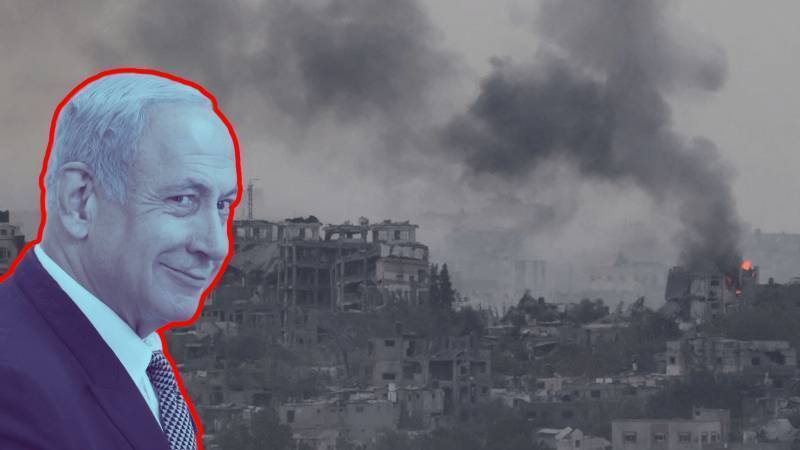
The resumption of Israel’s large-scale military operations in Gaza following a brief ceasefire underscores the Zionist regime’s strategic intent to prolong its genocidal campaign against the Palestinians. Benjamin Netanyahu’s decision to violate the ceasefire agreement aligns with his broader political agenda, which is aimed at consolidating his grip on power and evading accountability for both his domestic failures and his inability to secure the timely release of all hostages. Furthermore, his reluctance to transition into the second phase of the ceasefire plan stems from the fact that it would necessitate an end to Israel’s war machinery and indiscriminate killing spree, something Netanyahu appears unwilling to accept.
Moreover, Netanyahu’s political survival is inextricably tied to the continuation of war. Facing mounting corruption charges and declining domestic support, he has sought to deflect attention by fueling an endless cycle of violence in Gaza. His regime’s failure to negotiate the full return of hostages has drawn criticism from within Israel, particularly from families of those still in captivity. Instead of engaging in meaningful diplomatic efforts, he has chosen to escalate the war, thus, using it as a political tool to consolidate right-wing support and delay potential legal proceedings against him.
The second phase of the ceasefire deal, which would have required Israel to gradually de-escalate its military campaign, does not serve Netanyahu’s interests. The cessation of hostilities would not only weaken his political leverage but also expose the humanitarian devastation wrought by Israel’s relentless bombing campaign. By prolonging the war, Netanyahu ensures that his political fate remains linked to Israel’s military aggression rather than his own legal and political vulnerabilities. Thus, the renewal of airstrikes and ground offensives in Gaza is not simply a continuation of military operations—it is a calculated political maneuver.
On the one hand, Trump has signaled interest in ending the war in Ukraine, and, on the other, his administration believes in opening another war theatre in Yemen
Importantly, the escalation of violence is further facilitated by American military action in the broader region, particularly the recent US strikes on Houthi positions in Yemen. This development strengthens Israel’s strategic position by shifting global focus away from Gaza and framing the Houthis as an extension of Iran’s regional influence. By targeting the Houthis—who have been vocal in their opposition to Israel’s war on Gaza—Washington indirectly reinforces Netanyahu’s war strategy, granting him greater operational freedom to continue his assault on Palestinian civilians with impunity. The mass killings of civilians, the destruction of homes, and the obliteration of Gaza’s remaining infrastructure all serve as evidence of a campaign designed not merely to weaken Hamas but to systematically erase Palestinian existence in the enclave.
Ironically, contradictions in the American foreign policy under the Trump-led administration further complicate the geopolitical landscape. On the one hand, Trump has signaled interest in ending the war in Ukraine, and, on the other, his administration believes in opening another war theatre in Yemen. The looming possibility of Iran becoming the next target of this expanding military confrontation cannot be overlooked. If Tehran fails to navigate diplomatic options with the Trump administration, it may find itself in Washington’s crosshairs. The US has long sought to curb Iranian influence in the region, and any perceived failure on Iran’s part to engage in negotiations could justify further escalation. Netanyahu’s aggressive posture and the American administration’s willingness to accommodate Israeli expansionism make Iran’s diplomatic maneuvering all the more critical in the coming months.
Finally, the US must cease its involvement in and initiation of wars while ending its unconditional support for Israel’s aggression against the hapless Palestinians. The Trump administration should pursue a mutually acceptable resolution to the Russia-Ukraine conflict. Wars disrupt global supply chains, harming economies from the US and EU to China, while also exacerbating human suffering and environmental destruction. Thus, sustainable peace, rather than perpetual warfare, is the only viable path toward global stability, economic resilience, and the mitigation of climate-related devastation.