

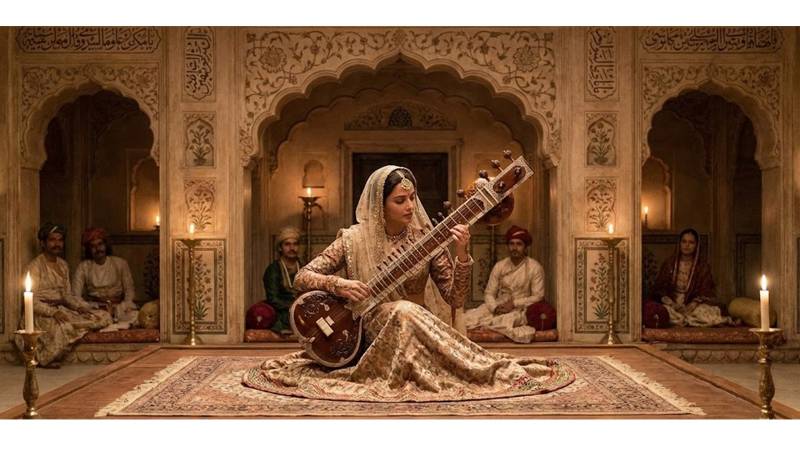
"If music be the food of love, play on"
(William Shakespeare, Twelfth Night)
My heart and soul are most alive when I am in Lahore. I sometimes contemplate that there is so much to see, feel and appreciate, and so little life to do all that the heart wants. The month of November, which is quite happening in Lahore, never fails to rejuvenate and replenish my love for the city. There are more events to attend every week than the days I am allowed to stay here. At the same time, this month reminds me that life is transient and that all we have are fleeting moments of joy.
I was back in the city on 16th November and a little bemused about which event to attend and which to miss. While reeling in indecision, a notification popped up on my cell phone’s screen. It was from Anjum Altaf Sahib and contained an invitation to attend a Mehfil-e-Sitar at National College of Arts, Lahore. The fog in my head instantly disappeared and I readily acknowledged the invitation with gratitude.
The night sky over The Mall was hazy due to smog and the air scraped the throat. I avoided strolling out and tried to reach the venue at my earliest. It was no wonder that NCA exuded exquisite charm and splendour throughout the month of November as 2025 marked the completion of 150 years of the institute. With a remarkable legacy spanning over one and a half centuries, National College of Arts undeniably stands as a premier institute for art, design and architecture. NCA Triennale 2025 was already the talk of the town with many students attending the workshops and other gentry gracing the specified mehfils and gatherings.
November in Lahore is a time when the city comes alive with cultural events, offering fleeting moments of joy that replenish the soul despite the transient nature of life
Until recently, I had relished the online sitar performances of Anoushka Shankar, the daughter of sitar virtuoso Ravi Shankar. Every time, a wish took root in my heart to watch the sitarists’ fingers move over the tar (strings), tumba (gourd body) and dandi (long neck) live in Lahore. With performances by different artists this time, my ears eventually got to cherish the classical elegance of the sitar at NCA.
By the time I reached the Shakir Ali Auditorium, where the sitarists and tabla players were meant to perform, it was past evening. From roughly 06:30 to 09:30 pm, I attended four performances. The lead was taken by the sitarist from Canada, Mohammad Abbas Assani, with Sabz Ali Khan on tabla. Sabz Ali Khan’s fingers were already stroking the sayahi, maidan and kanti of the tabla with finesse, and Assani gradually warmed up to the beat. They both ended the performance on an impressive note.
The next performer was Beena Raza with Shabbir Hussain Jhari on tabla. Her performance was characterised by slow, soulful and rhythmic flow and tone. It was one of a kind, and one wished it could last a little longer. The rendition that followed was by a very young and keen sitarist from London, Ayaan Saqib, alongside Sabz Ali Khan. Before he began his electric performance, he commented, “I touched down in Karachi but it was not until I reached Lahore that I felt being home.” His performance left many wondering, including this scribe, how one’s hands could create rhythmic tones with such agility and pace as he did.
The last performance I stayed for was by Shehroz Hussain. His fingers, masterfully acquainted with the strings of the sitar, sang songs. He stretched and curved the strings to a point that they ended up creating melodies. It was as though one was listening to a song in the voice of a sitar. He received considerable applause throughout his rendition.
In the name of events, something or the other is always happening in Lahore. But Mehfil-e-Sitar-like evenings are a rarity. The remarkable event added both great charm to the legacy of the institute and beauty to the wintry season. There is only one suggestion: the excess of anything makes everything look and feel monotonous. Had it lasted two hours, it would have been etched in the memories of the attendees with unforgettable words. Conversely, they could have included a few discussions on the role of sitar in South Asian classical music.
Still, I must say, it felt great to attend such an impressive musical soiree in Lahore.